Battle of Ansi
For three months in the summer and autumn of 645, a fortress in the Liaodong Peninsula held off the largest military force in the known world. Emperor Taizong of Tang had brought his army across China to crush the kingdom of Goguryeo. He captured cities, routed field armies, and advanced with the confidence of a ruler who had never lost. Then he reached Ansi, and the fortress refused to fall.
The Road to the Walls
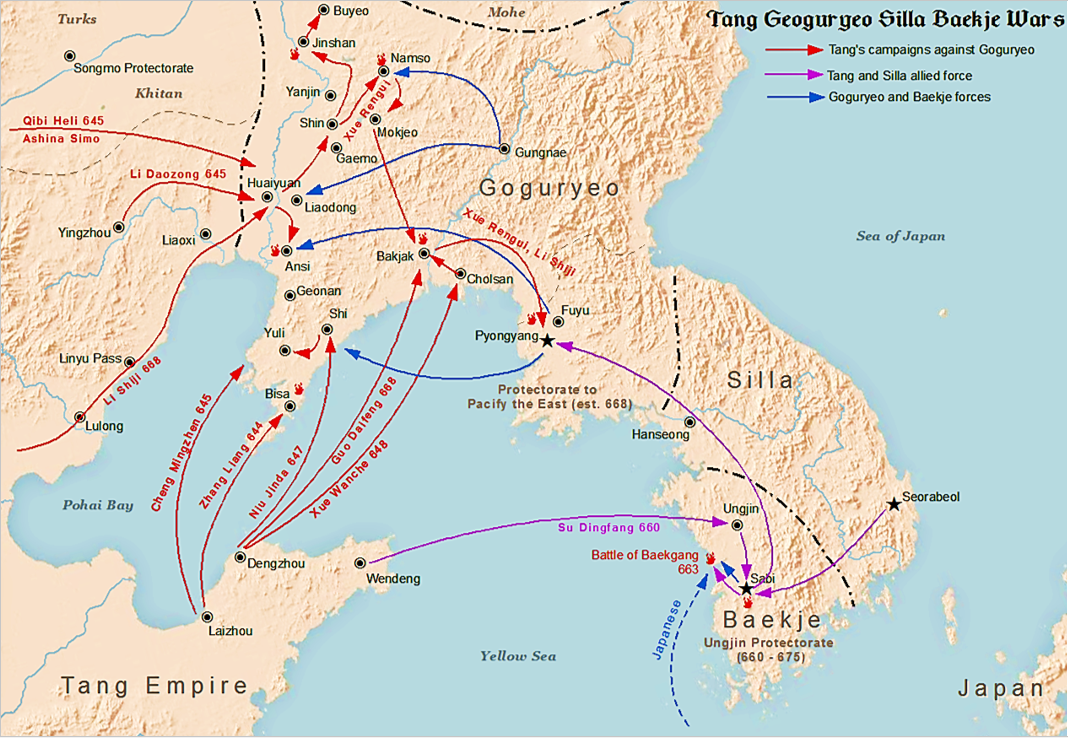
The invasion had its pretext in Goguryeo's attack on its neighbor Silla in 643, which gave Emperor Taizong the justification he wanted. By 644, preparations were underway: troops assembled, ships built, siege engines constructed. On April 1, 645, under the pretense of marching to camp Huaiyuan, Tang forces under General Li Shiji suddenly turned and invaded Goguryeo territory. The opening campaign was a success. Several cities fell. But Goguryeo's military dictator Yon Kaesomun responded by dispatching a relief force of 150,000 soldiers under generals Ko Yonsu and Ko Hyejin to rescue Ansi. On July 20, the two armies collided. Li Shiji led 15,000 troops in a frontal assault while General Zhangsun Wuji flanked with 11,000 elite cavalry. Taizong himself led 4,000 soldiers into the fight. The Goguryeo relief force was shattered: over 20,000 killed, 36,800 captured along with 50,000 horses, 50,000 cattle, and 10,000 iron suits of armor. Ansi was now isolated -- but its walls still stood.
The Siege Within the Siege
What followed was a war of attrition fought on two scales: the daily grind of siege warfare and a monumental engineering contest. Li Daozong began constructing a massive earthen ramp southeast of the fortress. The Ansi garrison responded by raising their walls higher. For sixty days this race continued, each side building against the other. The mound eventually rose high enough to overlook the city, and the Tang officer Fu Fu'ai took his position on the summit. Then came the moment that changed everything. Part of the ramp collapsed, crashing into the fortress walls and breaching them. It was the opportunity Taizong had spent months creating. But Fu Fu'ai, for reasons history has never explained, abandoned his post. The Goguryeo defenders charged through the breach, captured the collapsed earthwork, and turned it into part of their own defenses. Taizong was so enraged he executed Fu Fu'ai on the spot.
Chickens, Pigs, and Night Attacks
The siege was not only about walls and ramps. One evening, Taizong heard the sounds of chickens and pigs being slaughtered inside the fortress. He recognized the meaning immediately -- the garrison was feasting before a night assault, giving their soldiers strength for what might be a final charge. He warned Li Shiji, who prepared his defenses. When the attack came that night, Taizong personally led soldiers to repel it. The Goguryeo fighters were driven back inside the walls. It was a small victory, but it revealed the grim determination of the defenders: they were not waiting to be rescued, they were fighting with everything they had, willing to gamble on desperate sorties even as their situation grew more dire.
The Retreat Through Snow
Three days of heavy assault on the captured earthwork failed. Goguryeo reinforcements were arriving. October brought the Liaodong winter early -- temperatures dropping, grass dying, food supplies exhausted. On October 13, 645, Emperor Taizong ordered the withdrawal. The retreat was catastrophic. Soldiers who had survived months of siege died in snowstorms during the march home. Taizong himself tended to his wounded Turkic generals Qibi Heli and Ashina Simo, a gesture of personal compassion from a man whose imperial pride had been humbled. He founded a temple in Beijing -- the Minzhong Temple, the oldest in the city -- to honor the soldiers who never returned from Goguryeo. Taizong prepared another invasion for 648, but he died before it could be launched, possibly weakened by illness contracted during the Ansi campaign. The Goguryeo fortress had cost more than 20,000 of his soldiers. Whether it cost him his life remains an open question that history has never quite answered.
From the Air
Located at 40.78N, 122.78E, near Haicheng in Liaoning. The fortress site at Yingchengzi is southeast of modern Haicheng. Nearest airports are Anshan Teng'ao (ZYAS) and Shenyang Taoxian (ZYTX). The terrain is low-lying with scattered hills, characteristic of the Liaodong Peninsula's interior.