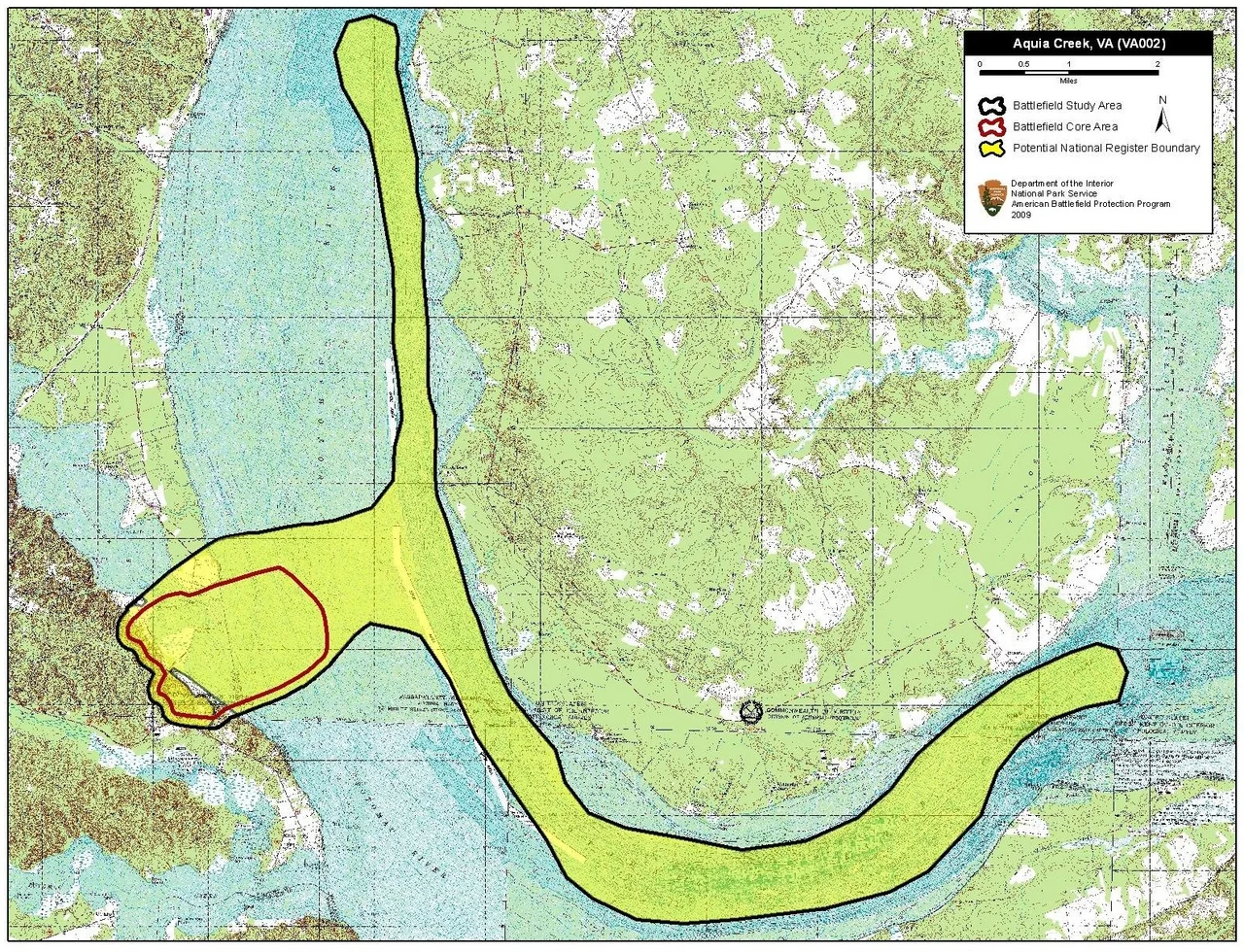

Battle of Aquia Creek
The casualty list for the Battle of Aquia Creek runs to two: one chicken and one horse. Both were Confederate. Both were killed by Union shellfire during the three-day artillery exchange on the lower Potomac in late May 1861. Captain William F. Lynch, the Virginia state navy officer commanding the shore batteries, reported the casualties himself, with no apparent embarrassment - he was busy noting damage to a few rear houses and three or four broken stretches of railroad track. The Union gunboats that fired all those shots also took minor damage in return and needed repairs. Nobody on either side died. Nobody was seriously wounded. The National Park Service nevertheless lists this engagement among the 384 principal battles of the American Civil War, because at the time it mattered. The war was three weeks old. Nobody knew yet how a real Civil War battle was going to look.
Closing the River
Virginia voted to secede on April 17, 1861, three days after Fort Sumter fell. The state convention scheduled a ratification referendum for May 23, but Governor John Letcher and the convention treated secession as already accomplished. On April 22 Letcher gave Robert E. Lee command of Virginia state forces with the rank of major general. Five days later, Abraham Lincoln extended the Union blockade of the Confederacy to the coasts of Virginia and North Carolina. Both sides now wanted control of the lower Potomac - the Union to keep Washington supplied and the Confederacy to deny the same. Lee dispatched Captain William F. Lynch of the Virginia state navy to scout defensible points and build batteries to close the river. On April 24, Major Thomas H. Williamson and Lieutenant H.H. Lewis examined the ground at Aquia Creek and chose Split Rock Bluff. The channel ran close inshore there, well within range of medium guns. Williamson began construction on May 8.
Thirteen Guns and a Railhead
The battery existed mainly to protect a railroad terminus. The Richmond, Fredericksburg and Potomac Railroad ended at Aquia Landing, where steamboats from Washington connected to trains running south. If the Federals seized the landing, they could ride the rails almost straight to the Confederate capital. By mid-May 1861 Lynch and his officers had positioned thirteen guns on the bluff. The USS Mount Vernon - a small Federal sidewheeler - spotted the battery on May 14 and chose not to engage. On May 29, however, Commander James H. Ward of the Potomac Flotilla brought a more aggressive squadron downriver to test the works. His flagship was the USS Thomas Freeborn, a converted New York harbor ferry pressed into wartime service. The Freeborn opened fire at long range. Confederate Captain Lynch reported afterward that the Freeborn had fired fourteen shots and managed only to wound one Virginian in the hand. The largest guns on the squadron were 32-pounders, which was probably not enough firepower for the job even if the gunners had been better.
Three Days of Wasted Powder
The bombardment continued for two more days. The USS Pawnee, a more substantial steam sloop, joined the line and added her broadsides. The Confederate batteries replied gun for gun. At the end of three days Lynch reported zero combat deaths and zero serious wounds among his garrison. The only fatalities he could list were one chicken and one horse. His works had taken some damage. Houses in the rear had been, in his phrase, knocked about. The Fredericksburg railroad had been torn up in three or four places. The Union ships did not get off scot-free either. Both the Thomas Freeborn and the Pawnee absorbed minor hits from the Confederate guns and required repairs after returning to Washington. The engagement was tactically inconclusive in a way that almost defies normal classification. Neither side could dislodge the other. Neither side could hurt the other. Both sides claimed a kind of victory and went home.
First Naval Mines, Then Abandonment
What the engagement did do was teach both sides about the limits of mid-nineteenth-century firepower against earthen fortifications. The Confederates reinforced their position by building a third battery on the bluff at Aquia and a fourth across the creek mouth at Brent Point. On July 7, 1861, they tried something new - the first use of naval mines in American waters, floated downriver toward the Federal blockading squadron. The mines failed to detonate. Sailors from the USS Resolute later swept the river for them, though at least one sank to the bottom and was never recovered. The standoff continued without further serious fighting until March 9, 1862, when the Confederates abandoned the Aquia batteries entirely. By then George McClellan's Army of the Potomac was about to launch the Peninsula Campaign, and every available Confederate gun and gunner was needed south to defend Richmond. Once the Confederates withdrew, the Union Army moved into Aquia Landing and used the wharves and storehouses as a major supply base. The troops marched off from these wharves to fight at Chancellorsville and Gettysburg in 1863, and again during Grant's Overland Campaign in 1864. The bluff is quiet now. A small park marks the site. Of the chicken and the horse, no monument survives.
From the Air
Aquia Creek joins the Potomac River at roughly 38.39 degrees N, 77.32 degrees W, in Stafford County, Virginia, about 35 miles south of Washington, D.C. The bluff still rises about 50 feet above the river. From 2,500 to 4,000 feet AGL the creek mouth, the railroad bridge of the modern CSX line, and the Potomac's broad lower reach are easily visible. Nearby airports include Stafford Regional (KRMN) about 12 miles west and Quantico MCAF (KNYG, restricted) just to the north. Watch for the P-49 and R-6606 restricted areas around Quantico - check NOTAMs before low transit.
Nearby Stories
- John Wilkes Booth 5.5 km away
- Pope-Leighey House 6 km away
- Germanna 8.4 km away
- Warrenton Training Center 14 km away
- Point Lookout Light 30 km away
- St. Mary's City, Maryland 30 km away
- Annapolis Convention (1786) 36 km away