Battle of Arachova
A young monk named Panfoutios Charitos slipped out of the Agia Ierousalim monastery in the dark, found the Greek camp at Distomo, and told General Georgios Karaiskakis the route the Ottoman army was taking. Then he slipped back to his cell before dawn, in time for the morning count. Without that walk, the Battle of Arachova does not happen the way it does. The next six days, on the snowy slopes of Mount Parnassus, would turn one of the lowest moments of the Greek War of Independence into one of its most consequential victories - and one of its hardest to look at directly.
Five Years In, Almost Lost
The Greek revolution had begun in February 1821 with extraordinary momentum. By the autumn of 1826, that momentum was nearly gone. The Egyptian army of Ibrahim Pasha had pillaged the Peloponnese; Missolonghi had fallen in April after a long siege that ended with a desperate breakout in which most of the garrison and population were killed; the Acropolis of Athens was under siege. Many Cretan and Moreote rebels had accepted Ottoman amnesty in exchange for a quiet winter. A faction of Greek notables were openly arguing for a deal: limited autonomy under the Sultan, like Wallachia, instead of independence. The First Hellenic Republic had been weakened by its own civil wars in 1824 and 1825. It was, on paper, a war the Greeks were losing. Karaiskakis had broken out of Missolonghi with a few hundred fighters and was working his way east through central Greece, looking for an opportunity.
Mustafa Bey's Mistake
An Ottoman force under Mustafa Bey - 2,000 men including 300 cavalry - left Livadeia in early November to relieve the Ottoman garrison at Amfissa and protect the gunpowder dump at Atalanti. On the night of November 17, his army camped at the Agia Ierousalim monastery near Davleia. Mustafa Bey questioned the hegumenos about Karaiskakis, and the abbot lied politely - claiming Karaiskakis was still besieging Domvrena, far to the east. Mustafa believed him but kept watch on the monks. That evening, while Mustafa and his lieutenant the kehaya were planning their next day's march over dinner, a monk who happened to speak Turkish was within earshot. The monks held a council and dispatched young Panfoutios on his night ride. By the time the Ottoman column was nearing Arachova at 10:00 the next morning, Karaiskakis had already moved his men into position. Five hundred Greek fighters held the church of Agios Georgios in Arachova and the surrounding houses. Four hundred more under Christodoulos Hatzipetros covered the southern passes.
Encirclement on Parnassus
The Albanian troops in the Ottoman vanguard were the first to notice the freshly cut firing loopholes in the village houses. They took cover behind rocks. The villagers, who had not been warned, fled. The two sides exchanged gunfire while Mustafa Bey funneled fresh troops into the village, and the Greeks - reinforced steadily through the morning by guerrilla bands from the surrounding country - tightened their cordon. By midday, the Ottoman force was completely encircled. A Greek charge from the Mavra Litharia hillock failed; Karaiskakis's right flank broke and ran; then a unit of Souliotes under Georgios Tzavelas mounted a second attack, killed an Ottoman officer, and rallied the deserters back into line. Three hundred Greek fighters under Giotis Danglis took a hill that overlooked the Ottoman position. Mustafa Bey led a counter-charge with his sword drawn, came on three times, and was driven back each time. By nightfall on November 18, the Ottoman camp was surrounded.
Six Days in the Cold
Then came the weather. Cold rain on November 19 and 20, then snow. The Ottoman troops in the camp had no shelter; their food was running out; their morale was draining as fast as the temperature dropped. On November 21, an 800-man Ottoman relief column under Abdullah Agha appeared and tried to break through to the besieged camp. The Greeks ambushed it at a narrow passage near Zemeno - thirty Ottoman soldiers killed, many wounded, eighty pack animals captured - and Abdullah Agha's force retreated in disorder. Inside the camp, Mustafa Bey's troops pressured him to negotiate. Karaiskakis demanded weapons, money, hostages, and the abandonment of Livadeia and Amfissa, with safe passage in return. The Ottoman messenger answered by shouting 'War!' three times. On the morning of November 22, Karaiskakis ordered a general fusillade. Mustafa Bey, encouraging his men outside his tent, was hit in the forehead and mortally wounded. The kehaya took command. A snowstorm rolled in. The Albanian officers told the kehaya they would lay down their arms if the terms were not accepted.
The Breakout, the Snowstorm, and the Aftermath
At midday on November 24, in heavy snow, 700 Ottoman soldiers charged a small Greek picket on the road toward the Agia Ierousalim monastery. Abdullah Agha's force, stationed nearby, was ordered to retreat - it never came. The initial breakout succeeded; then the Greeks regrouped and split the Ottoman column in half. The 500 men still in the camp were surrounded and killed. So were most of those who broke out. The kehaya, encountering Greek soldiers who did not speak Turkish, was killed without his pleas for mercy being understood. Of the 2,000 Ottoman troops who had marched from Livadeia three weeks earlier, only about 300 escaped, helped by a Greek turncoat named Zeligiannaios; most of those died in the snowstorm anyway. Greek losses were 12 killed and 20 injured.
The Trophy and What It Means
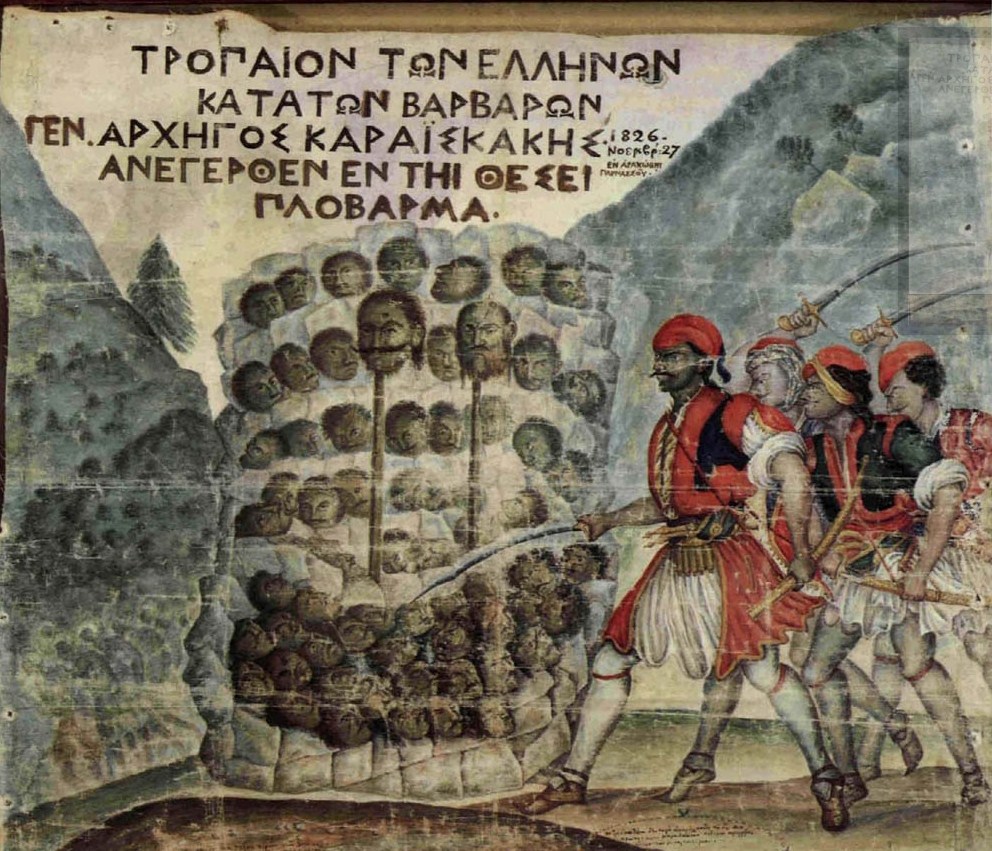
What Karaiskakis did with the dead is the part of the story that has been hardest to absorb in the centuries since. He ordered a pyramid built of three hundred severed heads, with the heads of Mustafa Bey and the kehaya placed on its sides, and a stone in front bearing the inscription 'Tropaion of Greek victory over the barbarians.' The severed ears of the Ottoman dead were preserved and shipped to Nafplio, the revolutionary capital. The acts mimicked Ottoman practice - Ottoman victory rituals had often included the display of heads and ears - but mimicking does not mean less brutal, only that brutality was the language both sides used. The men whose heads Karaiskakis stacked had been Ottoman soldiers, many of them Albanian conscripts who would not have chosen this campaign; the women and children of Arachova had also fled in terror at the start of the battle. There is no clean way to tell this story. What is true is that the victory bought the Greek revolution a decisive interval of time. With Karaiskakis's eastern front intact, the war went on long enough to provoke the European intervention that the Greeks could not have won without. The 1827 Treaty of London brought British, French, and Russian fleets into the conflict, the Battle of Navarino destroyed the Ottoman fleet that October, and Greek independence followed.
From the Air
38.48 N, 22.58 E. Arachova is on the southern slopes of Mount Parnassus, central Greece, about 10 km east of Delphi and 130 km northwest of Athens by road. Mount Parnassus rises to 2457 meters and is unmistakable from altitude - a long northwest-southeast ridge that dominates the landscape between the Gulf of Corinth and the central Greek plain. Athens (LGAV) is 90 nm southeast; Andravida (LGAD) is 100 nm southwest. The town itself sits at about 950 meters elevation and is famous now as a winter ski resort; in November and December, snow on the upper slopes is normal. Best clarity is mornings; afternoon clouds frequently build over Parnassus.