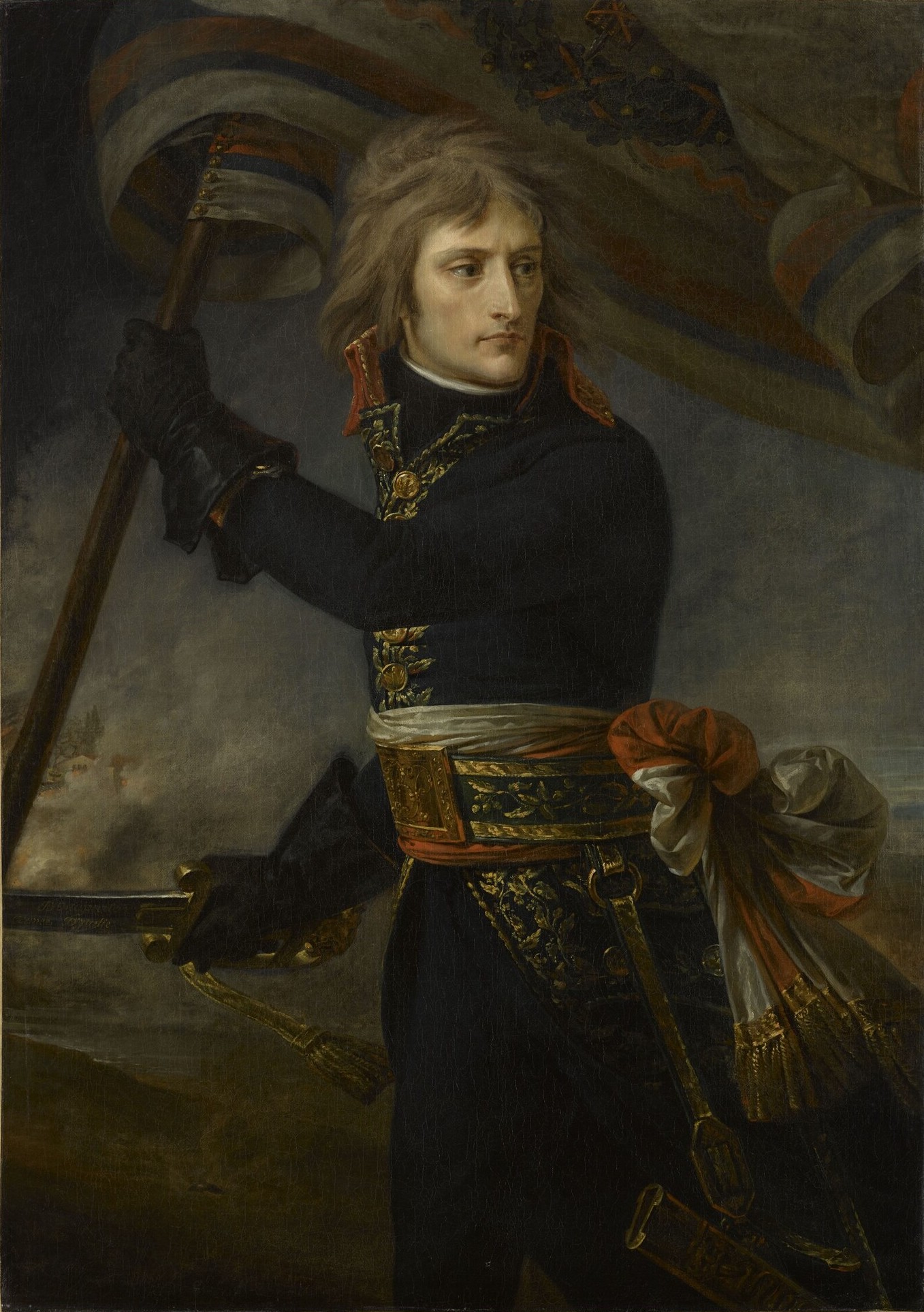
Battle of Arcole
Napoleon grabbed a flag and walked onto the bridge. It was November 15, 1796, the first day of what would become a three-day battle in the swampy flatlands around Arcole, a small village 25 kilometers southeast of Verona. His men had stalled under withering Austrian fire, and the 27-year-old general -- outnumbered, twice defeated in recent days, and privately despondent about his chances of survival -- did the thing that would become his signature: he made himself the story. Standing in the open on a narrow dike about 55 paces from the bridge, he was untouched. His aide-de-camp, Jean-Baptiste Muiron, was not. An unknown officer dragged Bonaparte into a muddy ditch. The legend had begun.
Three Balls in the Air
The strategic situation facing Bonaparte in mid-November 1796 was, as historian David G. Chandler put it, like a juggler keeping three balls in the air at once. Austrian Feldzeugmeister Jozsef Alvinczi was advancing from the east with approximately 23,000 men, the largest of the three threats. To the north, Paul Davidovich's 14,000-strong Tyrol Corps pushed down the Adige valley, having already routed the French division under Vaubois at the Battle of Calliano. And inside the fortress of Mantua, Wurmser commanded over 23,000 troops, though only about half were fit for the field. If any two of these forces linked up, the French Army of Italy was finished. Bonaparte had roughly 18,000 men to hold them all apart -- Massena's 7,937, Augereau's 6,000, and a reserve of 2,600 plus cavalry. Defeat on any front meant catastrophe.
Into the Marshes
Bonaparte's solution was characteristically audacious. Rather than attack Alvinczi head-on again -- two direct assaults had already failed, at Bassano and Caldiero -- he swung his entire force south, crossed the Adige River on a pontoon bridge at Ronco, and attempted to turn the Austrian left flank by advancing north through the marshy terrain between the Adige and its small tributary, the Alpone. The gamble relied on geography: in the waterlogged lowland, all movement was confined to narrow causeways and dikes along the riverbanks. The Alpone itself was only 20 yards wide and 5 feet deep. In this constricted landscape, Alvinczi's numerical superiority counted for far less. But the same terrain that neutralized Austrian numbers also funneled the French into killing zones. For two full days, Bonaparte's men threw themselves at the Austrian positions around Arcole and were repulsed each time.
The Third Day
By the afternoon of November 17, the third day, the battle seemed lost again. Austrian reinforcements surged out of Arcole and drove back the French troops under General Robert. Augereau's rattled division pulled back across the pontoon bridge to the west bank of the Alpone by 4:00 pm. Then Massena appeared from the western flank with fresh troops and ambushed the Austrians on the dike, sending them reeling back toward the village. Heartened, Augereau's men recrossed the river and renewed the fight. The final stroke was pure theater: a lieutenant and 25 cavalry Guides rode into the Austrian rear area and blew several bugles, creating the impression of a large flanking force. By 5:00 pm, the French had fought their way into Arcole. Alvinczi, his army battered and his colleague Davidovich too far away to help, began his withdrawal.
The Cost and the Legend
The butcher's bill was severe on both sides. French losses at Arcole totaled 3,500 dead and wounded, plus 1,300 captured or missing. The Austrians lost fewer killed and wounded -- about 2,200 -- but 4,000 men and 11 guns were captured. General Robert was mortally wounded; Austrian General-Major Rosselmini died in Vicenza two days later. The former enslaved man Joseph Hercule Domingue, serving as a French cavalry lieutenant, was promoted to captain and given a ceremonial sword by Bonaparte for his actions during the second day's fighting. Davidovich, who finally attacked Vaubois at Rivoli on the 17th and routed him, heard of Arcole's outcome too late. By November 23, Alvinczi's field army was retreating to the Brenta. The third Austrian attempt to relieve Mantua had failed by the narrowest of margins.
Where the Legend Was Born
French artists and newspapers transformed the bridge at Arcole into a founding myth almost immediately. Antoine-Jean Gros painted Bonaparte on the Bridge at Arcole in 1797 -- flag in hand, coat streaming behind him, untouchable amid the chaos. The reality was muddier, literally: Bonaparte ended up in a ditch. But the image stuck. Arcole is widely regarded as the moment Napoleon became Napoleon, the point where a talented young general became a figure of popular legend that would endure until his downfall in 1815. Today the village of Arcole sits quietly in the Veneto lowlands, the marshy terrain drained long ago. The narrow bridge that almost swallowed a legend has been replaced, but the landscape -- flat, bounded by rivers and dikes, open to the sky -- still reads like a battlefield where geography mattered as much as courage.
From the Air
Located at 45.36N, 11.28E in the Veneto lowlands, approximately 25 km southeast of Verona, Italy. The flat terrain between the Adige and Alpone rivers is clearly visible from altitude. Nearby airports include Verona Villafranca (LIPX) to the northwest and Vicenza (LIPT). The village of Arcole sits where the Alpone meets the Adige, with the characteristic pattern of dikes and drainage canals still visible in the landscape.