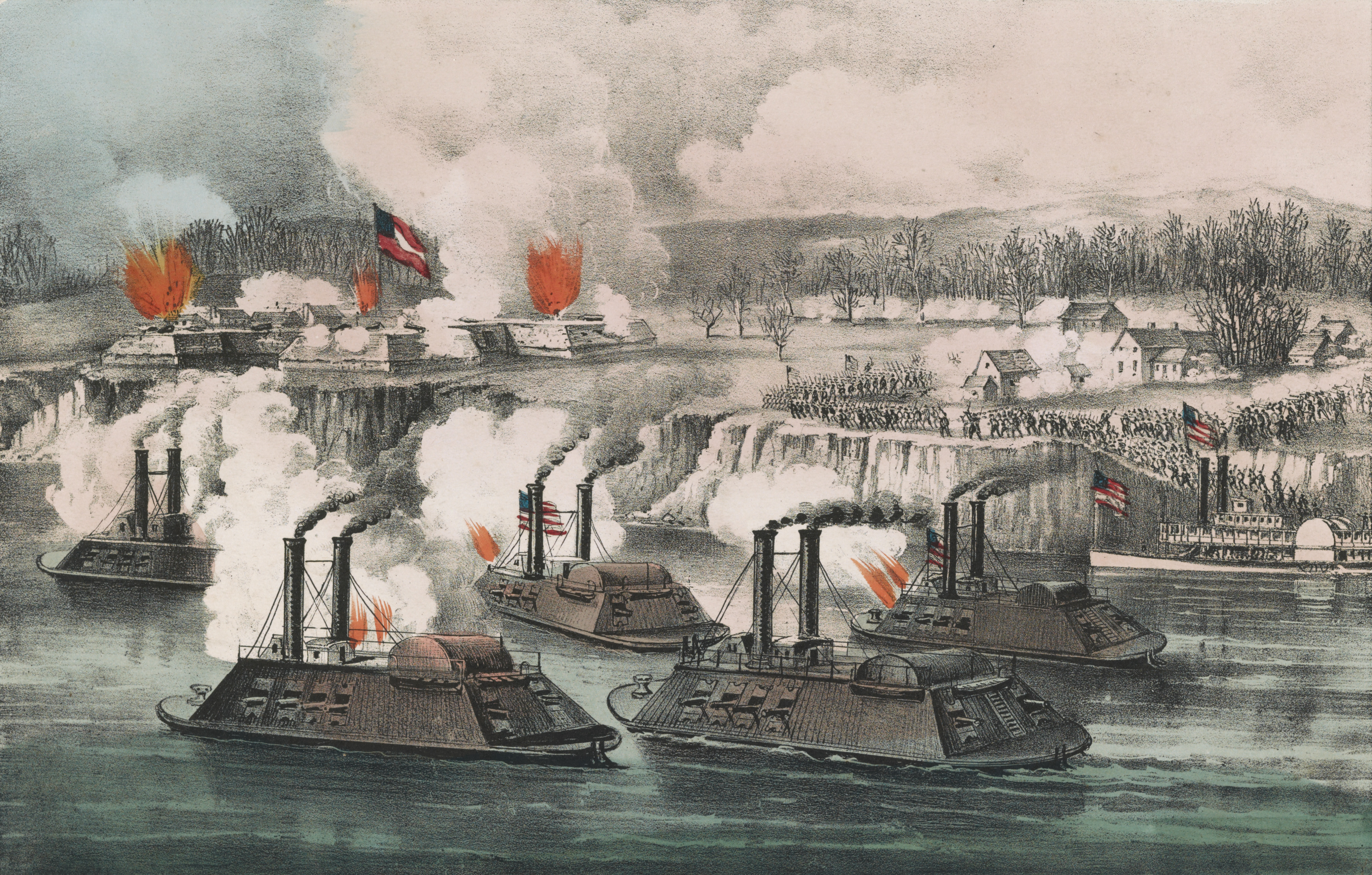
Battle of Arkansas Post
Grant called it a "wild-goose chase." When he learned that General John McClernand had diverted 31,000 Union troops up the Arkansas River in January 1863, the future president fired off an angry dispatch to Washington. But the three-day battle that unfolded at Fort Hindman, near the ancient settlement of Arkansas Post, would prove Grant wrong. The Confederate garrison there had been raiding Union supply vessels on the Mississippi, and the fort's capture removed a persistent thorn from the side of the Vicksburg campaign. By the time the white flags of surrender appeared -- in circumstances so confused that some Confederate units kept fighting while others stacked arms -- nearly 5,000 Confederates had been captured and the Arkansas River Valley lay open to Union control.
A Politician's War
The battle was born from ambition and rivalry. John McClernand, a former Illinois congressman turned general, had persuaded President Lincoln himself to authorize an independent expedition down the Mississippi. The Union high command -- Grant and General-in-Chief Henry Halleck -- distrusted McClernand's military judgment and maneuvered to undercut him. They redirected his recruits to William T. Sherman, who launched the riverine assault on Vicksburg before McClernand could arrive. When Sherman's attack failed at Chickasaw Bayou in late December 1862, McClernand finally caught up and took command, christening his force the Army of the Mississippi. Both men independently concluded that Fort Hindman had to go. Sherman wanted a victory to restore his battered reputation. McClernand wanted to prove he deserved command. The Confederates at Arkansas Post, armed mainly with short-range carbines and shotguns, stood in the path of converging egos.
Iron and Timber on the River
The Union fleet entered the White River on January 5, 1863, then slipped through a cutoff channel into the Arkansas -- a deception to preserve surprise. Three ironclad warships led the way: USS Baron DeKalb, USS Louisville, and USS Cincinnati, their armored hulls designed to absorb punishment from shore batteries. Fort Hindman's defenses included heavy Columbiad cannons salvaged from the ram CSS Pontchartrain, positioned in casemates of triple-layered timber reinforced with iron sheeting. A line of rifle pits stretched west from the fort to Post Bayou. On January 10, the gunboats opened their bombardment, but bad gunpowder prevented the fort's heavy guns from reaching the Union vessels. Confederate commander Thomas Churchill told his men to expect a fight to the death: "Gentlemen, the fight will commence in a very short time, and we must win it or die in the ditches."
White Flags in the Smoke
The decisive assault came on January 11. At 1:00 pm, Porter's warships resumed their bombardment while Union infantry attacked along the entire Confederate line. Baron DeKalb fired 158 shots, Louisville 212, and Cincinnati 100. The naval fire silenced every Confederate gun except one facing away from the river. On land, Union brigades pushed through ravines and felled timber toward the rifle pits. Brigadier General Charles Hovey took an arm wound but stayed on the field. By 4:30 pm, with nightfall approaching and no reinforcements in sight, white flags began appearing along the Confederate line -- but no one had ordered a surrender. The confusion was remarkable: Union troops advanced toward white flags only to be fired upon by Confederate soldiers who had not surrendered. Colonel James Deshler mistook the white flags for faded company colors and kept fighting until Sherman personally pointed out that Union soldiers had already swamped his position. Churchill finally agreed that surrender was the only practical option.
The 'Wild-Goose Chase' Vindicated
The toll was lopsided. Some 4,791 Confederates became prisoners -- roughly a third of all Confederate soldiers then in Arkansas. Union casualties totaled 1,092, with 134 killed. McClernand captured 17 cannons and 3,000 infantry weapons. Sherman later recalled McClernand crowing: "Glorious! Glorious! My star is ever in the ascendant!" Grant remained furious and ordered McClernand back to the Mississippi, but Porter and Sherman eventually convinced him of the operation's military value. Grant acknowledged that the Confederate force at Arkansas Post could have proved dangerously disruptive if left alone. He relieved McClernand of independent command on January 30 and took personal charge of the Vicksburg campaign, which culminated in the Confederate surrender on July 4, 1863. Today, part of the battlefield lies within the Arkansas Post National Memorial, though portions have been swallowed by the shifting Arkansas River. The fort's remains washed away as early as 1880.
From the Air
Located at 34.017°N, 91.345°W along the Arkansas River in southeastern Arkansas. The Arkansas Post National Memorial preserves portions of the battlefield on a bend in the river. The terrain is flat Delta lowland with extensive bayou and river channels visible from altitude. Nearest airport is Stuttgart Municipal (KDWU) approximately 40 nm north. Little Rock (KLIT) is roughly 65 nm northwest. Best viewed at 3,000-5,000 feet AGL to see the river meanders and former fort location. The Arkansas Post Canal runs through the area.