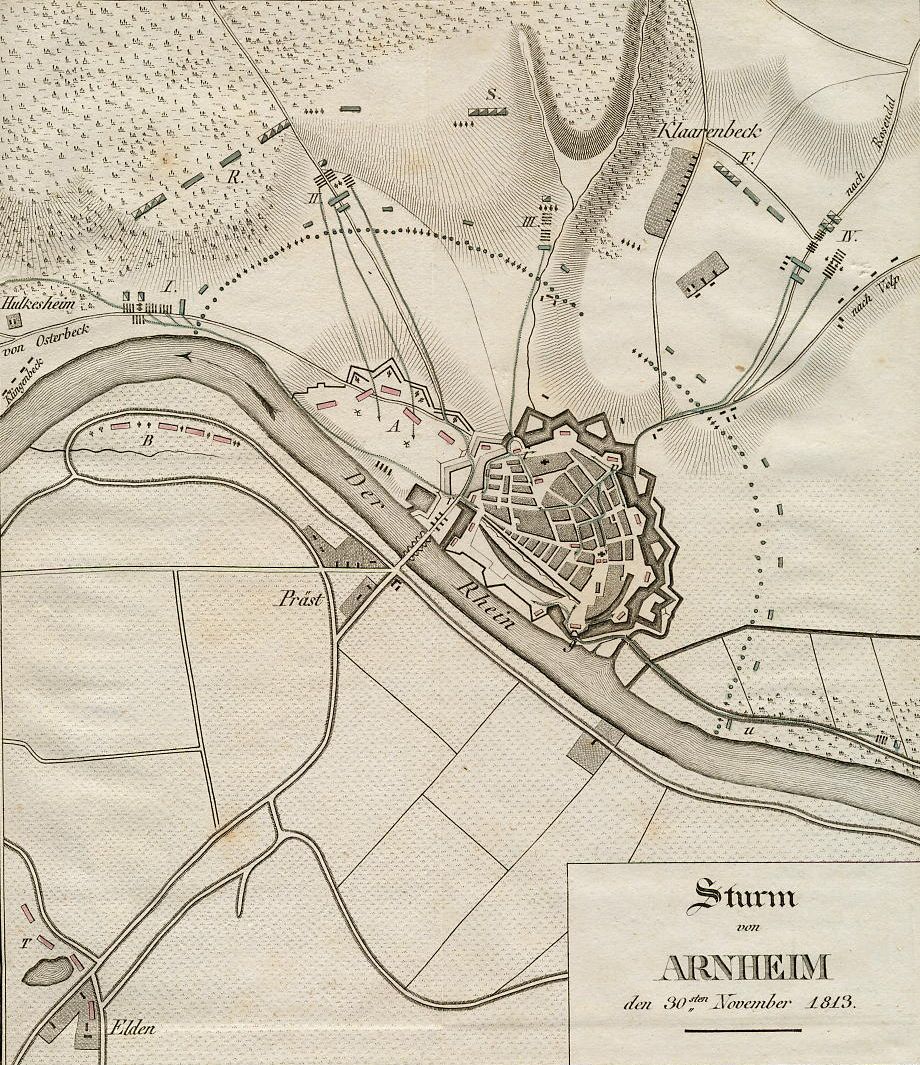
Battle of Arnhem (1813)
The fog over the Nederrijn on the morning of 30 November 1813 was thick enough that the Prussian columns assembling outside Arnhem could hear, but not see, French horses and wagons crossing the city's bridge. Inside the walls, the French commander Henri Charpentier had defied an order from Marshal MacDonald to evacuate the city the day before. He had also failed, for reasons no historian has ever explained, to post sentries at any of Arnhem's medieval gates. By the time the fog lifted at 11:00 in the morning, Friedrich Wilhelm von Bülow's Prussians were ready to come through all five of them at once.
After Leipzig, the Rhine
Six weeks earlier Napoleon had lost the Battle of Leipzig, the largest engagement in European history to that point. He led 203,133 soldiers and 738 guns against a Coalition army of 361,942 men and 1,456 pieces of artillery. The numbers afterward were worse: 46,000 French killed and wounded, another 38,000 captured, sick or defected. By November only 60,000 to 70,000 soldiers remained west of the Rhine to defend France itself. The Dutch, annexed outright to the French Empire by Napoleon in 1810, had absorbed catastrophic losses in the invasion of Russia and watched the Continental System wreck their trade. An uprising began in Amsterdam on 14 November. A Russian raiding force of Cossacks under Alexander von Benckendorff entered the city the same week. The provisional Dutch government took over by 19 November, waiting for the House of Orange-Nassau to come home.
The Approach from Minden
Bülow's III Prussian Corps, roughly 30,000 men with 96 guns, had crossed from Minden into the Netherlands on 13 November. The French commander on the lower Rhine, Marshal Jacques MacDonald, scattered his thin XI Corps along the river from Andernach to Wesel, padding his ranks with customs agents and gendarmes after foreign battalions deserted en masse. Bülow's advance guard under Adolf von Oppen took Doesburg on 23 November, capturing 112 French soldiers, and forced the surrender of Zutphen the next day. By 24 November Oppen had driven a French column from Velp into Arnhem in a running skirmish. He found the French had built an entrenched camp outside the city, and after several days of probing, pulled back to wait for the rest of the corps to come up.
An Order Disobeyed
MacDonald himself reached Arnhem on 28 November with 2,500 reinforcements, looked at the situation, and decided the city was not defensible. He returned to Nijmegen, leaving Charpentier and about 4,000 men in the entrenched camp. The next morning Charpentier launched a strong counterattack that pushed Oppen back to Velp and inflicted 50 casualties on a Prussian outpost at Lichtenbeek House. That afternoon MacDonald returned, took another look, and ordered Charpentier to abandon Arnhem entirely. Charpentier ignored him. He kept his troops in the city overnight without posting guards at the gates. To this day, no one has produced a convincing reason why.
Five Columns Through the Fog
Bülow arrived in the pre-dawn darkness on 30 November and personally organized a five-column assault. Colomb's raiding force, reinforced with two battalions and two guns, would strike the far eastern flank. Two western columns under Majors Zglinitzki and Schmidt would target the river-facing Rhine gate, with Schmidt's men forming up in Oosterbeek. Two central columns under Oppen would punch the northern Jans gate and the northeastern Velp gate simultaneously. After breaking through, each column would split in three: one part to hold the gate, one to outflank the next gate over, one to push into the city. The fog held the operation until 11:00. When it lifted, the assault went in. Colomb's horse artillery blew the Sabelpoort gate open with one shot. The Velp gate, defended by a handful of soldiers, fell almost without a fight. The Jans gate dropped just as quickly. Three Prussian columns were inside Arnhem before Charpentier understood where the main attack was coming from.
Hand-to-Hand on the Walls
The fighting on the western side was uglier. The Kolberg Regiment stormed the redoubt near the Rhine gate while Schmidt's men scaled the city wall under canister shot fired from French cannons across the river. The melee at the top of the wall was savage. General Jean Baptiste Simon Marie was bayoneted three times and taken prisoner. Charpentier, semi-conscious from a wound, barely escaped the same fate. General Amey took command of four French battalions and led them in retreat across the Rhine, leaving three battalions trapped inside the city. Expecting no quarter, they fought house to house through the streets. Some got out. Most were killed or captured. The retreating French set the bridge on fire as they crossed, but Prussian pioneers put out the blaze and repaired it before the day was over.
What the Storming Bought
The Prussians had lost about 600 killed and wounded out of 10,000 engaged. The French lost as many as 1,500 of 4,000, including 1,024 men captured and at least 14 guns. Two battalions of the 112th Line were essentially wiped out, with only 78 men escaping. Bülow occupied Utrecht on 2 December and the British landed in the Netherlands two days later under Thomas Graham, the future Baron Lynedoch. To Bülow's irritation, the newly liberated Dutch proved reluctant to volunteer for military service, and a cache of 25,000 British muskets meant for them was issued to the Westphalian Landwehr instead. The storming of Arnhem in fog, by a general who had been ordered not to defend the city he chose to die in, opened a door the Coalition would take fifteen months to walk all the way through to Paris.
From the Air
The 1813 battle was fought at the Dutch city of Arnhem at approximately 51.983 degrees north, 5.917 degrees east, on both sides of the Nederrijn (Lower Rhine). The assault originated from the east near Velp and from the west at Oosterbeek, converging on the medieval city gates. Nearest airports: Teuge (EHTE) 35 km north, Schiphol (EHAM) 95 km west, Düsseldorf (EDDL) about 90 km southeast across the German border. Recommended viewing altitude 2,500-4,000 feet AGL for grasping the bend of the Nederrijn and the approach roads from Velp, Oosterbeek, and Wesel. The medieval city walls and gates are long gone, but the street layout in central Arnhem still follows the old plan.