Battle of Arroyo dos Molinos
The hailstorm saved General Hill and doomed General Girard. On the night of October 27, 1811, as a British-allied force crept within four miles of a French division camped at the village of Arroyo dos Molinos in northern Extremadura, a violent hailstorm battered the countryside. By morning, the wind and rain were still so fierce that the French pickets on the outskirts of the village had turned their backs to the weather. They were facing away from the direction of attack when Hill's men struck at dawn.
Three Days Through the Rain
In mid-October 1811, General Jean-Baptiste Girard had crossed the Guadiana River at Merida with a French division and begun campaigning in northern Extremadura. Major-General Rowland Hill, one of Wellington's most trusted subordinates, saw an opportunity. After securing Wellington's permission to use his 2nd Division, Hill learned that Girard had halted at Arroyo dos Molinos, near Alcuescar. He force-marched his troops for three days through miserable weather, pushing them forward before the French could move on. By the evening of October 27, Hill had surrounded the village. The 71st Highland Regiment of Foot occupied Alcuescar, three miles away, blocking one escape route. The French, unaware, settled in for the night.
Dawn's Reckoning
Hill's attack at first light on October 28 achieved near-total surprise. The French 34th and 40th Line Infantry Regiments took devastating losses as British and Spanish troops poured into the village from multiple directions. The cavalry under Colonel Robert Ballard Long charged into the French horsemen, with the 2nd Hussars of the King's German Legion distinguishing themselves by breaking the French cavalry entirely. Over 200 cavalrymen were captured along with three pieces of artillery. Girard's entire division -- 4,000 men with supporting cavalry -- was destroyed as a viable fighting formation. A whole infantry division and a cavalry brigade simply ceased to exist as organized units in a matter of hours.
Eagles and Drums
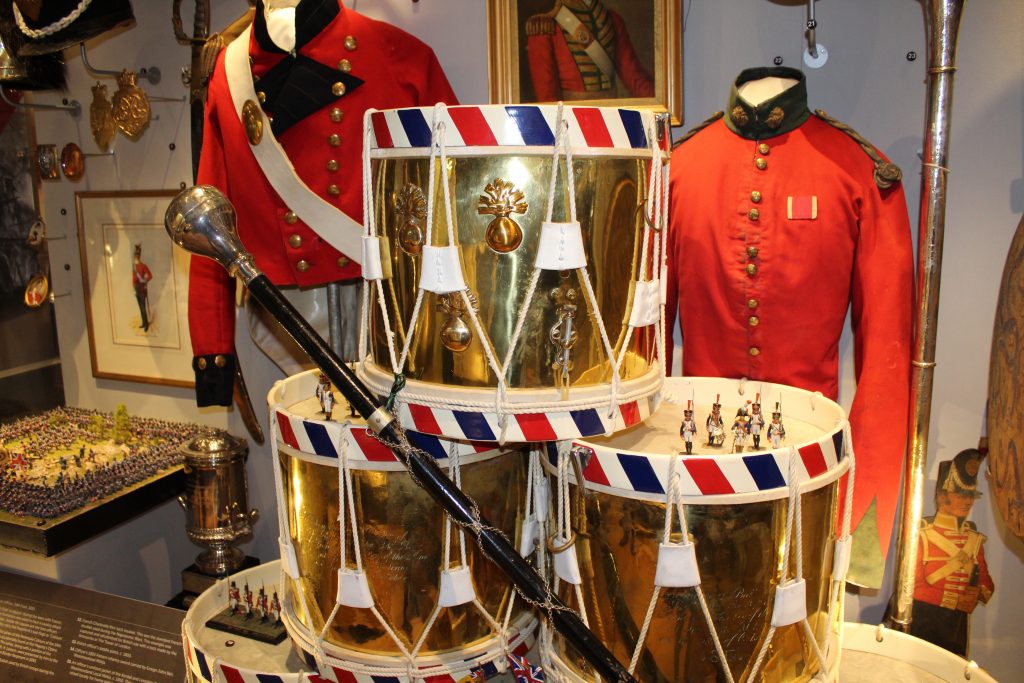
Marshal Soult, commanding French forces in the region, was anxious about one thing above all: the eagle standards of the 34th and 40th Regiments. He wrote to Napoleon with visible relief -- "L'honneur des armes est sauve; les Aigles ne sont pas tombes au pouvoir de l'ennemi." The honor of the army is saved; the Eagles did not fall into the hands of the enemy. But the British had captured something almost as humiliating. Sergeant Moses Simpson of the 34th Cumberland Regiment's Grenadier Company seized the drum-major's staff of the French 34th Regiment of Infantry, along with six side-drums including the grenadier company drum, its shell emblazoned with three flaming grenade emblems. These trophies traveled to England and are displayed today at Cumbria's Museum of Military Life in Carlisle Castle -- tangible evidence of a defeat so complete that Napoleon dismissed Girard from command.
Hill's Quiet Triumph
On November 5, a jubilant Hill -- who would be made a Knight of the Bath for the victory -- wrote to his sister describing the action. Hill was Wellington's favorite general precisely because of engagements like this one: meticulously planned, boldly executed, and decisive without being reckless. The battle demonstrated what well-coordinated British, Portuguese, and Spanish forces could achieve in the Peninsula. Hill's force included not only his 2nd Division but also Morillo's Spanish infantry and Penne de Villemur's Spanish cavalry division, a combined allied effort that left the French no avenue of escape. For the French, Arroyo dos Molinos was a sharp reminder that the guerrilla-plagued landscape of Extremadura could swallow entire formations, and that the allies were learning how to exploit it.
From the Air
Located at 39.18N, 6.17W near the village of Arroyomolinos in Caceres province, Extremadura. The terrain is hilly with low mountains visible to the south. The village of Alcuescar lies approximately 5 km to the southeast. Nearest major airport is Badajoz (LEBZ), approximately 100 km to the south-southwest.