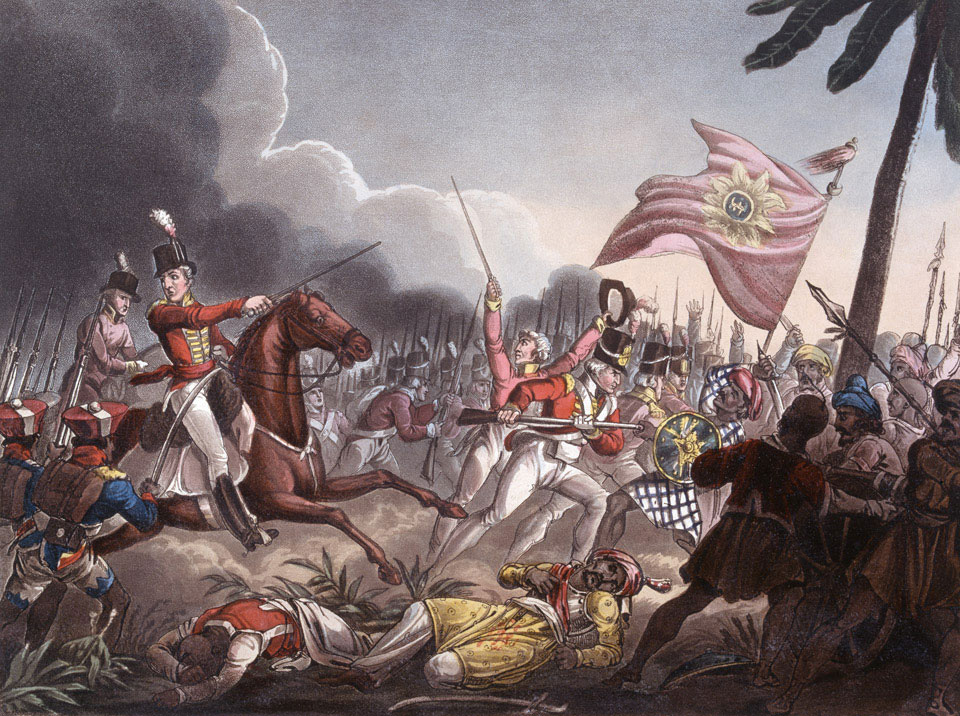
Battle of Assaye
Years later, after defeating Napoleon at Waterloo and becoming the most celebrated soldier in British history, the Duke of Wellington was asked to name his greatest battle. He did not say Waterloo. He did not name any engagement from the Peninsular War that made his reputation across Europe. He said Assaye - a small village in the Deccan that most Britons could not find on a map, where on September 23, 1803, he had led 4,500 troops against a combined Maratha army of over 40,000. He called it "the bloodiest for the numbers that I ever saw." More than a third of his force was killed or wounded in a few hours of fighting so desperate that he lost two horses shot or speared from under him. Assaye was not just Wellington's first great victory. It was the battle that taught him what war actually cost.
The Gamble at the Ford
Wellesley, then a thirty-four-year-old major general and the younger brother of the Governor-General of British India, had been chasing the Maratha army for weeks across the Deccan Plateau. He was supposed to converge on the enemy position with a second force under Colonel Stevenson, attacking together on September 24. But on the afternoon of the 22nd, his scouts reported that the Maratha army was not at Borkardan as expected but camped just five miles north, between the Kailna and Juah rivers. Their cavalry was already moving off, and the infantry would follow. Wellesley faced a choice: wait for Stevenson and risk the Marathas slipping away again, or attack alone with a force outnumbered roughly ten to one. He chose to attack. Reconnoitering ahead with a cavalry escort, he noticed two villages on opposite banks of the Kailna beyond the Maratha left flank. Where there were two villages facing each other across a river, he reasoned, there must be a ford. His engineer confirmed it. By three o'clock, the British were crossing.
Into the Mouth of the Guns
The Maratha army Wellesley faced was not a medieval horde. Its infantry had been trained and organized by European officers - Colonel Anthony Pohlmann, a Hanoverian and former East India Company sergeant, commanded the largest brigade of eight battalions. The artillery was formidable: over a hundred guns served by disciplined crews who stood by their cannon even as bayonets came for them. When Wellesley's six infantry battalions crossed the Kailna and formed up, Pohlmann reacted with startling speed, swinging his entire line ninety degrees to face the new threat. The Maratha guns opened a devastating barrage of canister, grape, and round shot. British artillery was brought forward but was quickly knocked out, overwhelmed by sheer weight of fire. Casualties mounted as infantry stood in formation under the bombardment with nowhere to hide. Wellesley made the only decision that could save his men from being destroyed in place: abandon the guns and advance directly into the Maratha artillery with fixed bayonets.
The 74th's Last Stand
The bayonet charge overran the Maratha gun line, and the gunners died at their posts. But the battle was far from over. On the British right, the 74th Highlanders and a battalion of pickets advanced too far and found themselves isolated, caught in a crossfire from artillery around the village of Assaye. Pohlmann saw the gap in the British line and sent his infantry and cavalry forward. The pickets were virtually annihilated - every officer killed except their commander, Lieutenant Colonel William Orrock, with only about seventy-five men surviving. The remnants of the 74th formed a rough square behind piled bodies of their own dead and held on. Meanwhile, Maratha gunners who had feigned death when the British advanced over them re-manned their cannon and poured fire into the British rear. Wellesley himself galloped to the reserve cavalry and led a charge to retake the gun line, ensuring this time that every gunner who remained was truly dead. The fighting was merciless on both sides.
The Reckoning
By six o'clock the Marathas were retreating, their irregulars abandoning Assaye village, their cavalry drifting off to the west. But the cost was staggering. British and Company casualties amounted to 1,584 men - 428 killed, 1,138 wounded, 18 missing. That was over a third of the engaged force, a casualty rate that would be considered catastrophic in any era. Wellesley wrote to Stevenson afterward: "I should not like to see again such a loss as I sustained on the 23rd September, even if attended by such a gain." Stevenson, ten miles to the west, had heard the guns and tried to march to the fight but was led astray by his guide - whom he later hanged. Troops were still being carried from the battlefield four days after the engagement. The 74th Regiment became known as the Assaye Regiment, and the battle honor was awarded across the units involved. Today the Indian Army's Madras Sappers no longer celebrate Assaye, having declared it a repugnant battle honour - a colonial engagement fought on Indian soil, in which Indian soldiers died on both sides of the line.
What Wellesley Learned
Assaye shaped the general who would one day defeat Napoleon. Wellesley learned that intelligence could be wrong and that a commander must adapt in the moment - his entire plan was improvised when the Maratha position turned out to be six miles south of where he expected. He learned the lethal effectiveness of disciplined artillery, a lesson he carried into every subsequent campaign. He learned that infantry advancing into cannon fire must close quickly or be destroyed, and that cavalry charges could turn a battle at its hinge point. Most of all, he learned the price. At Waterloo twelve years later, casualties were numerically higher but proportionally lower. The Duke never forgot the Deccan. The landscape around Assaye is quiet farmland today, the rivers shallow, the village small. There are no grand monuments on the battlefield. The ground that made Wellington has largely returned to what it was before the guns arrived: open fields under a wide Indian sky, indifferent to the ambitions of empires.
From the Air
Located at 20.235N, 75.888E in the Deccan Plateau of Maharashtra, India. The battlefield lies in flat, semi-arid farmland between the Kailna and Juah rivers, which are visible as seasonal watercourses from altitude. The village of Assaye is small and unremarkable from the air. Nearest airport is Chhatrapati Sambhaji Nagar Airport (VAAU/IXU), approximately 75km to the southwest. Jalgaon Airport (VAJL) lies approximately 130km to the north. The terrain is open agricultural land at roughly 500m elevation with good visibility most of the year. The confluence of the Kailna and Juah rivers, where the battle's critical ford crossing occurred, is identifiable from moderate altitude. Post-monsoon (October-March) offers the best flying conditions.