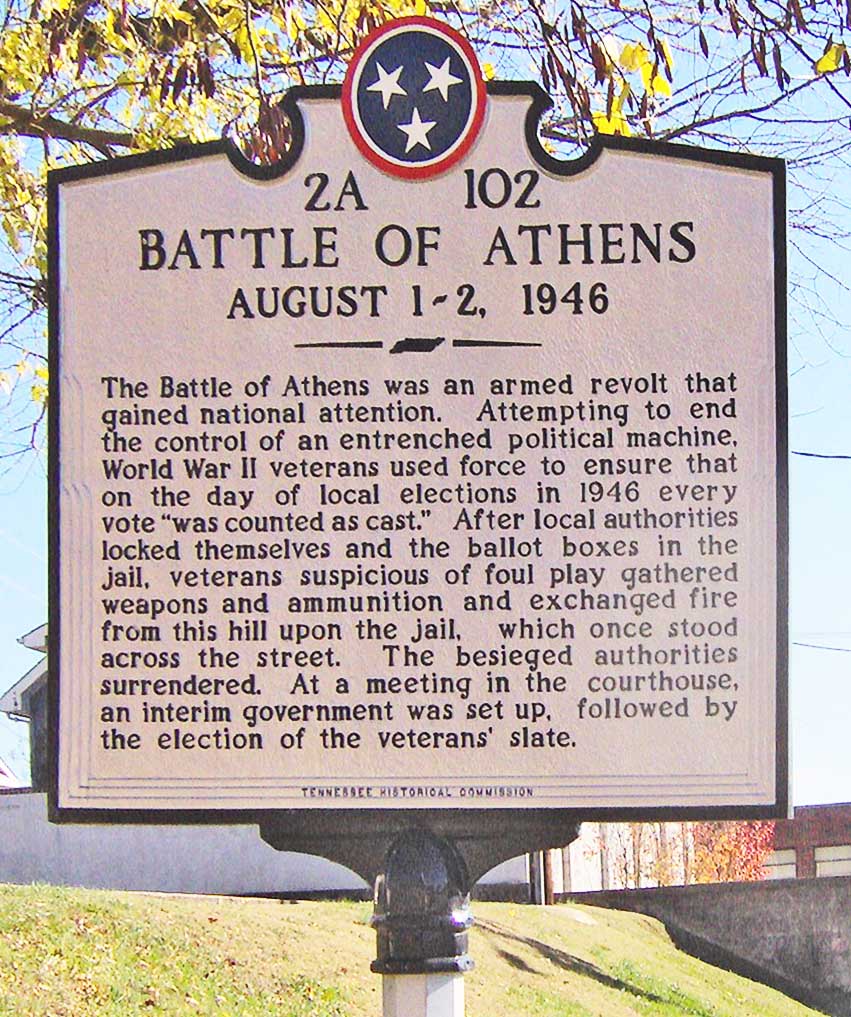
Battle of Athens (1946)
On the night of August 1, 1946, the sound of automatic weapons fire shattered the quiet of Athens, Tennessee. The men doing the shooting were not criminals or insurgents. They were World War II veterans -- former GIs who had fought across Europe and the Pacific -- and they were laying siege to the McMinn County jail because the sheriff's deputies inside had stolen the ballot boxes. By 3:30 a.m., dynamite had blown the jail doors open, and the veterans recovered the tally sheets. What they found confirmed what everyone already knew: the machine had scored the count fifteen to one in its own favor. The Battle of Athens remains the only successful armed uprising against a local government in twentieth-century America, and it started not with ideology but with a very simple question -- whether the men who had fought to defend democracy overseas would tolerate its absence at home.
The Machine That Owned a County
The rot began in 1936, when Paul Cantrell rode Franklin Roosevelt's coattails into the McMinn County sheriff's office. Cantrell came from a wealthy Etowah family and owed his victory to the E. H. Crump political machine based in Memphis, which controlled much of Tennessee's politics. Once in power, the system fed on itself. The sheriff and his deputies operated under a fee system -- they were paid for every person they booked, jailed, and released. This gave law enforcement a direct financial incentive to arrest as many people as possible, and the deputies obliged with enthusiasm. Predatory policing, police brutality, and voter intimidation became routine in McMinn County. The U.S. Department of Justice investigated allegations of electoral fraud in 1940, 1942, and 1944, but took no action. During the war, two servicemen on leave were shot and killed by Cantrell supporters. The machine operated with impunity.
The GIs Come Home
The veterans who returned to McMinn County after the war had seen things the Cantrell machine never anticipated. They had liberated concentration camps, stormed beaches, and watched friends die for the principle that free people deserve free elections. Ralph Duggan, a Navy veteran who served in the Pacific and later became a leading local lawyer, spoke for many when he said he had thought more about McMinn County than about the enemy. 'If democracy was good enough to put on the Germans and the Japs,' Duggan said, 'it was good enough for McMinn County, too.' The veterans organized a GI Non-Partisan League and fielded their own slate of candidates for the August 1946 elections. Knox Henry ran for sheriff against the incumbent Cantrell. The machine responded the way it always had -- with intimidation, rigged ballot boxes, and armed deputies at the polling stations.
Siege of the Jail
When the deputies seized the ballot boxes on election night and carried them to the county jail, the veterans knew exactly what was happening. Bill White, who had at least sixty men under his command, split his force -- Buck Landers took position at the bank while White moved the rest to the post office. Then White issued his challenge to the deputies barricaded inside: 'Would you damn bastards bring those damn ballot boxes out here or we are going to set siege against the jail and blow it down!' Automatic weapons fire erupted, punctuated by shotgun blasts. White later claimed he fired the first shot. A deputy ran for the jail and White shot him as he dove inside. The veterans thwarted attempts by outside deputies to reinforce the jail, and some of the men inside escaped through the back door. The standoff continued through the night until, shortly before dawn, the veterans used dynamite to blast the jail into submission.
Victory and Its Limits
When the final tally was counted from the recovered ballots, Knox Henry had won the sheriff's race with 2,175 votes to Cantrell's 1,270. The GI slate swept every contested position -- Frank Carmichael took trustee, George Painter won county clerk, and Charles Picket captured circuit court clerk. The morning of August 2 found Athens quiet, the public mood one of 'euphoria that had not been experienced in McMinn County in a long time.' The Battle of Athens inspired veteran movements across Tennessee, with ex-GIs in other counties forming coalitions against corrupt political machines. But the victory proved fragile. By January 1947, four of the five GI leaders issued an open letter conceding they had 'abolished one machine only to replace it with another and more powerful one in the making.' The GI government eventually collapsed. The Non-Partisan League itself advised veterans elsewhere that political violence was not the appropriate way to resolve political differences -- a conclusion that even Eleanor Roosevelt endorsed.
A Seven-Year-Old Witness
Lones Selber was seven years old the night the shooting started, watching from a nearby street as tracers lit up the darkness around the jail. He wrote about it nearly four decades later in a 1985 American Heritage article, capturing the confusion and the drama through a child's eyes. 'Opinion differs on exactly how the challenge was issued,' he noted, but the gunfire was unmistakable. Selber's account, along with Theodore H. White's contemporaneous reporting in Harper's Magazine, preserved the details of an event that might otherwise have faded from memory. Today, Athens is a quiet town of around 14,000 in the foothills of the Appalachian Mountains. There is no monument to the battle at the old jail site. The story survives in archives, oral histories, and the simple, stubborn fact that a group of veterans once decided that the democracy they had fought for abroad was worth fighting for at home.
From the Air
Located at 35.44N, 84.59W in Athens, Tennessee, in the foothills of the Appalachian Mountains in McMinn County. The town sits in the valley of the Hiwassee River corridor between Knoxville and Chattanooga. The old county courthouse and jail area are in the compact downtown grid. Nearest airports: McMinn County Airport (KMMI) approximately 3 nm southeast; Chattanooga Metropolitan Airport (KCHA) about 45 nm southwest. Best viewed at 3,000-5,000 ft AGL. The terrain is gentle rolling hills with the Great Smoky Mountains visible to the east.