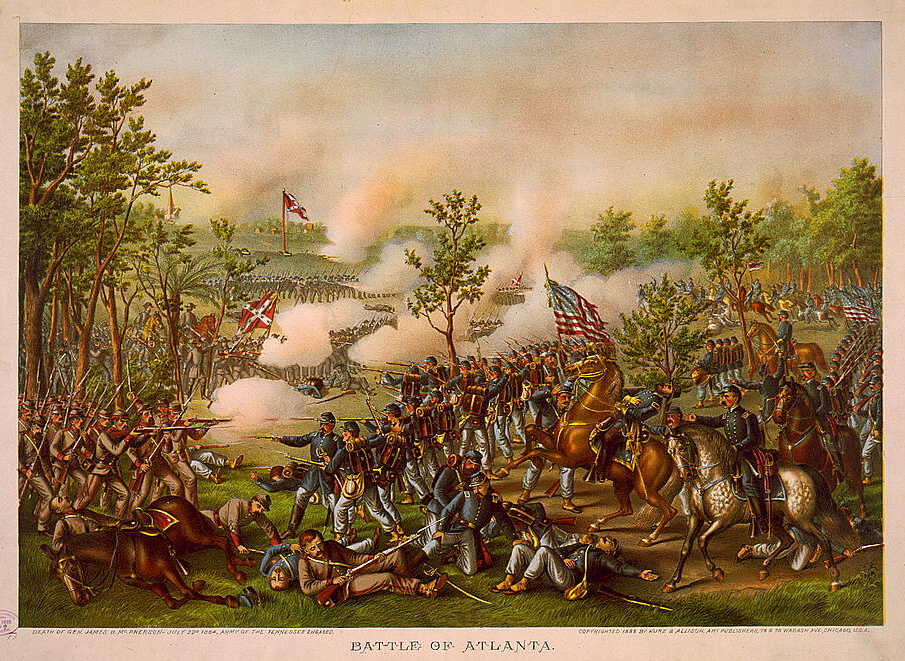
Battle of Atlanta
The telegram was five words long: "Atlanta is ours, and fairly won." When William Tecumseh Sherman sent that message to Washington on September 3, 1864, he understated the cost. The battle that bears Atlanta's name had been fought six weeks earlier, on July 22, in brutal summer heat just southeast of the city. It left over 9,200 men dead or wounded on both sides, killed Union Major General James B. McPherson -- the second-highest-ranking Union officer to die in combat during the entire war -- and set in motion a siege that would determine not just the fate of a city, but of a presidency and a nation. Despite its name suggesting a single decisive clash, the Battle of Atlanta was the violent midpoint of a campaign that had started in Chattanooga and would not end until Hood's army abandoned the city six weeks later.
The Long Chase South
The road to Atlanta began in the spring of 1864, when Ulysses S. Grant gave Sherman command of the Military Division of the Mississippi and a single objective: destroy the Confederate Army of Tennessee and seize its rail hub. Sherman marched south from Chattanooga with 112,000 troops. Opposing him, Confederate General Joseph E. Johnston had between 60,000 and 70,000 men dug into the rugged, forested mountains of northwestern Georgia. The campaign that followed was a deadly chess match. Johnston would fortify a position, Sherman would swing his forces around to outflank it, and Johnston would fall back to the next ridge. From Resaca to Kennesaw Mountain, the pattern repeated across 100 miles of red Georgia clay. Richmond grew furious with Johnston's retreating. On July 17, with Sherman closing on Atlanta, Confederate President Jefferson Davis replaced Johnston with the aggressive John Bell Hood -- a decision that remains one of the war's most debated.
Hood's Gamble at Bald Hill
Hood wasted no time. He attacked Sherman at Peachtree Creek on July 20, suffered over 2,500 casualties, and failed to slow the Union advance. Two days later, he tried again. His plan was ambitious: send William Hardee's corps on a night march around the Union left flank while Benjamin Cheatham's corps struck the front, crushing McPherson's Army of the Tennessee in a pincer. The march took longer than expected. A Confederate general, William H.T. Walker, was shot from his horse by a sharpshooter before the attack even began. But McPherson had read the threat correctly and moved his reserve XVI Corps to shore up his left. The fighting converged on a bare hilltop east of the city called Bald Hill. The struggle there was savage -- hand-to-hand in places -- and lasted until after dark. The Federals held the hill. Two miles north, Cheatham's men briefly broke through at the Georgia Railroad before Union artillery and Logan's XV Corps drove them back.
The Death of McPherson
James B. McPherson was 35 years old, a West Point graduate who had finished first in his class of 1853. Sherman considered him brilliant. On the morning of July 22, McPherson and Sherman were conferring under a stand of trees near what is now Cleburne Avenue when the first guns of the battle roared to the south. McPherson mounted his horse and rode toward the fighting to assess the situation. He stumbled into a gap in the Union line where Confederate troops had pushed through. Ordered to surrender, McPherson tipped his hat, wheeled his horse, and was shot through the lungs. He died within minutes. His death made him the highest-ranking Union officer killed in combat until that point was surpassed only once more during the entire war. Sherman wept when he received the news. Logan took command of the Army of the Tennessee and rallied the men to hold their ground.
Siege, Fire, and Five Words
The battle on July 22 cost the Union over 3,700 casualties and the Confederacy about 5,500 -- losses Hood's diminished army could not afford. But Hood still held Atlanta. Sherman settled into a siege, shelling the city while sending cavalry raids to cut the railroads feeding it from the south. When the cavalry failed, Sherman swung his entire army westward in a broad flanking arc. On August 31, his forces seized the railroad from Macon at Jonesborough. Hood's supply lines were severed. On September 1, he set fire to 81 ammunition cars and abandoned the city, the explosion lighting up the night sky for miles. The next day, Atlanta's mayor surrendered to Union forces, and Sherman sent his famous telegram north.
The Battle That Saved a Presidency
By the summer of 1864, war weariness was eroding Northern resolve. Lincoln faced a re-election challenge from George B. McClellan, whose Democratic Party platform called for an armistice with the Confederacy. Lincoln privately believed he would lose. Then Atlanta fell. Northern newspapers trumpeted the victory. The capture of the Confederacy's second-most-important rail center proved the war could be won. McClellan's peace platform collapsed. Lincoln won re-election with 212 of 233 electoral votes. Today, the Atlanta Cyclorama -- a massive panoramic painting of the battle, created in 1886 and restored in 2019 -- hangs at the Atlanta History Center, one of the largest oil paintings in the world. Among the stories it preserves is that of Ephraim Ponder's house, used by Confederate sharpshooters and destroyed by Union artillery. One of the people Ponder enslaved, Festus Flipper, was the father of Henry Ossian Flipper, who would become the first Black graduate of West Point.
From the Air
Located at 33.75N, 84.35W, in what is now the east side of Atlanta, Georgia. The battle centered on Bald Hill, in the area of present-day East Atlanta and Inman Park neighborhoods. Nearest airports: Atlanta Hartsfield-Jackson International (KATL) approximately 8nm south, DeKalb-Peachtree Airport (KPDK) approximately 6nm northeast, Fulton County Airport-Brown Field (KFTY) approximately 10nm northwest. The battlefield is entirely urbanized today, but Grant Park (home to the original Cyclorama building) and Oakland Cemetery -- where over 6,900 Confederate dead are buried -- remain visible green spaces from moderate altitudes. Best viewed at 2,000-4,000 feet AGL.