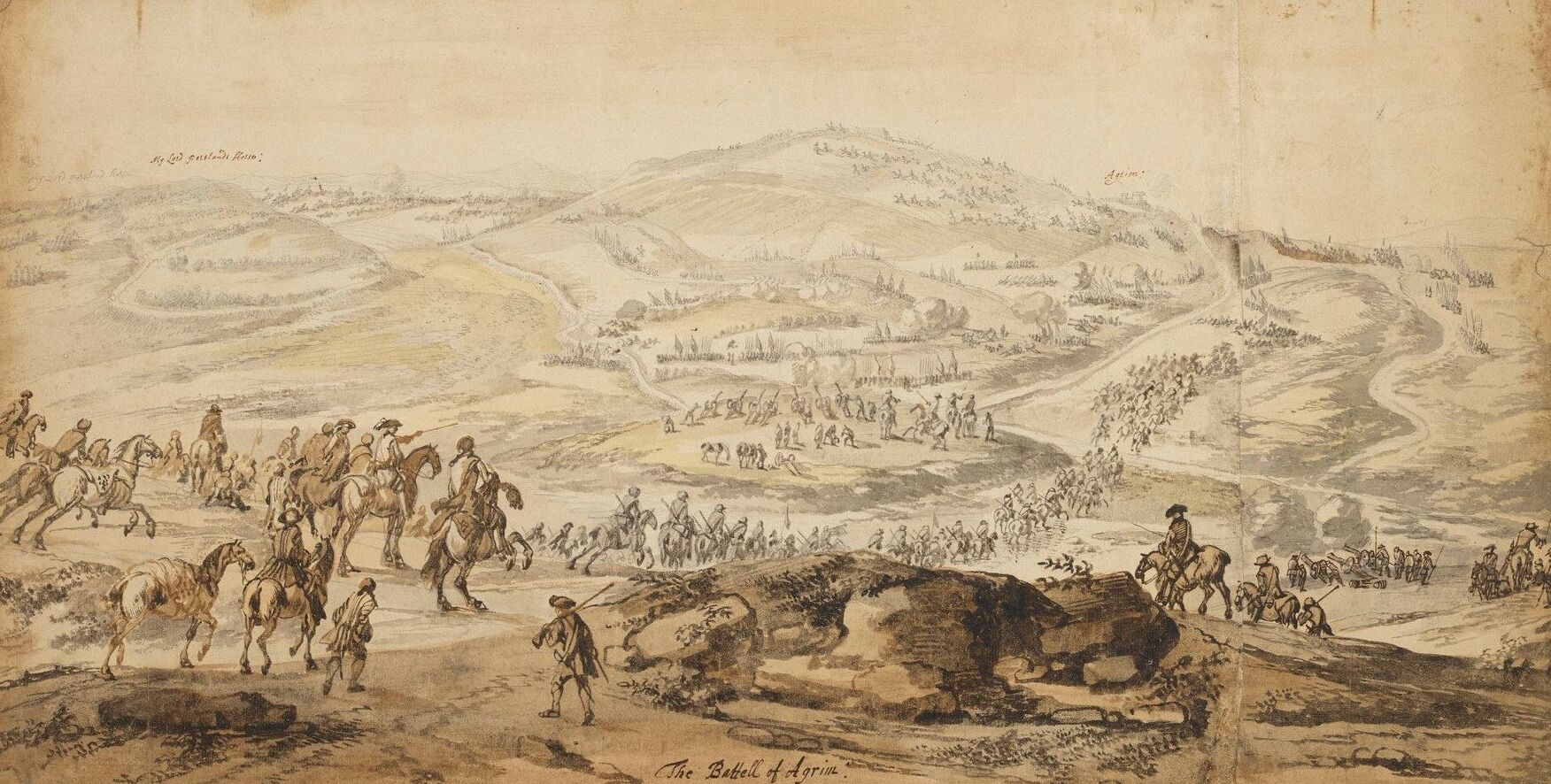
Battle of Aughrim
At the moment he believed he had won, Charles Chalmot de Saint-Ruhe was heard to shout: "They are running, we will chase them back to the gates of Dublin." He rode across the battlefield to rally his cavalry for the pursuit. He paused to direct the fire of a battery. A cannonball took his head off. The Jacobite army, which seconds earlier had been winning, collapsed within the hour. By nightfall on July 12, 1691, some 7,000 men lay dead on the fields around the village of Aughrim in County Galway -- making it, by most accounts, the bloodiest battle ever fought in the British Isles.
A Kingdom Divided Against Itself
The Battle of Aughrim was the decisive engagement of the Williamite War in Ireland, the conflict that would determine whether the Catholic James II or the Protestant William III would rule. By 1691, the Jacobite cause was already fracturing from within. The "Peace Party," led by James's viceroy Tyrconnell, wanted to negotiate terms with William. The "War Party," grouped around the charismatic Patrick Sarsfield, believed total victory was still possible. Louis XIV of France sent Saint-Ruhe to take command, with secret instructions to assess whether further French military aid was worth the investment. The Williamite army, under the Dutch officer Godert de Ginkel, was racing to end the war before French reinforcements could arrive at Galway or Limerick. Both sides assembled roughly 20,000 troops for a summer campaign that everyone knew would decide everything.
Waist-Deep in the Bog
Saint-Ruhe chose his ground well. He deployed his infantry along the crest of Kilcommadan Hill, their positions protected by stone-walled enclosures and hedgerows. A vast bog, impassable to cavalry, screened his center, and the Melehan River flowed through it. The Jacobite left was anchored by Aughrim castle and bounded by "a large Red Bogg, almost a mile over." When battle was joined between five and six o'clock in the evening, Ginkel's English and Scots regiments attacked uphill through waist-deep water against Irish defenders who fought from behind reinforced hedge lines. The assault was driven back with heavy losses. On the Williamite left, the Huguenot infantry was pushed into the bog by Irish soldiers fighting with reversed muskets; many attackers drowned. The Jacobite Guards and Gordon O'Neill's regiment fought with particular ferocity. At this stage, the Jacobites were winning.
The General's Last Words
The turning point came on the Jacobite left, where Ginkel's cavalry finally forced their way across a narrow causeway at the third attempt, under fire from Aughrim castle. Saint-Ruhe rode to meet this threat -- and that was when the cannonball found him. His death was catastrophic. No senior commander remained to direct the Jacobite left wing, and the Horse Guards regiment quit the field almost immediately. The cavalry and dragoon regiments of Luttrell, Sheldon, and Galmoy followed. Sarsfield, commanding the cavalry reserve, had been placed under strict orders not to move without Saint-Ruhe's personal command -- orders that now could never come. By nine o'clock, with darkness falling, the Jacobite infantry were pushed to the hilltop and broke, fleeing into the bogs. Most of the killing happened in the pursuit, ended only by nightfall, mist, and rain.
Aughrim of the Slaughter
The aftermath was grim. Ginkel ordered his own dead buried but left the Jacobite fallen where they lay. Their bones scattered the battlefield for years. An estimated 4,000 Jacobite soldiers died, with Williamite losses somewhere between 1,000 and 3,000. Another 4,000 Jacobites deserted. Prisoners promised quarter were killed; others were crowded onto Lambay Island, where disease and starvation took many more. Louth's regiment was reduced to 28 men. Irish tradition named it "Eachdhroim an air" -- Aughrim of the slaughter -- after a line by the poet Seamas Dall Mac Cuarta. The Jacobite cause in Ireland was effectively finished. Galway surrendered without a fight, and Sarsfield's remaining forces held out at Limerick only until autumn. The battle spawned a 1728 play by Robert Ashton that became one of the most popular works in Ireland for over a century, embraced by both Catholics and Protestants. Today, a memorial cross marks the battlefield, and an interpretative centre in the village houses artifacts recovered from the ground where 7,000 men died in a single evening.
From the Air
Located at 53.30N, 8.31W near Aughrim village in County Galway. The battlefield is rolling terrain with Kilcommadan Hill as the main feature. The M6 motorway now cuts through part of the former battlefield. Nearest airports: Shannon (EINN) approximately 60 km south, Galway (EICM) approximately 40 km west. Best viewed at 2,000-4,000 ft AGL to appreciate the terrain features that shaped the battle -- the hill, the bogs, and the causeway.