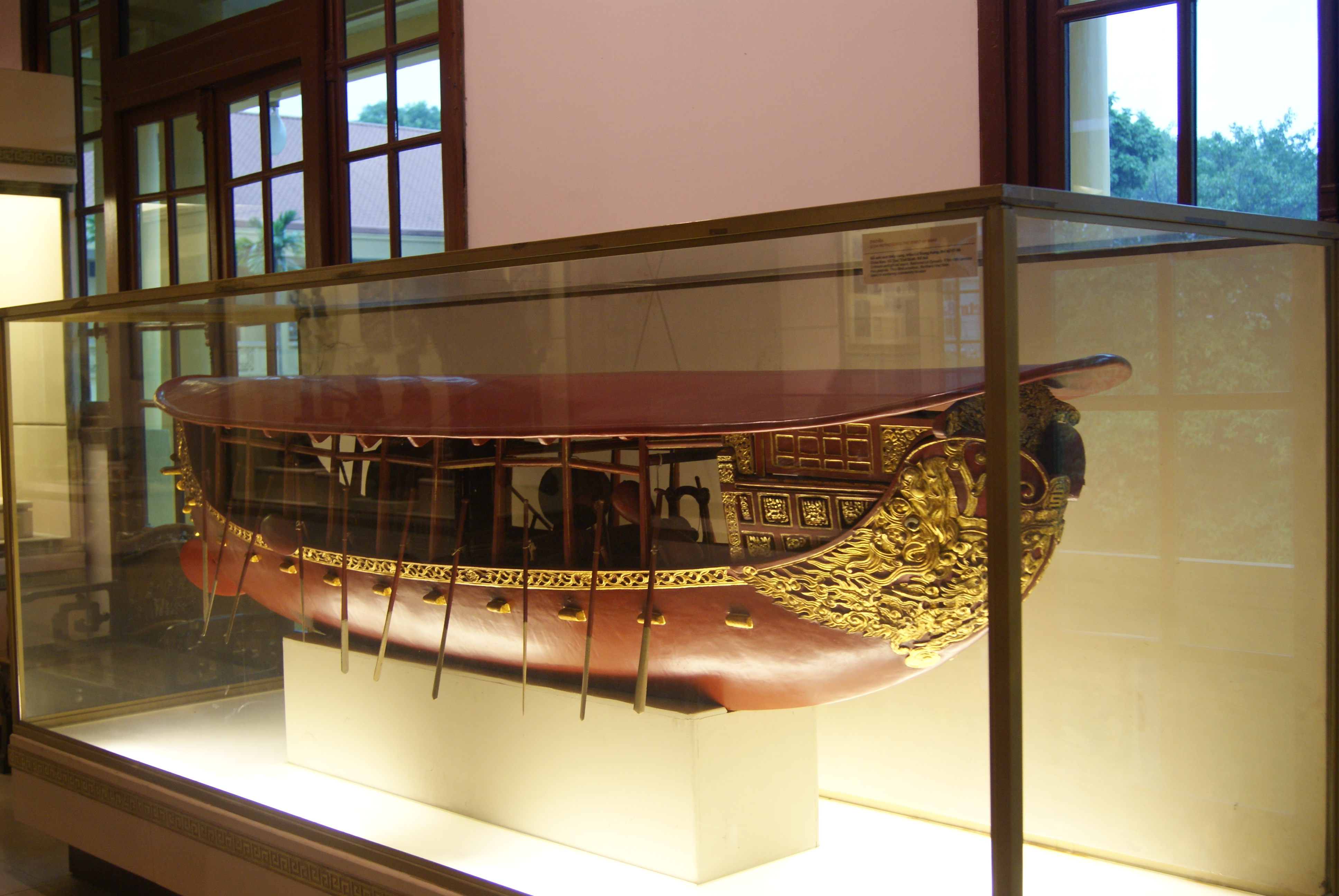
Battle of Bach Dang (1288)
The trap had worked once before, 350 years earlier and on the very same river. In April 1288, Commander-in-Chief Prince Tran Hung Dao bet everything on the idea that it would work again. He planted iron-headed stakes beneath the tidal waters of the Bach Dang River, sent small junks to bait a retreating Mongol-Yuan fleet into pursuing upstream, and waited for the tide to fall. When it did, the mightiest naval force in the 13th-century world found itself impaled, immobilized, and surrounded. By sundown, 400 Yuan warships had been captured or destroyed, and Kublai Khan's third and final attempt to conquer Vietnam was finished.
The Empire That Would Not Stop
Kublai Khan had already tried twice. The first Mongol invasion of Dai Viet, in 1258, ended in retreat. The second, in 1285, came closer -- Yuan forces under Prince Toghon captured the capital Thang Long and nearly seized the Vietnamese king Tran Nhan Tong at sea. But the invaders could not sustain themselves. Food ran out, disease spread, and the Vietnamese counterattacked during the withdrawal. Among the Yuan commanders who barely escaped was Omar bin Nars al-Din, a Khwarezmian-born admiral who had proven himself during Kublai's conquest of the Song dynasty. Omar fled to the coast, found a small boat, and sailed back to China. In late 1287, he was ordered to return. This time, the Yuan mobilized between 100,000 and 170,000 soldiers. Omar commanded the naval forces -- 18,000 soldiers, tens of thousands of sailors, 500 warships, and 70 transport vessels. The fleet sailed from Qinzhou on December 17, entering Dai Viet through the Bach Dang River.
Starving the Invader
The Vietnamese strategy was not to fight the Yuan head-on but to let hunger do the work. When Toghon's forces captured Hanoi on February 3, 1288, they found the capital stripped bare -- not a grain of rice left in the city. Toghon sent his generals to sweep the Red River Delta, pillaging crops from the countryside, while the army waited for a massive supply fleet under Zhang Wenhu sailing slowly south from China. It never arrived. Prince Tran Khanh Du and Tran Hung Dao ambushed Zhang's convoy at Van Don Island with just 30 warships, inflicting enough damage to force the supply ships back toward Hainan. Strong northeast monsoon winds scattered what remained. When King Tran Nhan Tong heard the news, he observed that food was what the Yuan needed most -- and they no longer had it. By March, the enormous Yuan army was stranded and starving. Toghon abandoned Hanoi on March 5, retreating toward the Chinese border. The Vietnamese destroyed bridges, sabotaged roads, and laid traps along every route.
Sunrise to Sundown
Omar and Admiral Fan Yi commanded the Yuan naval retreat. Their route home ran through the Bach Dang River -- the same estuary where, in 938, the Vietnamese lord Ngo Quyen had used iron-tipped stakes and tidal currents to destroy an invading Southern Han fleet. Tran Hung Dao knew the history intimately. Beginning in March, he had his soldiers drive iron-headed poles into the beds of the Chanh, Kenh, and Rut rivers, all northern distributaries of the Bach Dang. He positioned ambush forces behind the reef at Ghenh Coc, which stretches across the river between the Chanh and Kenh tributaries, and stationed his small flotilla in concealed positions along both banks. On the morning of April 9, Omar's fleet entered the estuary at high tide. Vietnamese junks sailed out, attacked, and then appeared to flee upstream. The Yuan ships pursued. When the tide receded, the iron stakes pierced through the falling water. The heavy Yuan warships ran aground or were impaled. Tran Hung Dao's forces closed from all sides. Fan Yi, seeing Omar's ships destroyed and his own fleet surrounded, leaped into the river and was killed. The battle lasted from sunrise to sundown.
The Unraveling of an Empire's Ambition
Four hundred Yuan warships were captured. Omar himself was taken prisoner. When news reached Kublai Khan, he banished his own son Toghon to Yangzhou for life. The Vietnamese and Mongols eventually agreed to exchange prisoners, but Tran Hung Dao -- who opposed releasing the admiral who had twice invaded his country -- arranged for Omar's transport ship to sink at sea. King Tran Nhan Tong accepted a nominal tributary relationship with the Yuan court to avoid further conflict, though he pointedly refused to appear in person. Kublai detained the Vietnamese envoy in retaliation. It was not until Kublai's successor, Temur Khan, took the throne in 1294 that relations finally normalized. The deeper consequence was strategic. The Mongols' failure at Bach Dang crushed their ambitions to conquer all of Southeast Asia, and smaller Asian states took note: the great empire could be beaten.
Poets on the Riverbank
The battle entered Vietnamese memory not merely as history but as literature. Emperor Tran Minh Tong, visiting the site in the early 14th century, composed a poem simply titled Bach Dang River. The mandarin-scholar Pham Su Manh wrote his own verse depicting the battle. A century later, the Le dynasty scholar Nguyen Trai traveled to the estuary and wrote Bach Dang hai khau, meditating on what the river had witnessed. In the 1940s, the composer Luu Huu Phuoc wrote a patriotic song bearing the river's name, connecting the medieval victories to Vietnam's modern struggles for independence. Today the Bach Dang flows quietly through Quang Ninh province, its banks lined with mangroves and fish farms. The iron stakes are gone. But for the Vietnamese, this stretch of tidal water carries the weight of proof -- that the land itself, understood and used with patience, can defeat any invader.
From the Air
Located at 20.94N, 106.63E on the Bach Dang River in Quang Ninh province, northern Vietnam. From altitude, the river appears as a wide tidal estuary flowing northeast into the Gulf of Tonkin, with the dramatic limestone karsts of Ha Long Bay visible just to the east. The flat deltaic landscape of the Red River system extends westward. Cat Bi International Airport (VVCI) in Hai Phong is approximately 15 km to the south-southwest. Noi Bai International Airport (VVNB) in Hanoi lies roughly 110 km to the west. Van Don International Airport (VVVD) is approximately 50 km to the northeast.