Battle of Bach Dang (938)
A thousand years of foreign rule ended in a single tide. In the autumn of 938, on the muddy estuary where the Bach Dang River meets the Gulf of Tonkin, a Vietnamese lord named Ngo Quyen drove iron-tipped stakes into the riverbed and waited for the Southern Han fleet to sail upstream. When the water dropped, the stakes did the rest. The battle lasted hours. Its consequences shaped a civilization.
A Millennium in Chains
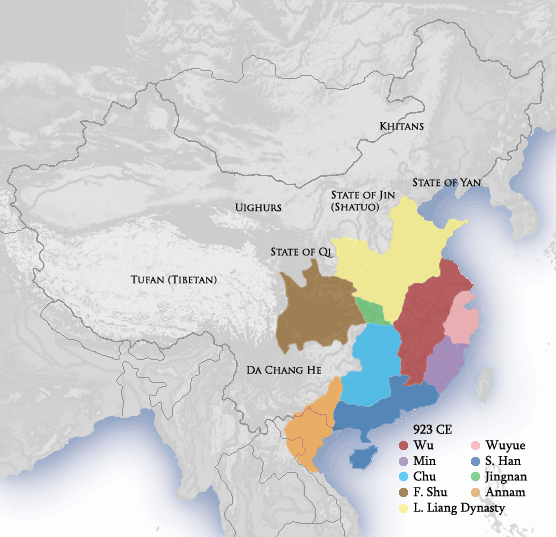
By the 930s, the Vietnamese had endured Chinese rule for over a thousand years -- a period their historians would call the Era of Northern Domination. The latest occupiers were the Southern Han, a Chinese state that controlled much of southern China during the chaotic Five Dynasties and Ten Kingdoms period. In 930, the Southern Han emperor Liu Yan attacked the Jinghai Circuit, a Viet principality governed by the Khuc clan, and captured its leader Khuc Thua My. A year later, the local general Duong Dinh Nghe raised an army of three thousand retainers and drove the occupiers back to the border. Independence, however tenuous, returned briefly to the Red River Delta. But in 937, Dinh Nghe was assassinated by one of his own officers, Kieu Cong Tien -- a man who would prove more useful to the Southern Han alive than any garrison they could station.
The Son-in-Law's War
Ngo Quyen was Dinh Nghe's general and son-in-law. When he learned of the assassination, he mobilized his forces to overthrow the traitor Kieu Cong Tien. Cong Tien, desperate, appealed to Liu Yan for help. The Southern Han emperor saw opportunity: he dispatched his own son, Liu Hongcao, at the head of an invasion fleet that sailed through the Gulf of Tonkin and turned up the Bach Dang River toward the heart of Viet territory. Liu Yan himself followed with reinforcements. It was meant to be decisive -- a father-and-son campaign to reclaim a rebellious province. Ngo Quyen understood what was coming. Rather than meet the fleet in open water, where the larger Southern Han warships had every advantage, he chose the tidal estuary of the Bach Dang and began preparing what would become one of the most celebrated ambushes in Vietnamese history.
Iron Beneath the Water
The plan was elegant and brutal. Ngo Quyen ordered massive wooden stakes, their tips sheathed in iron, hammered into the riverbed at the mouth of the Bach Dang. At high tide, the stakes vanished beneath the brown water. His own soldiers manned small, shallow-drafted boats -- vessels that could skim over the stakes without harm. When Liu Hongcao's warships entered the estuary, each carrying some fifty men including sailors, warriors, and crossbowmen, the Vietnamese craft darted out to harass them, then retreated upstream as if fleeing. The Southern Han pursued, confident in their heavier ships and greater numbers. Then the tide turned. As the water dropped, the iron-tipped stakes surfaced like teeth. The Southern Han warships, deep-keeled and heavy, impaled themselves or ran aground. Ngo Quyen's fleet counterattacked, driving the immobilized enemy back toward the stakes. Half the Southern Han force perished -- killed in combat or drowned in the falling river. Liu Hongcao was among the dead.
A Kingdom Proclaimed
When word of his son's death reached Liu Yan, still at sea with his reinforcements, the emperor turned his fleet around and sailed back to Guangzhou. He would not attempt the Bach Dang again. In the spring of 939, Ngo Quyen proclaimed himself king and established his capital at Co Loa, the ancient citadel north of modern Hanoi that had served as a royal seat centuries before Chinese rule began. The symbolism was deliberate: by choosing Co Loa, Ngo Quyen linked his new kingdom to the deepest roots of Vietnamese sovereignty. The Third Era of Northern Domination was over. Vietnamese historians mark this moment as the birth of their nation's independence -- not merely a military victory but the point at which Vietnamese history, as the Vietnamese themselves tell it, truly began.
The River Remembers
Three hundred and fifty years later, the Bach Dang would witness an almost identical scene. In 1288, the Vietnamese commander Tran Hung Dao, explicitly inspired by Ngo Quyen's example, planted iron-tipped stakes in the same river and lured the retreating Mongol-Yuan fleet into the same trap. That second battle destroyed Kublai Khan's ambitions in Southeast Asia. The two victories, separated by centuries but united by the same river and the same tactic, became the twin pillars of Vietnamese military identity. Today, the Bach Dang estuary flows quietly through Quang Ninh province near Ha Long Bay. The stakes are long gone, dissolved by centuries of salt and silt. But the river's name carries the weight of what happened here -- two moments when a smaller nation used the land itself as a weapon and won.
From the Air
Located at 20.84N, 106.63E on the Bach Dang River estuary in northern Vietnam, near the coast of the Gulf of Tonkin. The river mouth is visible from altitude as a wide tidal estuary flowing into Ha Long Bay to the northeast. The flat, deltaic terrain of the Red River system extends to the west. Nearest major airport is Cat Bi International Airport (VVCI) in Hai Phong, approximately 20 km to the southwest. Ha Long Bay's distinctive limestone karsts are visible to the east-northeast. Noi Bai International Airport (VVNB) in Hanoi lies roughly 120 km to the west.