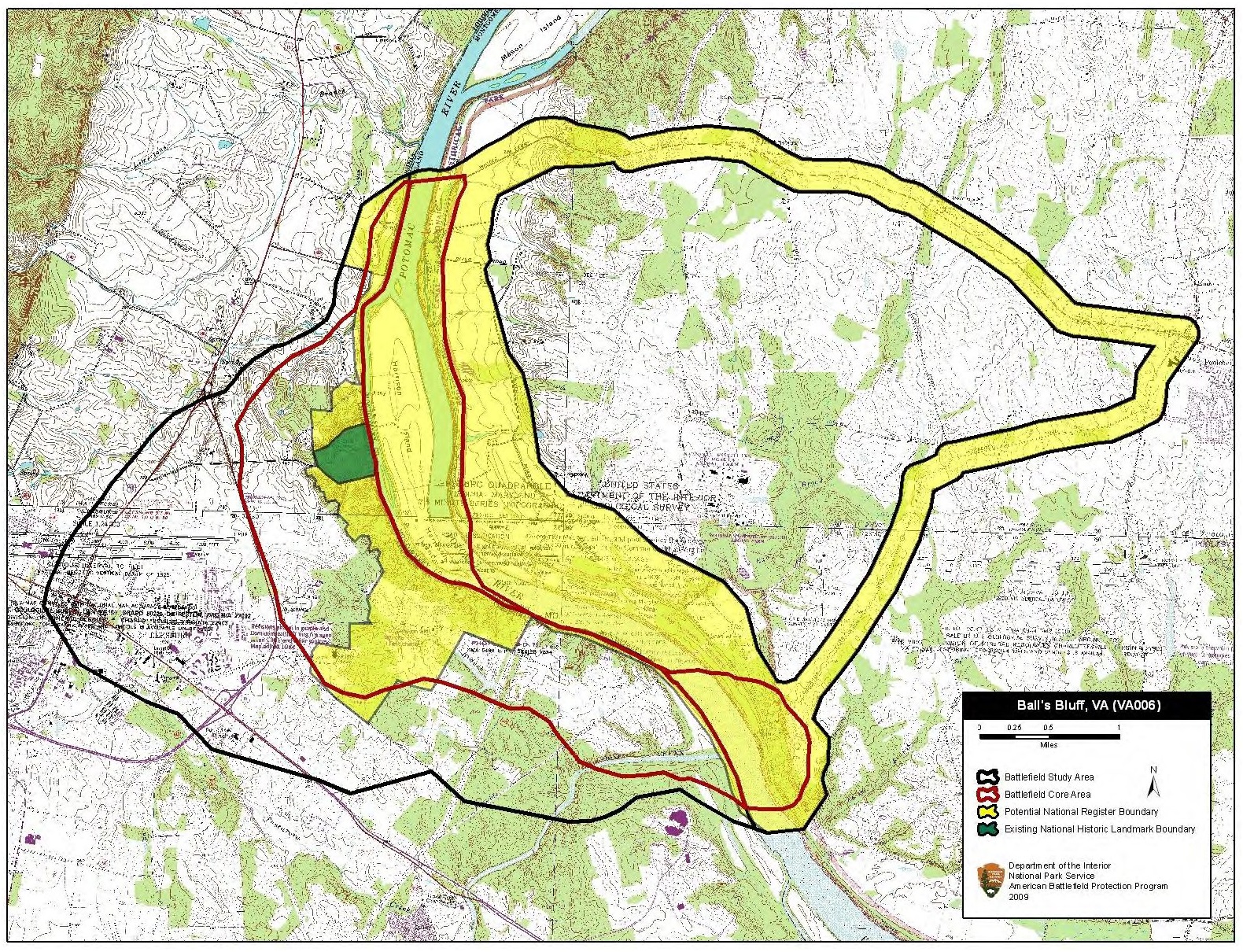
Battle of Ball's Bluff
It started with a row of trees. On the night of October 20, 1861, Captain Chase Philbrick led 20 men across the Potomac River from Harrison's Island to the Virginia bluffs above. Advancing nearly a mile inland in the dark, the inexperienced officer mistook a line of trees for the white tents of a Confederate camp. He did not investigate further. He returned and reported an unguarded enemy position. By the time the sun rose and the mistake became obvious, the chain of blunders was already in motion. Within twenty-four hours, 223 Union soldiers would be dead, a sitting United States senator would be killed in battle -- the only one in American history -- and bodies would be floating down the Potomac to the capital.
A Slight Demonstration Gone Wrong
Three months after the Union humiliation at Bull Run, Major General George McClellan was slowly building the Army of the Potomac. On October 20, he ordered Brigadier General Charles Pomeroy Stone to conduct "a slight demonstration" along the river near Leesburg to probe Confederate positions. Stone moved troops to Edwards Ferry, fired artillery into suspected positions, and briefly crossed about a hundred men of the 1st Minnesota to the Virginia shore before recalling them. The demonstration drew no reaction. Then came Philbrick's false report of a Confederate camp on the bluff. Stone immediately ordered Colonel Charles Devens of the 15th Massachusetts to cross 300 men, attack the camp at dawn, and return. What was supposed to be a quick raid became a catastrophe, compounded by a critical communication failure: Stone did not know that McCall's division had been ordered back to Washington, leaving his men without potential reinforcement.
The Senator Who Chose to Cross
Colonel Edward Dickinson Baker was a United States Senator from Oregon, a close personal friend of the Lincoln family, and a man with no business commanding troops in combat. When he arrived at Stone's headquarters on the morning of October 21 to inquire about the action, Stone gave him discretion to either withdraw the forces already in Virginia or reinforce them. Baker chose to reinforce. He ordered every available unit to cross the river -- but never checked how many boats were available. There were almost none. A bottleneck developed immediately, with Union troops trickling across in small numbers throughout the day while Confederate strength grew on the opposite bank. Baker himself did not cross until 2:30 in the afternoon, by which time Devens's men had already been skirmishing for hours with an increasingly formidable enemy.
Slaughter at the Bluff's Edge
The serious fighting began around 3:00 p.m. and raged almost without pause until dark. Baker commanded from the front, exposed and conspicuous. At approximately 4:30 p.m., he was shot and killed -- becoming the only sitting U.S. Senator ever killed in battle. His death threw the Union command into confusion. The Federals attempted to break out of their constricted position near the bluff, but the arrival of a fresh Confederate regiment, the 17th Mississippi, shattered any hope of escape. The rout drove Union soldiers down the steep southern slope of Ball's Bluff and into the Potomac. Boats attempting to ferry men back to Harrison's Island swamped and capsized under the weight of desperate soldiers. Many drowned, including wounded men unable to swim. In the days that followed, bodies floated downriver past Washington and as far as Mount Vernon.
The Political Earthquake
The butcher's bill read 223 killed, 226 wounded, and 553 captured -- modest numbers by the standards of what was coming, but staggering in October 1861, when the nation was still absorbing the shock of Bull Run. The death of a senator struck Washington like a thunderbolt. Congress demanded answers. The result was the Joint Committee on the Conduct of the War, a body that would torment Union generals for the next four years, particularly those who were Democrats. General Stone became the scapegoat. Suspected of harboring Confederate sympathies, he was arrested without charges and imprisoned for 189 days -- a grim preview of the political warfare that would plague the Union command throughout the conflict.
Ghosts and Future Justices
Among the wounded at Ball's Bluff was Lieutenant Oliver Wendell Holmes Jr. of the 20th Massachusetts, who took a near-fatal bullet through his chest. He survived to become an Associate Justice of the Supreme Court in 1902. Herman Melville commemorated the battle in his poem "Ball's Bluff -- A Reverie," published in 1866. Lieutenant John William Grout of the 15th Massachusetts was killed, and his death inspired the poem and song "The Vacant Chair," beloved in both the North and South for its universal expression of grief. Along the Chesapeake and Ohio Canal on the Maryland bank, canal workers refused to tie up their boats near the battlefield overnight, convinced the stretch was haunted by drowned soldiers. The site is preserved today as Ball's Bluff Battlefield and National Cemetery, a National Historic Landmark since 1984. Fifty-four Union dead lie buried there. Only one has ever been identified.
From the Air
Ball's Bluff is at 39.128N, 77.528W, on the Virginia bank of the Potomac River in Loudoun County, about 3nm northeast of Leesburg. From the air, the steep wooded bluff rising above the river is clearly visible, as is Harrison's Island in the Potomac just to the east. The battlefield sits within a small preserved park. Leesburg Executive Airport (KJYO) is 4nm southwest. Dulles International Airport (KIAD) is 15nm southeast. Recommended viewing altitude: 2,000-3,000 feet AGL to appreciate the steep bluff and the narrow river crossing that doomed the Union troops.