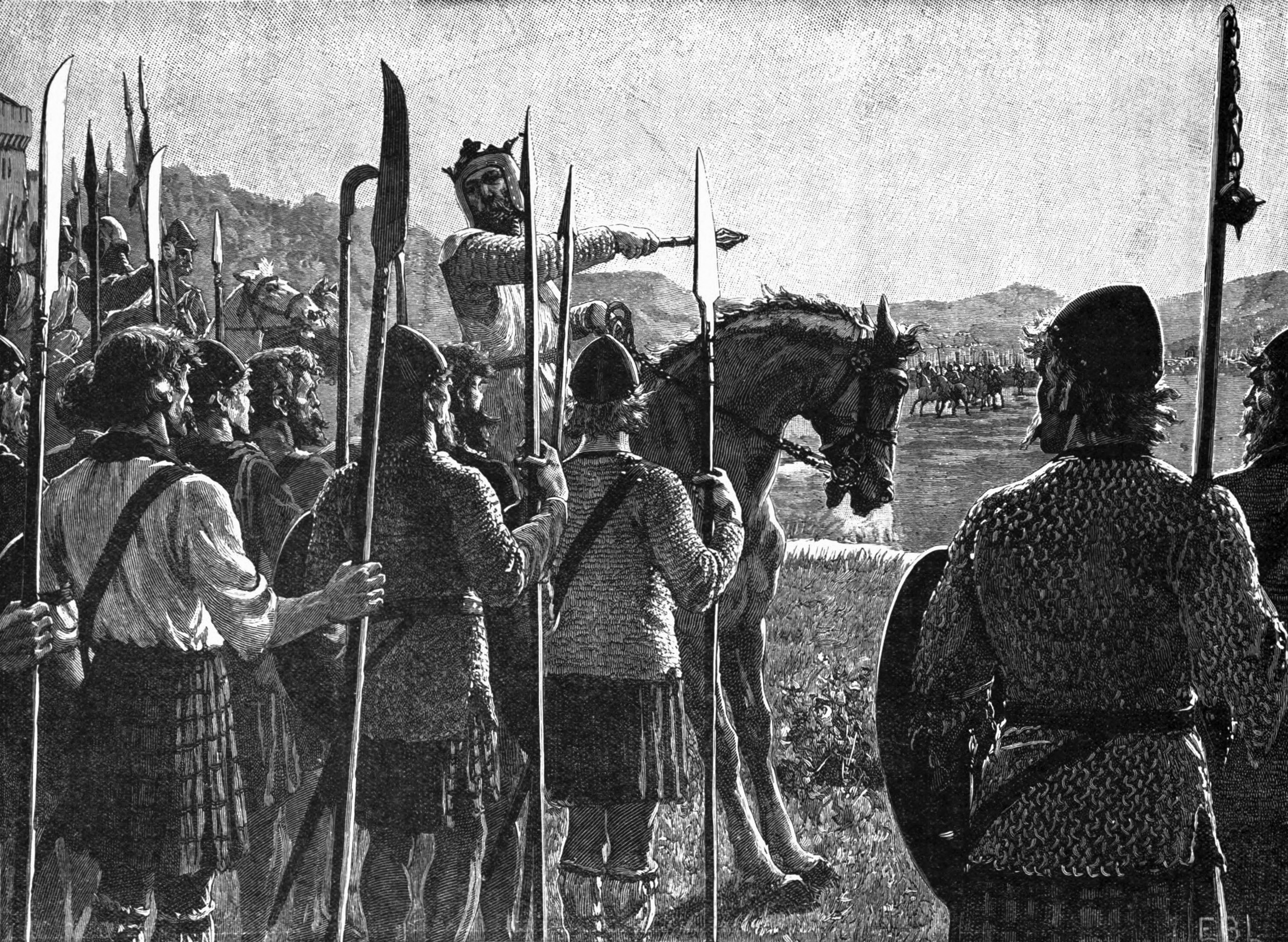
Battle of Bannockburn
He rode a small grey palfrey, not a warhorse. When Sir Henry de Bohun spotted Robert the Bruce at the head of the Scottish line on the morning of 23 June 1314, the English knight saw opportunity: a king lightly armed, mounted on an inferior horse, separated from his bodyguard. De Bohun couched his lance and charged. Bruce waited, then swerved at the last instant and brought his battleaxe down on the knight's helmet with such force that it split both helm and skull and shattered the axe handle. The encounter set the tone for two days of fighting near Stirling in which 6,000 Scots would rout an English army of 25,000, delivering Scotland's most famous military victory and one of the defining moments of British medieval history.
A King With Everything to Prove
Robert the Bruce had been King of Scots since 1306, but his grip on the throne was far from secure. He had murdered his rival John Comyn in a church, been excommunicated by the Pope, and watched his wife, sisters, and daughter imprisoned in England for eight years. His legitimacy rested not on ceremony but on his ability to expel the English garrisons that controlled Scotland's great castles. By 1314, only Stirling Castle remained in English hands, and Bruce's brother Edward had struck a deal with its governor: if no English relief force arrived by midsummer, the castle would be surrendered. Edward II of England could not let that stand. He assembled the largest army ever to cross the Scottish border, summoning 25,000 infantry and 2,000 cavalry from England, Ireland, and Wales. Bruce had roughly 6,000 men, many of them common spearmen trained in the schiltron formations that would decide the battle.
The Ground Chose Sides
Bruce selected his ground with care. He positioned his army in the New Park, a royal hunting forest south of Stirling, where the trees and marshy ground along the Bannock Burn would neutralise England's overwhelming advantage in heavy cavalry. The terrain funnelled Edward's army into a narrow front where numbers counted for less than discipline. On the first day, Bruce's schiltrons held firm against English cavalry charges while the boggy ground swallowed horses and riders. That evening, a Scottish knight serving in the English army defected and told Bruce that English morale was collapsing. The king made his decision: he would attack at dawn, using his schiltrons not as static defensive walls, as William Wallace had done at Falkirk, but as offensive formations that would advance into the English line. It was a gamble. If the schiltrons broke, there was no reserve.
The Rout
On the morning of 24 June, the Scottish schiltrons advanced in echelon across the carse. The English, hemmed between the Bannock Burn and the River Forth, had no room to deploy their cavalry or bring their archers to bear. The Earl of Gloucester charged the Scottish line and was killed, his horse impaled on the spears. As the English cavalry piled into one another in the confined space, panic spread through the ranks. Edward II fled the field, first to Stirling Castle, where the governor refused him entry because the castle was about to be surrendered, then south to Dunbar Castle with James Douglas in pursuit. The rest of the English army broke and ran. Historian Peter Reese wrote that only one sizeable group of foot soldiers made it back to England. The dead included the Earl of Gloucester and Sir Robert Clifford. The captured included the Earl of Hereford, whose ransom bought the freedom of Bruce's imprisoned queen and family.
What Victory Made Possible
Bannockburn did not end the Wars of Scottish Independence, which continued for another fourteen years. But it transformed the conflict. The immediate aftermath was the surrender of Stirling Castle, which Bruce promptly razed to prevent its recapture, and the fall of every remaining English stronghold in Scotland except Berwick. More profoundly, the battle forced Edward II to release Bruce's wife Elizabeth de Burgh, his sisters Christina and Mary, and his daughter Marjorie, ending their eight-year captivity. The victory electrified Scotland's sense of national identity. Robert Burns immortalised it in 'Scots Wha Hae,' and the chorus of 'Flower of Scotland,' the nation's unofficial anthem, refers directly to the battle. The National Trust for Scotland operates a visitor centre at the battlefield, where a statue of Bruce on horseback looks out over the ground where medieval Europe learned that disciplined infantry could defeat the finest cavalry on the continent.
From the Air
Located at 56.09N, 3.94W, approximately 2 nm south of Stirling. The battlefield lies in flat carse land along the Bannock Burn, with Stirling Castle visible on its volcanic crag to the north. The National Trust visitor centre and Bruce equestrian statue are on the western edge of the site. Nearest airports: Glasgow (EGPF) approximately 30 nm west; Edinburgh (EGPH) approximately 30 nm east. Best viewed at 2,000-3,000 ft AGL for a clear perspective of the terrain that shaped the battle.