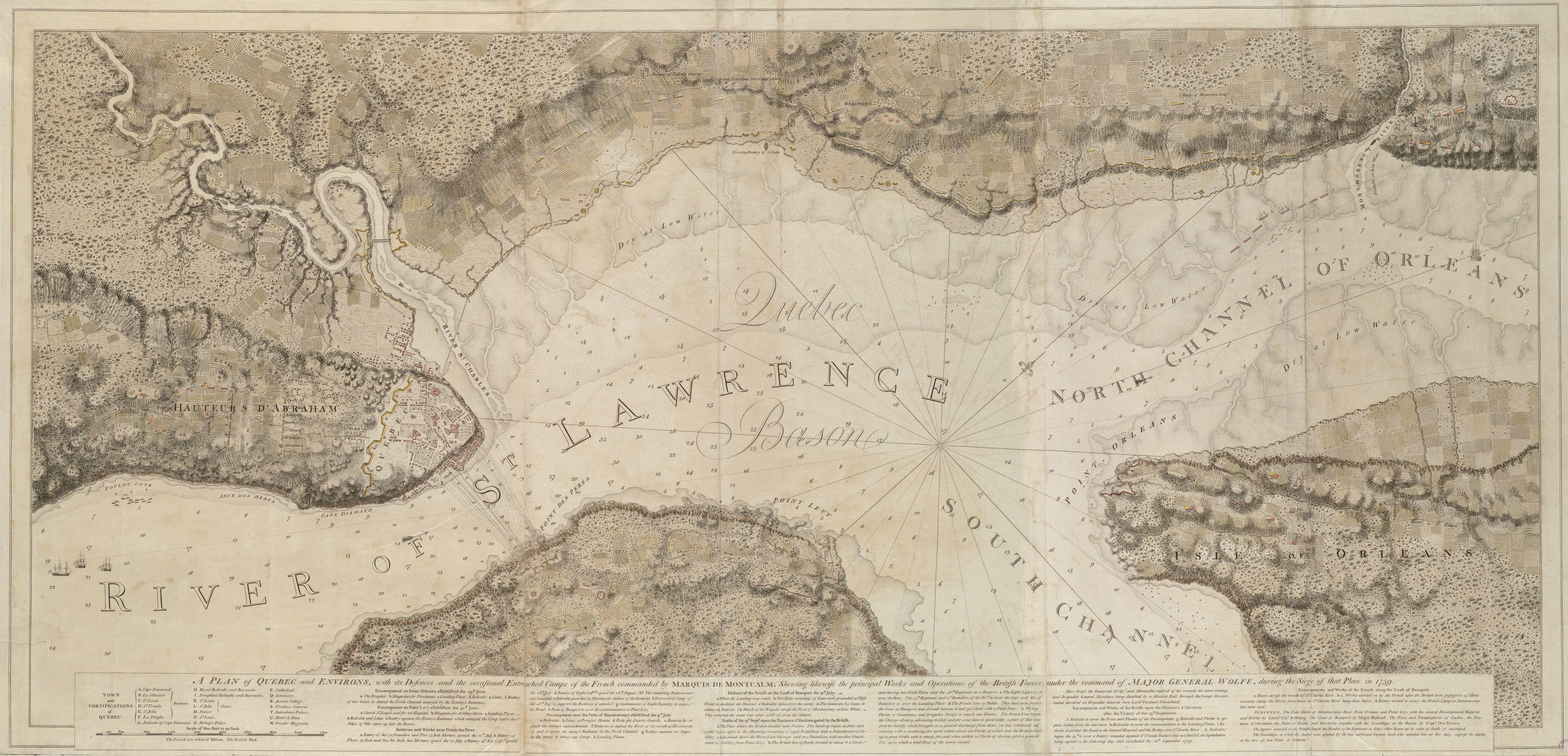
Battle of Beauport
The summer storm broke at the worst possible moment. On the afternoon of July 31, 1759, thirteen companies of British grenadiers were scrambling up muddy slopes toward French entrenchments on the Beauport shore, east of Quebec City, when rain hammered down and soaked their gunpowder into uselessness. The troops from the Montmorency camp had not yet linked up with the main landing force. General James Wolfe ordered a retreat. Behind him, 210 British soldiers lay dead and another 233 were wounded. It was the most significant French victory of the entire Quebec campaign, and yet the battle's true importance lay not in its outcome but in what it forced Wolfe to do next.
Wolfe's Dilemma on the St. Lawrence
By the summer of 1759, British fortunes in the Seven Years' War had turned decisively. The campaigns of 1758 had captured the fortress of Louisbourg and destroyed Fort Frontenac, though French General Louis-Joseph de Montcalm had stopped a British thrust at the Battle of Carillon. William Pitt, directing British strategy, organized a major campaign against Quebec, the capital of New France and the key to the entire French position in North America. The thirty-two-year-old Wolfe was given command of roughly 7,000 men and a powerful naval squadron. When he arrived before Quebec on June 26, he found the city perched on its commanding clifftop, the northern shore of the St. Lawrence heavily fortified, and the Beauport shoreline, the most natural landing site, bristling with entrenchments, redoubts, and floating batteries. Montcalm commanded 12,000 regulars and militia. The search for a viable point of attack consumed Wolfe for weeks.
A Camp Beneath the Falls
In early July, Wolfe established a camp on the north shore east of the spectacular Montmorency Falls, beyond the eastern end of the French defensive line. The landing was unopposed. Brigadier George Townshend's brigade and part of James Murray's brigade joined Wolfe there, and the British constructed batteries, rafts, and floating gun platforms in preparation for an assault on the French positions. Meanwhile, the Royal Navy achieved a significant breakthrough on the night of July 18-19, threading seven warships past Quebec's batteries and into the river above the city. This opened the tantalizing possibility of landing troops west of Quebec, bypassing the Beauport defenses entirely. Wolfe briefly considered a landing near the village of Saint-Michel but abandoned the plan when a French battery at Samos damaged the frigate Squirrel. He returned to the Montmorency camp on July 26, reconnoitered the French lines, and discovered a ford across the Montmorency River. A sharp skirmish there cost the British 45 killed and wounded but confirmed the strength of the French position.
The Assault Goes Wrong
Wolfe finalized his attack plan on July 28, targeting a French redoubt near the Beauport line. The assault relied on coordinated naval support, a landing force from Ile d'Orleans, and troops crossing from the Montmorency camp. On the morning of July 31, the warship Centurion positioned itself near the falls to bombard French batteries. Wolfe boarded the armed transport Russell and, seeing the battlefield up close for the first time, immediately recognized a critical flaw: the redoubt he intended to seize sat within easy musket range of French entrenchments on the high ground above. Taking the redoubt would not force the French out; it would turn his own men into targets. Despite this realization, Wolfe pressed forward, encouraged by what he described in his journal as "confusion and disorder" in the enemy lines. The landing proved disastrous. Boats carrying the main force struck a hidden shoal, delaying the assault by hours. The troops finally landed around 5:30 in the evening under darkening skies.
Gunpowder in the Rain
The grenadiers and 200 soldiers of the Royal Americans charged uphill toward the French entrenchments. Fire from the Montreal militia and regular troops on the heights cut into the advancing British columns. Then the sky opened. A violent summer thunderstorm drenched the battlefield, rendering muskets and powder useless on both sides but devastating for the attackers who needed firepower to advance against fortified positions. Wolfe ordered the retreat before the troops marching from the Montmorency camp could join the fight. The British withdrew with 443 total casualties. Wolfe, writing to Brigadier Monckton the next day, insisted the losses were not great and the defeat was no cause for discouragement. Montcalm was more perceptive. He wrote to fellow officer Bourlamaque that the Beauport attack was merely a prelude to something more important, which the French could do nothing but patiently await.
The Road to the Plains of Abraham
Montcalm was right. The failure at Beauport forced Wolfe to abandon his strategy of attacking the fortified shoreline east of Quebec. Over the following six weeks, Wolfe turned his attention westward, upstream of the city, where the cliffs were steep but less defended. On the night of September 12-13, 1759, British troops scaled the cliffs at a cove called Anse-au-Foulon and assembled on the Plains of Abraham above Quebec. The battle that followed on the morning of September 13 lasted barely fifteen minutes but changed the course of North American history. Both Wolfe and Montcalm were mortally wounded. Quebec fell to the British, Montreal surrendered the following year, and by the Treaty of Paris in 1763, France ceded its North American empire. The Beauport shore, where Wolfe had suffered his most stinging defeat, had taught him the lesson he needed. The direct approach had failed. The audacious one succeeded.
From the Air
Located at 46.89°N, 71.15°W on the Beauport shore, northeast of Quebec City along the St. Lawrence River. The Montmorency Falls (83 meters high) are visible from altitude as a white ribbon at the eastern edge of the battlefield. The Beauport shoreline stretches westward toward Quebec City's clifftop old town. Nearest airport: CYQB (Quebec City Jean Lesage International, 6 nm southwest). Best viewed at 3,000-5,000 ft AGL approaching from the south across the St. Lawrence to appreciate the tactical geography: the high ground the French defended, the river the British had to cross, and the falls marking the eastern anchor of the French line.