Battle of Beda Fomm
The British had three days' worth of fuel, a column of battered tanks that had been fighting for two months, and one chance. In late January 1941, intelligence revealed that Italy's 10th Army was evacuating Cyrenaica, retreating south along the Via Balbia from Benghazi. If the British could cut the coastal highway before the Italians reached safety, they could trap the entire army. The problem was distance: the direct route through the desert, south of the Jebel Akhdar mountains, was brutal terrain that would destroy already-worn vehicles. But Lieutenant-General Richard O'Connor ordered the gamble anyway. The 7th Armoured Division would race across the desert to block the road, while the 6th Australian Division pursued the Italians along the coast.
Thirty Minutes to Spare
Because the tanks were too slow for the desperate timetable, an improvised flying column of wheeled vehicles -- armored cars, rifle companies, field guns, and anti-tank guns -- was assembled under Lieutenant-Colonel John Combe and sent ahead at maximum speed. Combeforce, as it became known, drove southwest across the chord of the Jebel Akhdar, covering ground that had only been reconnoitred from the air. Late on 5 February, the column reached the Via Balbia south of Benghazi near Sidi Saleh and set up roadblocks. Thirty minutes later, the lead elements of the Italian retreat drove straight into the ambush. The British artillery, anti-tank guns, and armored cars threw the column into chaos. Italian soldiers from the 10th Bersaglieri tried to advance down the road and probe for gaps, but without artillery support of their own -- most of their guns were still with the rearguard to the north -- they could not break through.
Tank Duels Among the Ridges
The 4th Armoured Brigade arrived later, its tanks having struggled across terrain so rough that broken-down vehicles were simply abandoned along the route. Near a small white mosque north of the roadblock, the British found a series of low ridges with folds between them -- natural positions from which tanks could hide, dash to the road, fire at close range, and withdraw. When the Italian Babini Group attacked at dawn on 6 February with their M13/40 tanks, the cruiser tanks of the 2nd Royal Tank Regiment used these ridges to devastating effect. As Italian tanks crested the first ridge, British turrets appeared and rapidly knocked out eight M13s before disappearing below the ridge again. The cruisers then drove to the next ridge near the mosque and destroyed another seven. The British held a critical advantage in communications: their tanks had radios, while most Italian tank commanders had to dismount and receive orders on foot, turning every tactical adjustment into a slow and dangerous process.
Burning Lorries at Dusk
Throughout 6 February, the fighting seesawed. The 7th Hussars attacked the Italian column from the north while the 2nd RTR held the Pimple, a low hillock west of Beda Fomm with clear views in both directions along the road. By noon, roughly forty Italian medium tanks had been knocked out, but the 2nd RTR was down to just fifteen cruisers. In the afternoon, the concentration of Italian tanks and artillery was enough to briefly recapture the Pimple and open the road south. British tanks pursued the convoy, firing into it and setting vehicles alight. Drivers abandoned their lorries or veered into the coastal dunes to escape, where they bogged down in sand under British artillery fire. Petrol trucks burned, illuminating the dusk and giving the approaching British tanks something to aim at. The artillery crews, finding they were not needed, spent the evening rounding up prisoners and recovering abandoned Italian vehicles -- particularly those carrying fuel to keep the British tanks running for one more day.
The Last Tank at the Officers' Mess
By dawn on 7 February, the Italians had about thirty tanks left. They launched a final push to break through Combeforce, and the M13s overran the infantry positions of the 2nd Rifle Brigade, concentrating their fire on the anti-tank guns of the 106th Royal Horse Artillery. One by one the guns were silenced until only a single weapon remained. The battery commander, assisted by his batman and the unit cook, dragged the last gun to a flanking position and began firing as the surviving M13s drove toward the officers' mess tent -- which had been set up behind the reserve company the day before. The improvised crew knocked out the final Italian tank within yards of the tent. On the road to the north, the 4th Armoured Brigade surrounded another group, and the resistance collapsed. The Italian 10th Army surrendered. Among the prisoners were General Annibale Bergonzoli and the staff of the army command. General Giuseppe Tellera, the army commander, was found mortally wounded inside one of the M13s.
The Gamble's Price
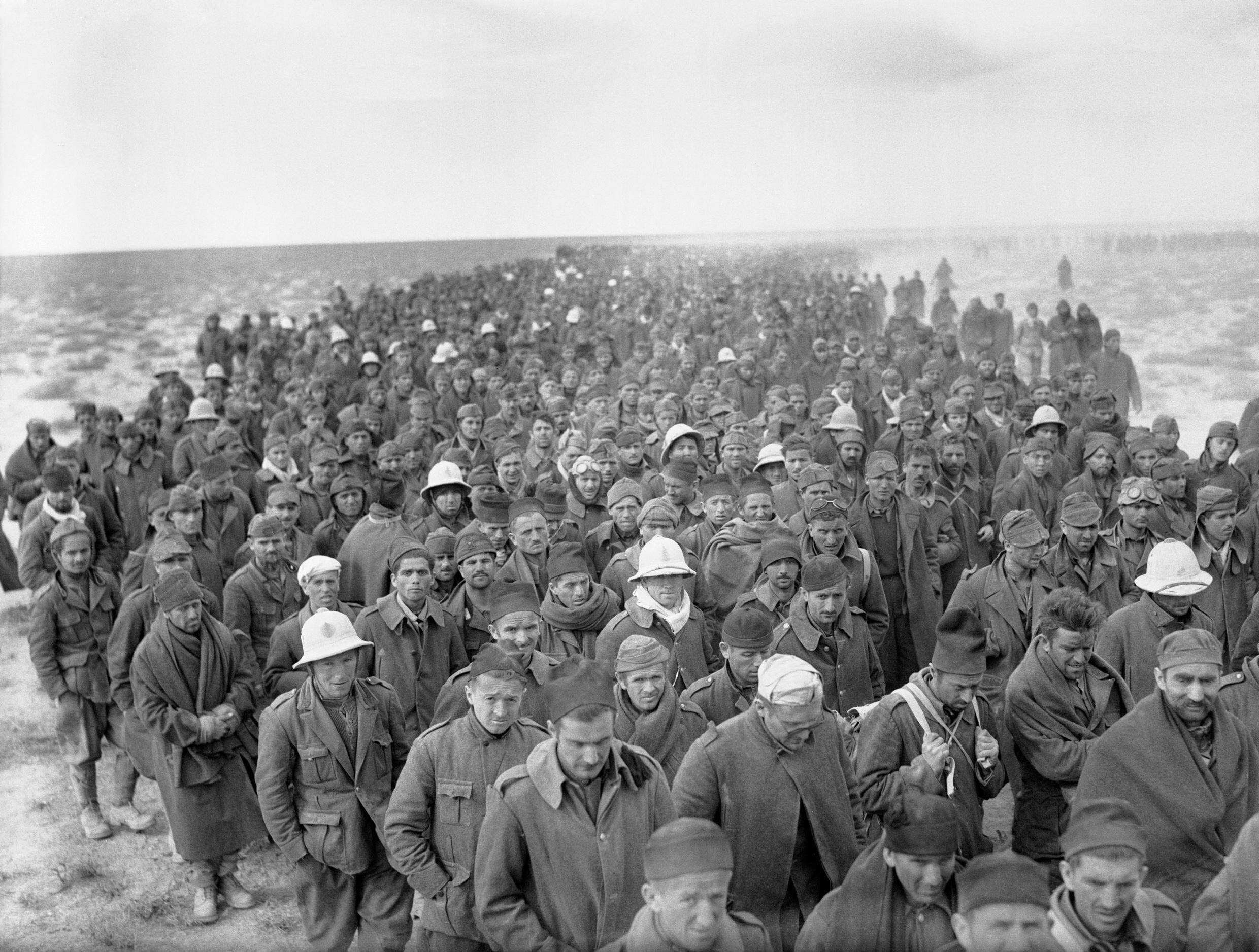
The British captured approximately 25,000 prisoners, over 100 tanks -- many still operational -- and hundreds of vehicles at Beda Fomm. Across the whole of Operation Compass, from December 1940 to February 1941, British and Commonwealth forces had advanced some 800 kilometers, destroying or capturing the bulk of an entire Italian army. But the pursuit could not continue. Tanks were broken down, vehicles worn out, and supply lines stretched to their limit. On 9 February, Churchill ordered the advance to stop and troops to be dispatched to Greece. Within weeks, the first units of the German Afrika Korps under Erwin Rommel landed in Tripolitania, transforming the desert war. The audacious gamble at Beda Fomm had worked, but the window it opened closed almost immediately.
From the Air
The battle took place along the Via Balbia (coastal highway) south of Benghazi near the village of Beda Fomm, at approximately 30.75N, 20.17E on the Gulf of Sidra in eastern Libya. The terrain is flat coastal desert with low ridges east of the road. From altitude, the coastline's curve along the Gulf of Sidra and the highway running along it are the primary landmarks. Nearest airport is Benina International Airport (HLLB) near Benghazi, approximately 150 km to the northeast.