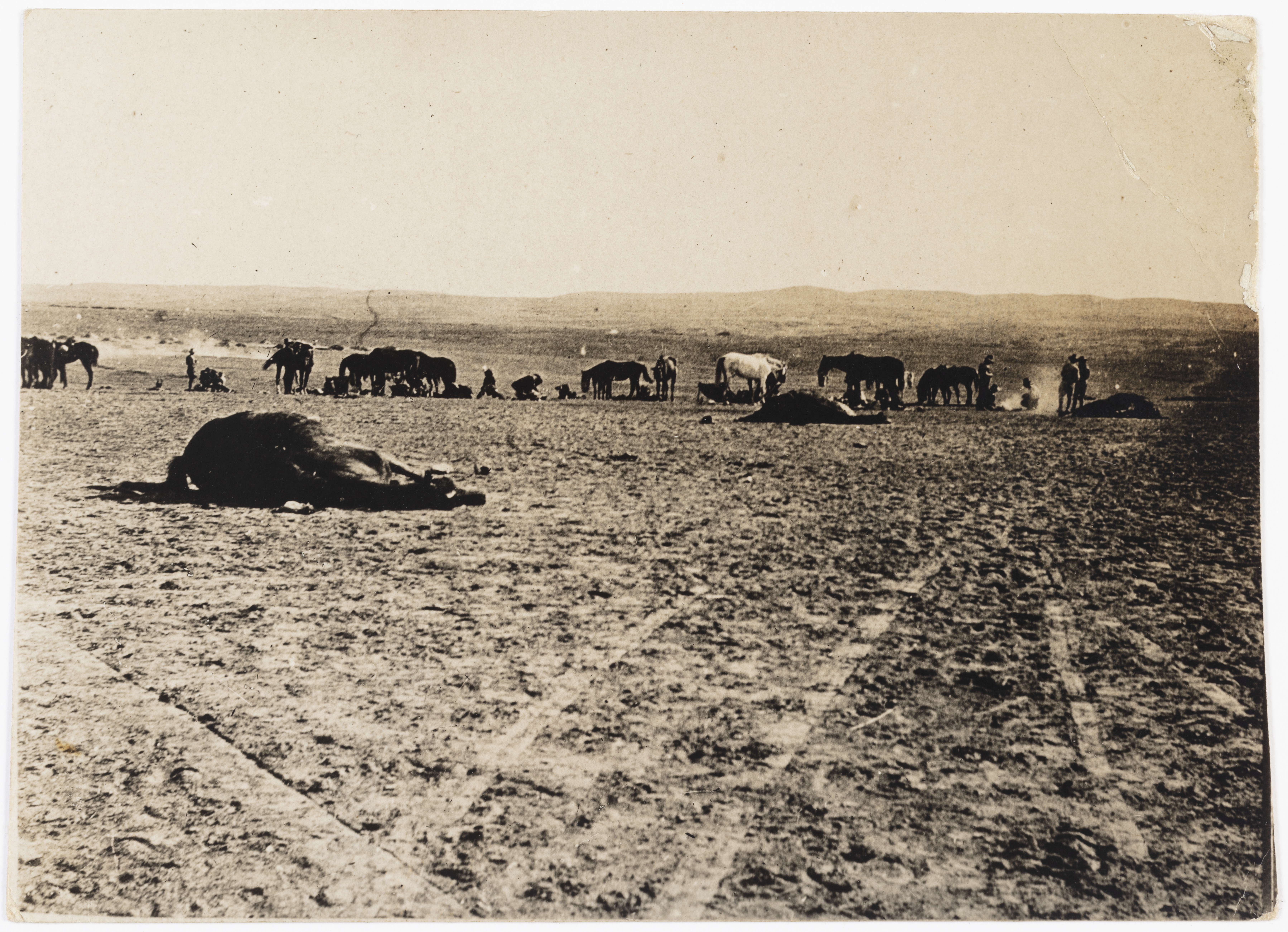
Battle of Beersheba (1917)
Their rifles were useless on horseback. Australian light horsemen were mounted infantry, not cavalry -- they rode to the fight, then dismounted to shoot. They carried no swords. So when the order came on the afternoon of October 31, 1917, to charge directly at the Ottoman trenches outside Beersheba, the men of the 4th and 12th Light Horse Regiments drew their bayonets, gripped them like swords, and galloped across the open plain toward a fortified town that had already absorbed a full day of bombardment and infantry assault. It was the kind of desperate improvisation that either ends in annihilation or becomes legend. At Beersheba, it became both.
The Fortress at the Edge of the Negev
Beersheba sat at the eastern anchor of the Ottoman defensive line that stretched 30 miles from Gaza to the Judean Hills. Since ancient times it had been a trading center, with roads radiating in every direction -- northeast to Jerusalem via Hebron and Bethlehem along a metalled motor road, northwest to Gaza across the open plain, and south toward the Negev and Sinai. The Ottomans had developed it into a modern garrison town with a hospital, army barracks, a railway station, engine sheds, and stone buildings with red-tiled roofs. A German beer garden served the officers. Semicircular entrenchments protected the town from the west and south, with redoubts on high points extending up to four miles out. On the eastern approach, the formidable Tel el Saba redoubt dominated the plain. The garrison included roughly 4,400 rifles, 60 machine guns, and 28 field guns.
Allenby's Gamble
After two humiliating defeats at Gaza earlier in 1917 -- costing some 10,000 British Empire casualties -- General Edmund Allenby replaced the sacked commanders and devised a new strategy. Rather than batter the fortified Gaza head-on, he would feint there while striking Beersheba with overwhelming force from the east and south. The plan required extraordinary logistics: 203 miles of metalled road, 300 miles of water pipeline, and 388 miles of railway had been laid across the Sinai to support operations this far forward. Supply columns had to sustain infantry and mounted divisions for 24 hours beyond the railhead. Intelligence from the Nili spy ring -- a Jewish network operating behind Ottoman lines -- provided detailed maps of defensive positions that made targeted attacks possible. Success depended on speed: Beersheba's wells had to be captured intact before the Ottoman garrison could destroy them, or the attacking divisions would have no water in the desert.
A Day of Grinding Assault
The coordinated attack began at dawn on October 31, with infantry from the 60th London and 74th Yeomanry Divisions advancing from the southwest under artillery bombardment. By mid-morning, the 60th Division had captured Hill 1070 on the outer defenses. A joint assault then pushed through the main trench lines west of town. Meanwhile, the Anzac Mounted Division swung wide to the northeast, cutting the Beersheba-Hebron-Jerusalem road and isolating the garrison. Continuous fighting through the afternoon focused on Tel el Saba, the fortified mound dominating the eastern approaches. Its capture by the Anzac Division's New Zealand and Australian brigades removed the last major obstacle east of town -- but daylight was running out. Every brigade of both mounted divisions was already committed. The only reserve was the 4th Light Horse Brigade, and they had no swords.
Bayonets at the Gallop
At approximately 4:30 in the afternoon, Brigadier General William Grant ordered the 4th Light Horse Brigade forward. The 4th and 12th Light Horse Regiments -- roughly 800 men -- formed up on the open plain southeast of Beersheba. What followed covered about six kilometers at a gallop. Ottoman machine guns and rifle fire tore into the advancing lines, but the speed of the charge made the horsemen difficult targets for the defenders, who had set their rifle sights for a slower infantry advance. The 4th Regiment on the right jumped the Ottoman trenches, then wheeled and dismounted to attack the infantry in the gun pits and redoubts from behind. The 12th Regiment on the left rode past the main defenses, found a gap, crossed the railway line, and charged into Beersheba itself. By dusk, the town and much of its garrison had been captured. The wells, critically, were taken before they could be destroyed.
The Road to Jerusalem
Beersheba was the first step in Allenby's offensive that would capture Jerusalem six weeks later, on December 9, 1917. The battle broke the eastern anchor of the Ottoman Gaza-Beersheba line and forced a general retreat that unraveled the entire defensive position in southern Palestine. For Australia, the charge at Beersheba became a defining national narrative -- a complement to the tragedy of Gallipoli, proof that Australian soldiers could achieve spectacular battlefield success. An ANZAC Memorial Center now stands in modern Be'er Sheva, and the centennial in 2017 drew commemorations from both countries. The light horsemen who charged that afternoon carried no sabers, wore no cavalry uniforms, and followed no textbook doctrine for mounted assault. They improvised with bayonets and audacity, and in doing so opened the road that led through the Judean Hills to the Holy City.
From the Air
Located at 31.25N, 34.80E at modern Be'er Sheva in southern Israel, on the northern edge of the Negev Desert. The battlefield extended across the flat plain south and east of the town. Best viewed at 3,000-5,000 feet AGL. The Judean Hills rise to the north and northeast. Nearest airports include LLBS (Be'er Sheva/Nevatim) approximately 5 nm east, and LLBG (Ben Gurion International) approximately 55 nm north-northwest. Tel el Saba mound is visible east of the modern city.