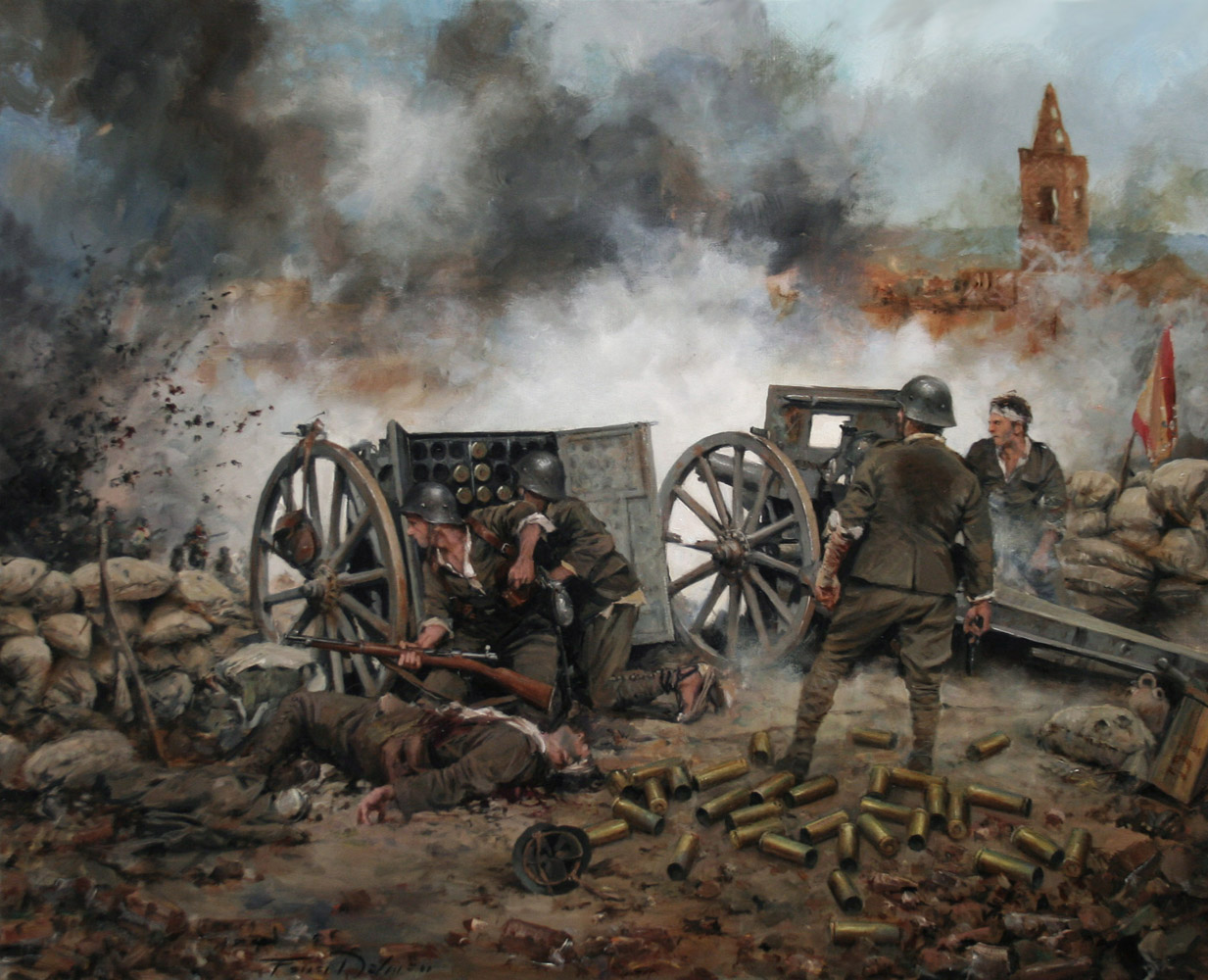
Battle of Belchite (1937)
Both sides claimed Belchite. The Republicans called it a victory to disguise the failure of their larger offensive against Zaragoza. The Nationalists lionized its defenders as modern-day Numantines, invoking the ancient Iberian siege to counterbalance the international outrage over Guernica. Even Ernest Hemingway, who arrived to report on the Republican triumph, helped cement the new name: what began as the Offensive of Zaragoza became the Battle of Belchite, a rebranding exercise conducted over the bodies of soldiers and civilians alike.
The Gamble for Zaragoza
By the summer of 1937, the Republican government was desperate. The Brunete offensive had stalled, the Nationalists were advancing in the north, and internal politics demanded action. The plan was audacious: eighty thousand men, two hundred aircraft, and over a hundred T-26 tanks would strike along a hundred-kilometer stretch of the Aragon front between Zuera and Belchite. The real prize was Zaragoza, the regional capital and communications hub for the entire Aragon front. General Pozas set up headquarters at Bujaraloz, splitting his forces across seven breakthrough points to dilute Nationalist counterattacks. But the offensive also served a political purpose -- bringing communist troops into Aragon would weaken anarchist and POUM influence in the region. War and ideology marched together.
Trapped Between Armies
The offensive launched on 24 August 1937. On the northern and central fronts, Republican forces advanced through largely vacant territory. The real fighting happened in the south: La Puebla de Alborton, Codo, Mediana, and Quinto fell in succession, though even the tiny village of Codo tied down two Republican brigades for two days with a single Requete company and forty Falangists. Belchite proved far worse. Close to five thousand people -- 2,273 soldiers and roughly 2,600 civilians, including women, children, and elderly residents -- were trapped inside the encircled town. They held out until 6 September, far longer than Republican commanders had expected. The delay was fatal to the broader offensive. Logistic failures and poor coordination between brigades gave the Nationalists time to bring up reinforcements, and the surprise attack on Zaragoza never materialized.
Death from Above
While Republican forces besieged Belchite on the ground, the sky belonged to the Nationalists. The German Condor Legion's Heinkel He 70 reconnaissance planes photographed Republican positions daily, enabling precise bombing runs that destroyed battery after battery. Junkers Ju 52 cargo planes dropped ammunition, food, and medicine into the besieged town, prolonging resistance that should have ended days earlier. Over a hundred Nationalist aircraft -- Fiat CR.32 fighters, Savoia-Marchetti bombers, Heinkel He 51 biplanes -- pounded the Republican lines. The ground forces, twenty kilometers away, could not break through to relieve Belchite. But the air campaign bought enough time for the defense to become legend, and for the offensive on Zaragoza to collapse into a two-month grind that ended in failure.
A Town Left to Crumble
Franco retook Belchite on 11 March 1938, after intensive bombing and artillery barrages that finished what the Republicans had started. Rather than rebuild, he ordered the ruins preserved as a monument to what he called the destruction wrought by the "Red Army" -- though both sides had contributed to the devastation. A new town was constructed nearby, and the shattered buildings of old Belchite were left to the weather and the weeds. Today, visitors walk through the skeletal remains: roofless churches, collapsed facades, streets that lead nowhere. The artillery positions on Lobo Hill to the south, where Republican guns once fired on the town, are open to the public, as are the Nationalist positions at El Saso and the Seminary. Belchite stands as Spain's most visible Civil War ruin, a place where propaganda calcified into stone.
From the Air
Located at 41.30N, 0.75W in the dry Aragon plains southeast of Zaragoza. The ruins of old Belchite are visible alongside the newer replacement town. Nearest major airport is Zaragoza (LEZG), approximately 40 km to the northwest. Best viewed at 3,000-5,000 feet AGL in the clear, arid conditions typical of the Ebro valley.