Battle of Belmont
Belmont, Missouri, was not a town. It was three shacks and a ferry landing on the Mississippi River, directly across from the Confederate fortress at Columbus, Kentucky. On November 7, 1861, it became something more -- the place where Ulysses S. Grant, a failed farmer and former clerk who had re-entered the Army only months earlier, first tested himself in combat. Grant arrived by steamboat with 3,114 men, overran a Confederate camp, watched his soldiers lose all discipline in celebration, then fought a desperate retreat to the river while enemy reinforcements closed in from three sides. He nearly didn't make it back. The battle proved nothing strategically, but it introduced the American public to a general who would one day accept Robert E. Lee's surrender at Appomattox -- and it taught Grant himself a lesson about victory, chaos, and the thin line between the two.
A River Divided
The Mississippi River in late 1861 was more than a waterway -- it was the strategic spine of the Western Theater. Kentucky had declared neutrality at the war's outbreak, but that fiction collapsed in September when Confederate Major General Leonidas Polk marched his troops into Columbus and fortified the bluffs overlooking the river. The Columbus batteries were formidable: 10-inch Columbiads, 11-inch howitzers, and the 'Lady Polk,' a 128-pounder Whitworth rifle that was the largest cannon in the Confederacy. Three days after Polk's move, Grant seized Paducah, Kentucky, for the Union. For two months the opposing forces watched each other across the water. Then theater commander John C. Fremont ordered Grant to make a feint toward Columbus to prevent the Confederates from reinforcing Arkansas. Grant, commanding the District of Southeast Missouri from Cairo, Illinois, decided a feint was not enough. He would attack.
Steamboats and Cornfields
On November 6, Grant loaded his men aboard six steamboats -- the Aleck Scott, Chancellor, Keystone State, Belle Memphis, James Montgomery, and Rob Roy -- escorted by the gunboats USS Tyler and USS Lexington. They steamed downriver from Cairo and landed at Hunter's Farm, three miles north of Belmont, safely out of range of the Columbus batteries. The next morning Grant marched his men south along the single road, forming a battle line in a cornfield a mile from Camp Johnston, the small Confederate observation post at Belmont. The opposing lines were green troops on both sides: five Illinois and Iowa regiments against five Tennessee and Arkansas regiments. For most of the morning, both armies surged forward and fell back in confused, bloody succession. Grant was constantly at the front. His horse was shot from under him; his aide Captain William S. Hillyer gave Grant his own mount. By 2 p.m., Gideon J. Pillow's Confederate line collapsed and the Southerners fled toward the river.
Demoralized by Victory
What happened next became one of the war's earliest cautionary tales. Grant's men, delirious with their first taste of victory, dissolved into a mob. They plundered the captured Confederate camp, cheered wildly, and ignored their officers. Brigadier General John A. McClernand planted the Stars and Stripes at the center of camp and called for three cheers. A carnival atmosphere took hold. To restore order, Grant ordered the camp set on fire. In the confusion and blinding smoke, wounded Confederates trapped in the burning tents were accidentally killed -- an atrocity that the returning Southern troops believed was deliberate. Meanwhile, Polk was ferrying reinforcements across the river on the transports Prince and Charm. When the fresh Confederate troops threatened to cut off Grant's retreat, and the massive Lady Polk began firing into the Union ranks from Columbus, Grant rallied his men with five words: 'We must cut our way out.'
A Horse That Understood the Situation
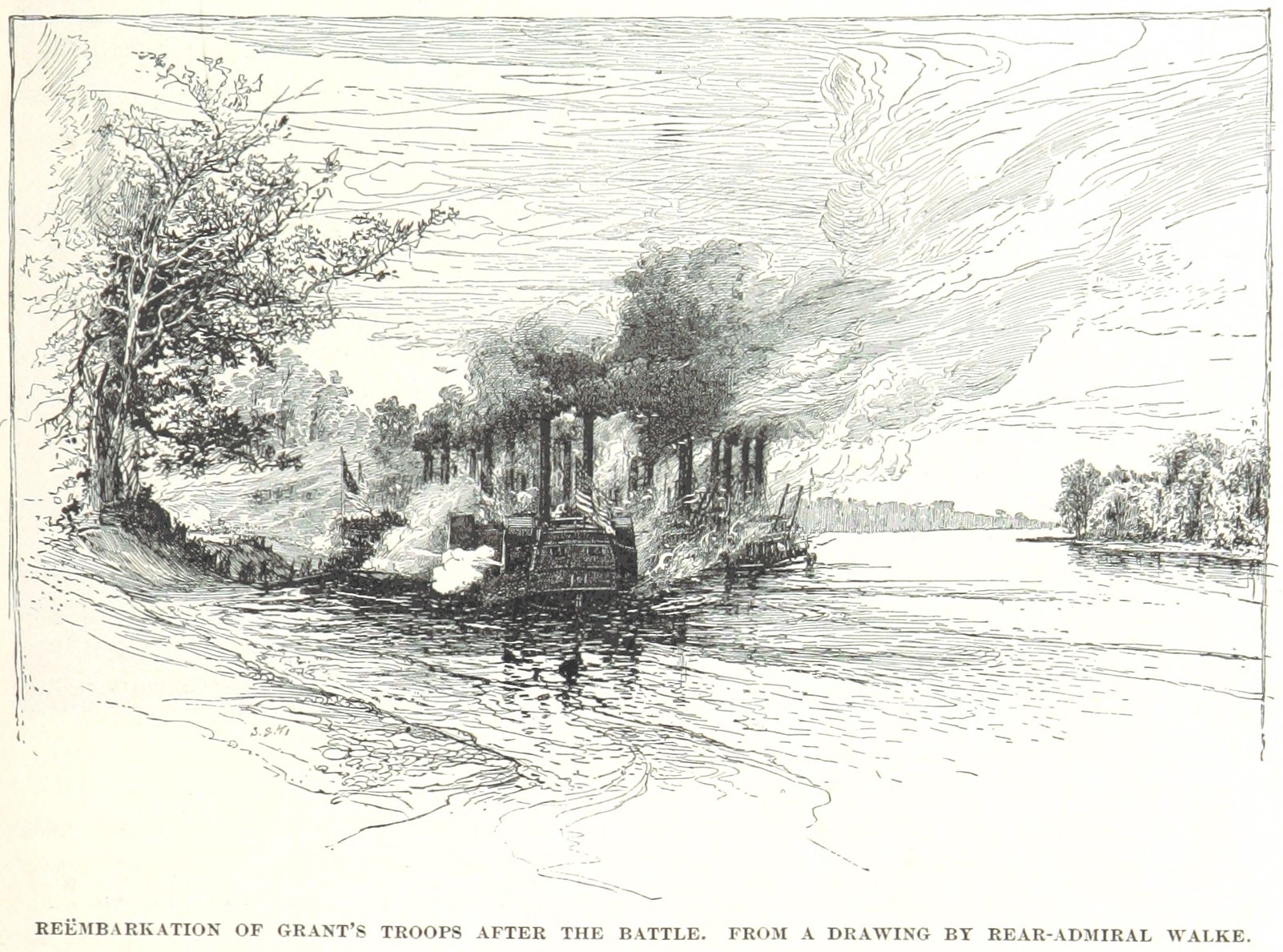
The retreat to the river became a running fight. The rear of Grant's column suffered badly as it ran the gauntlet of Confederate fire. When Grant reached the landing, he discovered one regiment was missing. He galloped back to search for it, found only enemy soldiers moving toward him, wheeled his horse, and raced for the riverbank -- only to see that the steamboat captains had already cast off their mooring lines. Grant wrote in his memoirs what happened next: 'The captain of the boat that had just pushed out recognized me and ordered the engineer not to start the engine; he then had a plank run out for me. My horse seemed to take in the situation. He put his fore feet over the bank without hesitation or urging, and, with his hind feet well under him, slid down the bank and trotted on board.' The missing Illinois regiment was spotted marching upriver during the return trip and taken aboard. Grant lost his bay horse, saddle, mess chest, and gold pen in the retreat. McClernand lost his iron-framed cot, field desk, and an inkstand inscribed with his name.
The Making of a General
Both sides claimed victory. Confederate General Albert Sidney Johnston declared that 'the 7th of November will fill a bright gap in our military annals.' Union casualties were 607 -- 120 dead, 383 wounded, 104 captured or missing. Confederate losses were slightly higher at 641. The battle was militarily inconsequential, but with little happening elsewhere, it drew enormous press attention. Grant saw it differently from either the newspapers or his opponent. He maintained that the battle's two objectives were accomplished: the Confederates abandoned plans to reinforce Arkansas, and they suffered losses heavy for that period of the war. More importantly, Belmont gave Grant something no classroom could provide -- experience commanding thousands of men in chaos. It also gave President Abraham Lincoln, desperate for generals willing to fight, a positive impression of the obscure officer from Illinois. Within three months, Grant would capture Fort Henry and Fort Donelson, and the trajectory from Belmont to Appomattox would be set.
From the Air
Located at 36.77N, 89.12W on the Missouri bank of the Mississippi River in Mississippi County, Missouri. The battlefield sits on low, flat river-bottom terrain directly across from Columbus, Kentucky, where the high bluffs of the former Confederate fortress (now Columbus-Belmont State Park) are clearly visible from the air. The Mississippi River makes a distinctive bend here. Cairo, Illinois -- Grant's staging point -- is approximately 20 nm north at the confluence of the Ohio and Mississippi Rivers. Nearest airports: Columbus-Hickman Airport (K0M2) about 5 nm east; Cairo Regional Airport (KCIR) about 20 nm north. Best viewed at 2,000-4,000 ft AGL to see the river crossing and the contrast between the low Missouri bottomlands and the Kentucky bluffs.