Battle of Bentonville
General Joseph E. Johnston knew the odds were impossible. By March 1865, his cobbled-together Army of the South numbered barely 21,000 men against William T. Sherman's 60,000-strong juggernaut marching north through the Carolinas. But faulty Confederate maps showed Sherman's two wings separated by a full day's march, and Johnston saw a sliver of opportunity. He would stake everything on one last gamble in the pine forests of Johnston County, North Carolina, near a crossroads village called Bentonville. What unfolded over three days in March became the last full-scale battle between the western armies of the Civil War, and the Confederacy's final attempt to halt Sherman's relentless advance.
Sherman's Long Shadow
Sherman had already burned a trail of devastation from Atlanta to Savannah during his March to the Sea, and by early 1865 he was carving northward through the Carolinas with the same ruthless efficiency. General-in-chief Ulysses S. Grant wanted Sherman to transport his forces to Virginia, but Sherman argued he could do more damage marching overland, destroying Confederate supply lines to Petersburg along the way. He split his command into two wings: the Left Wing, or Army of Georgia, under Major General Henry W. Slocum, and the Right Wing, the Army of the Tennessee, under Major General Oliver O. Howard. The two columns marched separately toward Goldsboro, and no one in the Union high command expected serious resistance. On February 23, Robert E. Lee had ordered Johnston to take command of scattered Confederate forces across the Carolinas, Georgia, and Florida, with a simple directive: concentrate everything and drive Sherman back. It was an order born of desperation.
Three Days in the Pines
Johnston's trap sprung on March 19 as Slocum's wing marched along the Goldsboro Road. The Confederates had arrayed themselves in a cunning formation: Robert Hoke's division faced west on the left, while Alexander P. Stewart's Army of Tennessee faced south on the right, forming an L-shape designed to envelop the Union column. Slocum, convinced he faced only cavalry, told Sherman he needed no help. At 3 pm, the Army of Tennessee surged forward, driving the Union left flank back in chaos and overrunning the 14th Army Corps field hospital. But the attack was uncoordinated, and Union Brigadier General James D. Morgan's division held firm despite being assaulted from three sides. Reinforcements arrived and stabilized the line. Fighting raged past nightfall before the exhausted Confederates withdrew to their original positions and began digging in. The next day brought only skirmishing as Howard's wing arrived to reinforce Slocum, doubling the Union strength on the field.
A Father's Grief, A General's Regret
The battle's most poignant and consequential moments came on March 21. Union Major General Joseph A. Mower requested permission for a "little reconnaissance" on the Confederate left flank. What he launched was a full assault with two brigades that drove deep into the Confederate rear, threatening Mill Creek Bridge, Johnston's only escape route. Mower's men came tantalizingly close to the crossing before Sherman ordered them to pull back. Sherman later admitted in his memoirs that this was a mistake, that he had squandered a chance to capture Johnston's entire army and end the campaign on the spot. Among the Confederate dead that day was sixteen-year-old Willie Hardee, son of Lieutenant General William J. Hardee. The elder Hardee had reluctantly allowed his boy to attach himself to the 8th Texas Cavalry just hours before Mower's attack. The teenager's death cast a personal shadow over an already grim Confederate defeat.
The Last Grand Review
That night, Johnston withdrew across Mill Creek and burned the bridge behind him. The Union army did not detect the retreat until it was complete. Sherman chose not to pursue, continuing his march to Goldsboro instead. The Confederates had suffered nearly 2,600 casualties: 239 killed, 1,694 wounded, and 673 missing, with about half the losses coming from the Army of Tennessee. The shattered Confederate force reassembled at the Everitt P. Stevens House, where on April 6, 1865, the Army of the South held its last Grand Review. Generals Hardee and Johnston stood alongside Governor Zebulon Baird Vance as their weary troops passed in formation one final time. Little more than a month after Bentonville, and just days after Lee surrendered at Appomattox, Johnston met Sherman at Bennett Place near Durham Station. On April 26, he signed the surrender that effectively ended the war.
What Remains at Bentonville
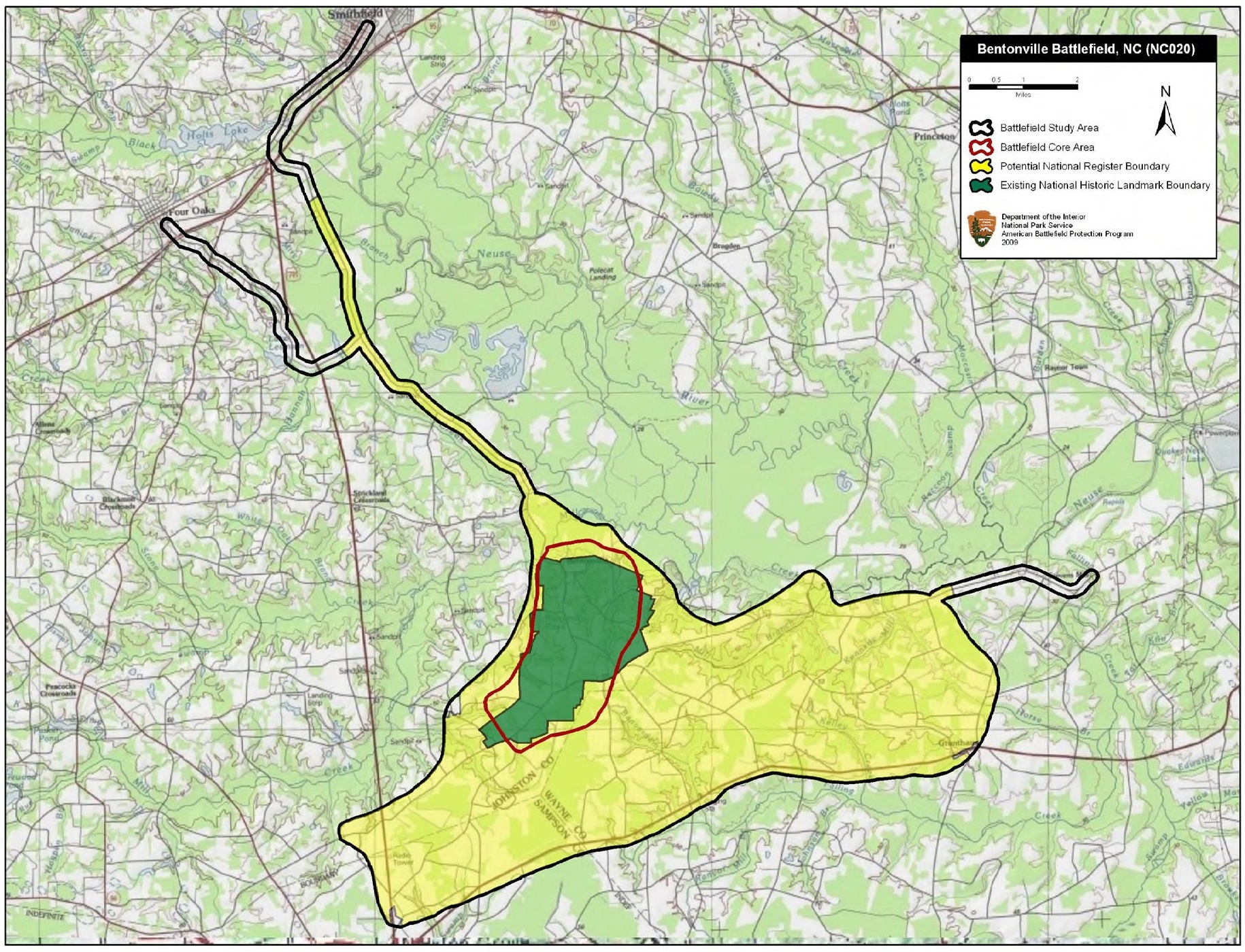
The battlefield is preserved today as the Bentonville Battleground State Historic Site, designated a National Historic Landmark in 1996. The park, founded in 1965, centers on the restored Harper House, a handsome 1850s farmstead that served as a Union field hospital during the fighting. Visitors can walk the grounds where Morgan's men held against three-sided assault, trace the route of Mower's audacious charge, and stand where Johnston marshaled his desperate defense. The American Battlefield Trust and the Bentonville Battlefield Historical Association have together acquired and preserved additional acreage in more than 55 separate land acquisitions since 1990. The quiet Carolina landscape belies the ferocity of what happened here, but the monuments and interpretive trails ensure that the story of the Confederacy's last stand in the west endures.
From the Air
Located at 35.31°N, 78.32°W in Johnston County, North Carolina. The battlefield lies in flat, rural terrain south of the village of Bentonville. Best viewed at 2,000-3,000 feet AGL. The nearest airports are Raleigh-Durham International (KRDU, approximately 40 nm northwest) and Seymour Johnson AFB (KGSB, approximately 25 nm east near Goldsboro). The battlefield's clearing and monument areas are visible against the surrounding pine forest in clear conditions.