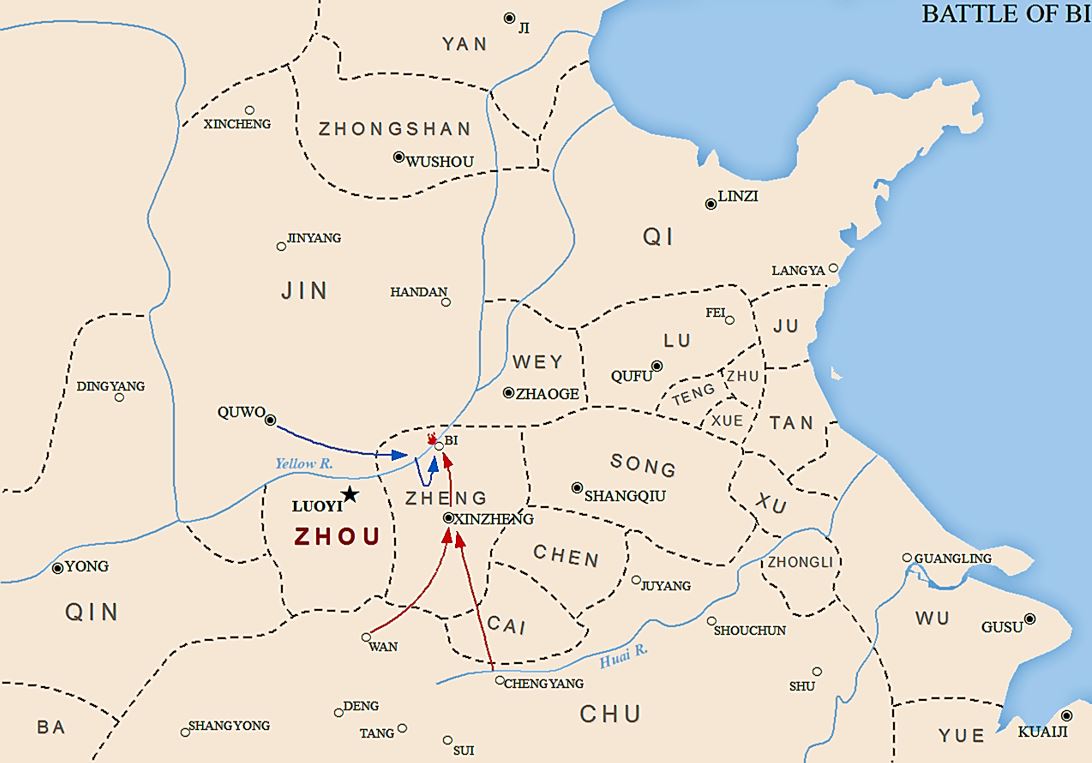
Battle of Bi
Neither side wanted to fight. That is what makes the Battle of Bi, fought in 597 BC during the Spring and Autumn period, such a remarkable study in how wars begin despite the intentions of the men who wage them. King Zhuang of Chu was intimidated by the Jin army facing him. Jin's commander Xun Linfu wanted to retreat. Both armies had been maneuvering toward a negotiated truce. Then two Jin generals, frustrated by their commander's hesitation, decided to provoke the Chu forces on their own initiative -- and the resulting chain of misunderstandings triggered a battle that neither king nor commander had sought.
The Rivalry Behind the Battle
Jin and Chu had been the two dominant powers of the Spring and Autumn period, but their rivalry was shaped by a deep cultural asymmetry. Jin was a legitimate Zhou state, rooted in the political and cultural traditions of the northern Chinese heartland. Chu controlled territory in the middle Yangtze River valley, encompassing many non-Chinese cultures, and was considered at best half-civilized by northern standards. Three and a half decades before Bi, Jin had decisively defeated Chu at the Battle of Chengpu, establishing Duke Wen of Jin as hegemon among the vassal states. Chu had spent the intervening years seeking an opportunity to reverse that humiliation. When a rapid succession of deaths weakened Jin's leadership in the late 600s BC -- Zhao Dun in 601, Duke Cheng in 600, Xi Que in 598 -- King Zhuang of Chu saw his opening and marched north.
A Battle No One Ordered
King Zhuang's campaign targeted Zheng, a Jin ally, and succeeded in forcing Zheng to switch allegiance. When Xun Linfu arrived with the Jin army to relieve Zheng, only to find it had already surrendered, he favored retreat. But his adjutant Xian Hu refused to accept what he considered cowardice from the hegemonic state and led his own troops across the Yellow River without orders, forcing the rest of the army to follow. On the Chu side, King Zhuang was equally reluctant -- even his commander Sunshu Ao initially favored withdrawal. It was the Chu officer Wu Can who argued for battle, pointing out that Xun Linfu was inexperienced, Xian Hu was rash, and the Jin commanders were divided against each other.
Dust, Confusion, and Collapse
The trigger was almost absurdly accidental. Two more Jin generals, dissatisfied with Xun Linfu's dithering, rode out to provoke the Chu forces on their own. King Zhuang personally pursued them. When Xun Linfu sent a relief force to escort the rogue generals back to Jin lines, the dust cloud raised by the approaching troops was mistaken -- by the Chu side -- for a general Jin advance. Fearing King Zhuang would be cut off, Sunshu Ao ordered an immediate full attack. The unexpected onslaught hit the disorganized Jin forces like a wave striking sand. Jin's army collapsed and was routed. What had begun as a series of unauthorized provocations ended as the most significant military defeat Jin had suffered in a generation.
Mercy at the Yellow River
King Zhuang's conduct after the victory defined his legacy as much as the battle itself. He led his generals to water their horses in the Yellow River -- a symbolic act of triumph over a northern rival. When his officers requested permission to pursue and destroy the retreating Jin forces, the king refused. The humiliation of Chengpu had been avenged, he declared, and there was no need for further slaughter. This restraint earned King Zhuang recognition as one of the Five Hegemons of the Spring and Autumn period, a ruler who wielded power with wisdom rather than cruelty. The Battle of Bi did not end the Jin-Chu rivalry, but it established that the rivalry would henceforth be between equals.
From the Air
The battle took place near present-day coordinates 34.788N, 113.392E, in the area near Xingyang, Henan province, along the Yellow River's northern reaches. Nearest major airport is Zhengzhou Xinzheng International (ZHCC/CGO), approximately 30 km to the southeast. The Yellow River is the dominant terrain feature and key navigation reference. Best viewed at 5,000-8,000 feet altitude where the river's course through the plains is clearly visible.