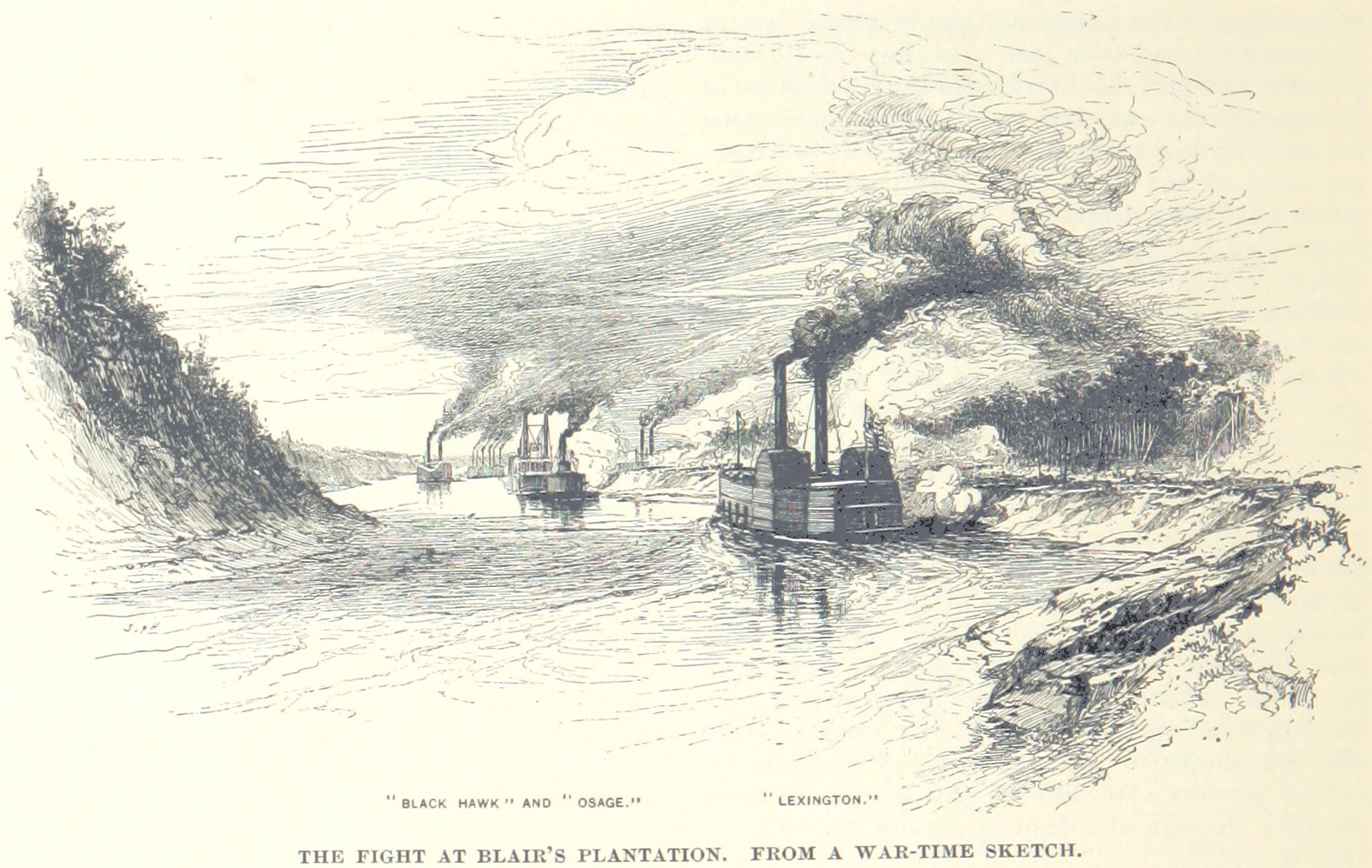
Battle of Blair's Landing
One Texan who served under Brigadier General Tom Green recalled that he "was a man who, when out of whiskey, was a mild mannered gentleman, but when in good supply of old burst-head was all fight." On the afternoon of April 12, 1864, Green proved the observation fatally accurate. After an all-night cavalry march through the Louisiana backcountry, he arrived at Blair's Plantation on the Red River to find a Union fleet in disarray -- gunboats grounded on sandbars, transports tangled together, horses and soldiers crammed aboard vessels that could barely move in the dropping water. Green saw an opportunity to destroy the retreating flotilla of Rear Admiral David Dixon Porter. What followed was an hour of furious combat between cavalry on the bluffs and ironclads in the shallows, ending with one of the most dramatic deaths of the entire Red River Campaign.
A Fleet in Reverse
The Union expedition on the Red River had turned into a fiasco. President Lincoln and General Halleck had ordered a push up the Red River toward Shreveport to establish a Union foothold in Texas. Major General Nathaniel Banks led the land forces while Porter commanded six gunboats, two monitors, and twenty river transports carrying 2,500 soldiers under Brigadier General Thomas Kilby Smith. But the river was falling fast, and the Confederates had sunk the steamboat New Falls City, loaded with bricks and mud, across the channel near Springfield Landing. When a courier arrived with news that Banks had been beaten at the Battle of Mansfield on April 8, Porter had no choice but to turn around. The river was so narrow the ships could not turn -- they had to reverse downstream, stern-first, for hours before finding room to swing bow-forward. By April 12, the battered fleet had limped to Blair's Landing with vessels damaged by snags, stumps, collisions, and sandbars.
Horsemen Against Ironclads
Confederate General Richard Taylor, left with only 5,200 troops after his superior sent most of the infantry to Arkansas, ordered Tom Green to intercept Porter's fleet. Green set out at 6:00 pm on April 11 with roughly 1,000 dismounted cavalrymen from the 12th, 23rd, and 36th Texas Cavalry Regiments and a section of the Grosse Tete Flying Artillery. He crossed Bayou Pierre at Jordon's Ferry with difficulty, getting only three cannons across, and pushed his men through the night. Arriving at Blair's Plantation that afternoon, Green found the transport Alice Vivian, loaded with 400 horses, hard aground in mid-stream with the monitor Osage stuck right behind her. The transport Black Hawk was lashed alongside the Osage, and the Lexington sat near the east bank. Green's men crept through the trees on the bluff above the riverbank -- but the pilot of the Black Hawk spotted them and sounded the alarm.
Not Six Inches Without a Bullet
The fighting erupted into a storm of small arms fire from both sides. The Confederates were shielded by the high riverbank; the Union soldiers aboard the transports crouched behind cotton bales and sacks of oats. Guns on the transport Emerald, a howitzer on the Black Hawk, and four heavy Parrott rifles on the Rob Roy poured fire into the bluffs. The volume of musketry grew so intense that the Black Hawk's crew abandoned their vessel and took shelter aboard the armored Osage. Porter later remarked that "there was not a place six inches square that was not perforated by a bullet" on the Black Hawk. The Osage freed herself from the sandbar, moved toward the west bank, and opened fire with her heavy guns. When canister and grapeshot ran out, the gunners improvised, loading shrapnel shells with one-second fuses that detonated almost at the muzzle. The Confederate artillery horses were killed, forcing the Texans to drag their cannons by hand to new positions.
The Man on the White Horse
When the Neosho arrived and joined the Lexington and Fort Hindman in raking the west bank, and the Alice Vivian finally drifted free of the shoal, every Confederate cannon was out of action. Green decided to charge. The water in places was only shoulder-deep to a horse, making a mounted assault conceivable if reckless. Green rode to the men of Colonel Peter Woods' 36th Texas and yelled that he was going to show them how to fight. Aboard the Osage, Lieutenant Thomas Oliver Selfridge Jr. spotted an officer on a white horse standing on the riverbank and ordered a cannon fired at him. The figure disappeared. Tom Green had been killed by an artillery projectile that took the top of his head off. The battle ended at dusk, having lasted about an hour. Confederate General Taylor called Green's death "an irreparable" loss. The National Park Service records 60 Union and 57 Confederate casualties from the engagement.
Smoke-Stacks Like Pepper Boxes
The Union fleet pressed downriver through the night, anchoring at 1:00 am. The ordeal was far from over. The next day, the transport John Warner ran hard aground, and Confederate forces under General Liddell set up small guns on a bluff at Bouledeau's Point to harass the stalled fleet. Banks sent reinforcements who marched overland to Campti, drove off Liddell, and escorted the battered vessels back to Grand Ecore. The last stragglers arrived on April 16. A witness who saw the fleet described vessels riddled with holes and smoke-stacks that looked like "pepper boxes." When the relief force left Campti, they burned the town to the ground. The engagement at Blair's Landing was a small battle in the larger catastrophe of the Red River Campaign, but it produced one of the war's most vivid scenes: a general on a white horse, charging gunboats in shallow water, silenced by a single well-aimed shot.
From the Air
Located at 31.941N, 93.289W along the Red River in Red River Parish, Louisiana. From altitude, the Red River's distinctive reddish-brown course is clearly visible winding through the northwest Louisiana lowlands. Blair's Landing sits on the river where the channel narrows -- the same geography that trapped Porter's fleet in 1864. The terrain is flat agricultural land with dense tree lines along the riverbanks. Nearest airport is Natchitoches Regional (KIER), approximately 40 miles southeast. Alexandria International (KAEX) is about 80 miles south. Shreveport Regional (KSHV) lies roughly 75 miles north-northwest. Best viewed at 2,000-3,000 feet AGL to appreciate the river's winding course and the bluffs that gave the Confederates their firing positions.