Battle of Bloody Marsh
The war started with an ear. In 1731, Spanish coast guards boarded the British brig Rebecca off Florida and found its captain, Robert Jenkins, smuggling. They cut off his ear for piracy. Eight years later, Parliament dusted off the nearly forgotten incident to rally public opinion, and Britain declared war on Spain. The conflict they called the War of Jenkins' Ear would stretch from the Caribbean to the Georgia coast, and on a rainy July afternoon in 1742, it came down to a handful of British soldiers crouching behind palmetto trees on St. Simons Island, waiting for the Spanish to walk into range.
Oglethorpe's Gamble on the Golden Isles
James Oglethorpe founded Georgia in 1733 as a place for England's poor debtors to start over. But the colony sat squarely in the contested territory between British South Carolina and Spanish Florida - land Europeans called the "Debatable Land." Oglethorpe understood that Georgia would survive only if it could be defended. With Native American guides, he selected St. Simons Island for a fortified town and persuaded Parliament to fund a military garrison. In 1736, settlers arrived by boat to found Frederica, building the town and its fort on a bend of the Frederica River to control approaches from both directions. Oglethorpe recruited Scottish Highlanders from Inverness to settle at Darien on the mainland, forming the Highland Independent Company. Two forts stood five miles apart on the island, connected by a single wagon-width track called Military Road.
Five Thousand Against a Thousand
Spanish Governor Manuel de Montiano assembled an invasion force of up to 5,000 men, with roughly 2,000 ground assault troops. Oglethorpe had fewer than 1,000 - regulars, militia, and Native American allies. On July 5, 1742, Montiano landed nearly 1,900 men from 36 ships near Gascoigne Bluff. Fort St. Simons fired its cannons but could not stop the landing. Oglethorpe made the hard decision to abandon Fort St. Simons, ordering his garrison to spike the guns and damage the fortifications to deny the Spanish a usable position. The Spanish occupied the ruins the next day and used them as a base. Two days later, a Spanish reconnaissance column of 115 men pushed up Military Road toward Frederica, assuming it was merely a farm track. Near the fort, they met British soldiers under Noble Jones, who routed them and killed or captured nearly a third of their number.
Muskets in the Marsh
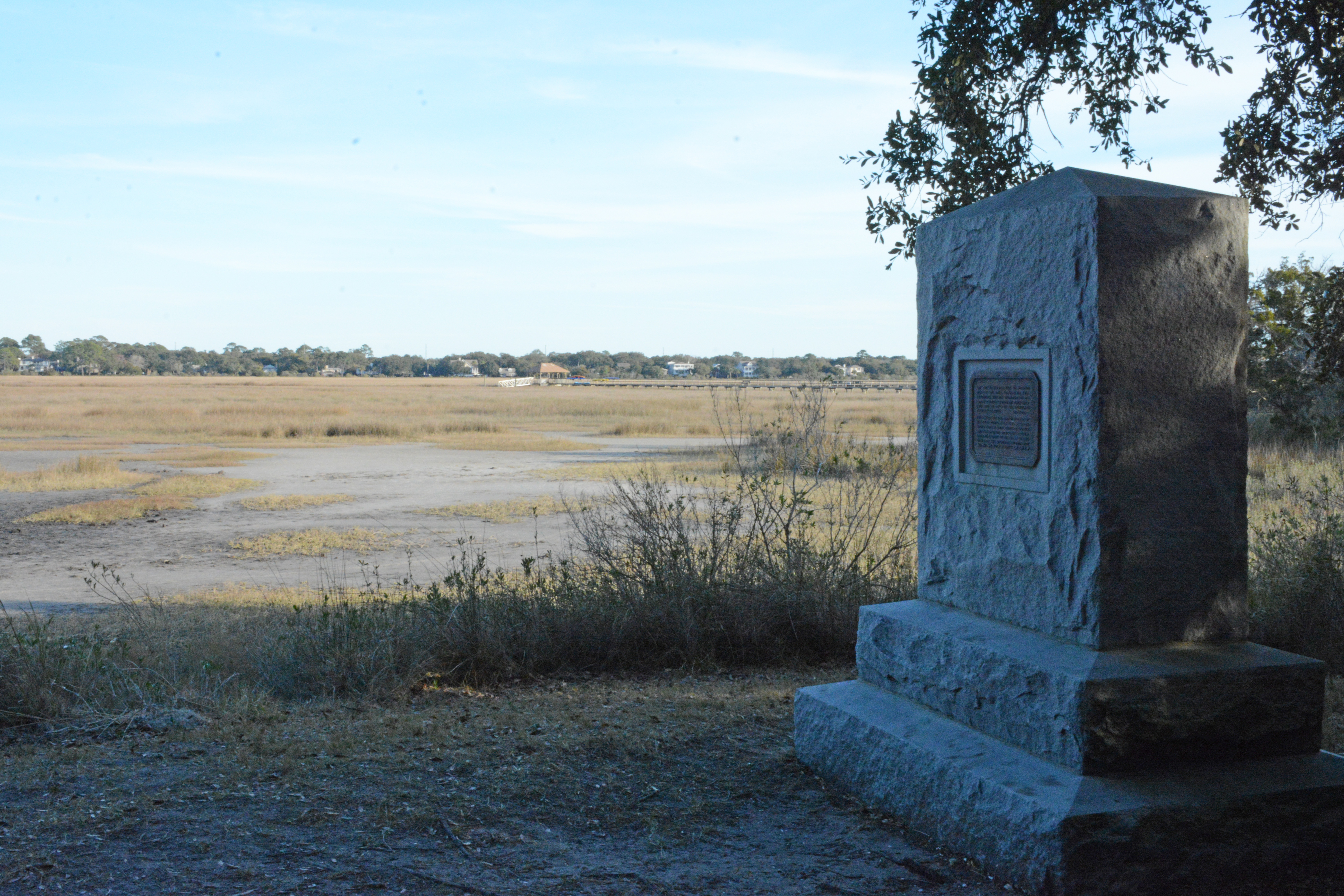
Pursuing the retreating Spanish, the British advance party ran into fresh enemy reinforcements and fell back. At a bend in the road, Lieutenants Southerland and Macoy ordered their men to stop. The soldiers took cover in a semicircle behind trees and palmettos around a clearing, watching the marshy ground ahead. When the Spanish came into view, the British unleashed multiple volleys from concealment. Rain began to fall, and musket smoke hung in the humid air until neither side could see the other clearly. Half the British broke ranks in confusion. Oglethorpe himself had left to fetch reinforcements, leaving his men without their commander. The Spanish, despite outnumbering the defenders, never pressed their advantage. After an hour, they ran out of ammunition and retreated toward Fort St. Simons. The engagement killed seven Spaniards and a few British soldiers. Tradition held that the marsh ran red with blood, giving the battle its name - though Spanish records suggest the casualty count was modest.
The Letter That Won the War
Oglethorpe was not finished. Learning that a French deserter had fled to the Spanish camp, he feared the man would reveal how pitifully small the British force actually was. So Oglethorpe crafted a deception. He wrote a letter to the deserter, addressing him as if he were a British spy, instructing him to keep up his stories until reinforcements arrived. He arranged for a prisoner to carry the letter - knowing the man would hand it straight to the Spanish officers. Montiano took the bait: he executed the Frenchman as a double agent. When British ships arrived shortly after, the Spanish interpreted them as the reinforcements mentioned in the letter. On July 25, Montiano withdrew from St. Simons Island entirely. Spain never again attempted to invade colonial Georgia.
The Marsh Remembers
The Treaty of Aix-la-Chapelle ended the war in 1748 and formally recognized Georgia as a British colony. Spain ratified the arrangement in the Treaty of Madrid. Georgia's position was further cemented in 1763 when Spain ceded Florida to Britain under the Treaty of Paris. Oglethorpe, promoted to brigadier general, left Georgia around 1744, married an English heiress, and never returned. The battle site on St. Simons Island is now part of Fort Frederica National Monument. A stone marker stands in the marsh where the skirmish took place, and Wormsloe Plantation in Savannah holds an annual commemoration of the War of Jenkins' Ear. The marsh itself remains - tidal, green, quiet - offering little hint that a confused hour of musket fire here once decided which European empire would hold the coast of Georgia.
From the Air
Located at 31.157N, 81.380W on St. Simons Island, one of Georgia's Golden Isles barrier islands. The Bloody Marsh battle site is a component of Fort Frederica National Monument, visible as a cleared area with a stone marker amid the island's salt marshes and live oak canopy. St. Simons Island is roughly 18 miles long and easily identified from the air by its distinctive shape and the Sidney Lanier Bridge connecting it to the mainland at Brunswick. McKinnon St. Simons Island Airport (KSSI) is on the island's south end, approximately 3 nm south. Brunswick Golden Isles Airport (KBQK) is 8 nm to the northwest. Jekyll Island is visible to the south across St. Simons Sound. Best viewed at 1,500-3,000 ft AGL. Expect coastal weather patterns with frequent afternoon sea breezes.