Battle of Blue Licks
"Them that ain't cowards, follow me." With those words, Major Hugh McGary spurred his horse across the Licking River ford on the morning of August 19, 1782, and 182 Kentucky militiamen followed him straight into a trap. Daniel Boone, watching from the riverbank, understood exactly what was about to happen. "We are all slaughtered men," he said, and crossed the river anyway. The war in the east had been over for ten months -- Cornwallis had surrendered at Yorktown the previous October -- but here on the Kentucky frontier, the Revolution's ugliest chapter was still being written.
A War That Refused to End
The frontier did not recognize Yorktown. While diplomats in Paris negotiated the peace that would formally end the Revolution, the western borderlands burned hotter than ever. British agents operating out of Fort Detroit continued to arm and coordinate Indigenous warriors -- Shawnee, Mingo, Wyandot, Miami, Odawa, Ojibwe, and Potawatomi -- in a sustained campaign to drive American settlers back across the Appalachians. In July 1782, British Indian Department officials met with their allies at the Shawnee village of Wakatomika, near the headwaters of the Mad River. Captain William Caldwell and his company of Butler's Rangers joined several hundred warriors in a combined force that first targeted Wheeling on the upper Ohio, then pivoted south when scouts reported George Rogers Clark -- the one American commander the Indigenous nations genuinely feared -- was preparing an invasion.
The Siege No One Remembers
Caldwell's force crossed the Ohio into Kentucky in August with roughly 300 Indigenous warriors, accompanied by Alexander McKee and the notorious Simon Girty of the British Indian Department. Their target was Bryan Station, a settlement near Lexington. The settlers had been warned, though, and sheltered inside their stockade. Caldwell besieged the station beginning at dawn on August 15, but without artillery he knew the fort would hold. His men destroyed the crops, burned outlying buildings, and slaughtered livestock before withdrawing on August 17 when Kentucky militia reinforcements approached. The raiders left a trail so obvious it practically begged to be followed -- and that was the point. Caldwell was not retreating. He was setting a trap at a place called the Lower Blue Licks, a salt spring on the Licking River where the terrain would do the killing for him.
The Reckoning at the Ford
The militia arrived at the Licking River on August 19 and spotted Indigenous scouts watching from across the ford. Behind them rose a hill wrapped in a bend of the river -- perfect ambush ground. Colonel John Todd convened a council and turned to Boone, the most experienced woodsman among them. Boone saw through it immediately: the trail was too obvious, the signs of force carefully obscured. He urged them to wait for Benjamin Logan's reinforcements, just a day away. But McGary, described by contemporaries as both fierce and dangerously unstable, would not wait. He rode into the ford alone, daring the others to follow. Officers scrambled after him, hoping to restore order. The militia charged up the hill into a devastating crossfire from 50 Rangers and 300 warriors. The battle was brief and catastrophic. Among 182 Kentuckians, roughly 70 were killed, including Colonel Todd and Lieutenant Colonel Stephen Trigg.
Vengeance and Its Cost
George Rogers Clark, who had not been present at Blue Licks, was blamed for allowing the British-Indigenous force to penetrate so deeply into Kentucky. In November 1782, he launched the last major offensive of the American Revolution with over 1,000 men, including both Logan and Boone. They destroyed five unoccupied Shawnee villages on the Great Miami River, though the Shawnee refused to stand and fight, falling back to their Mad River settlements. Clark reported ten Indigenous warriors killed, seven captured, and two white captives recovered, against his own losses of one killed and one wounded. But the cycle of violence spiraled further. Four years later, McGary -- the man whose recklessness had triggered the Blue Licks disaster -- accompanied Logan's expedition against the Mad River villages. He confronted Shawnee chief Moluntha and asked if he had been at Blue Licks. Moluntha, who had surrendered peacefully and stood holding an American flag and a signed peace treaty, misunderstood the question and nodded. McGary killed him with a tomahawk.
What the Hill Remembers
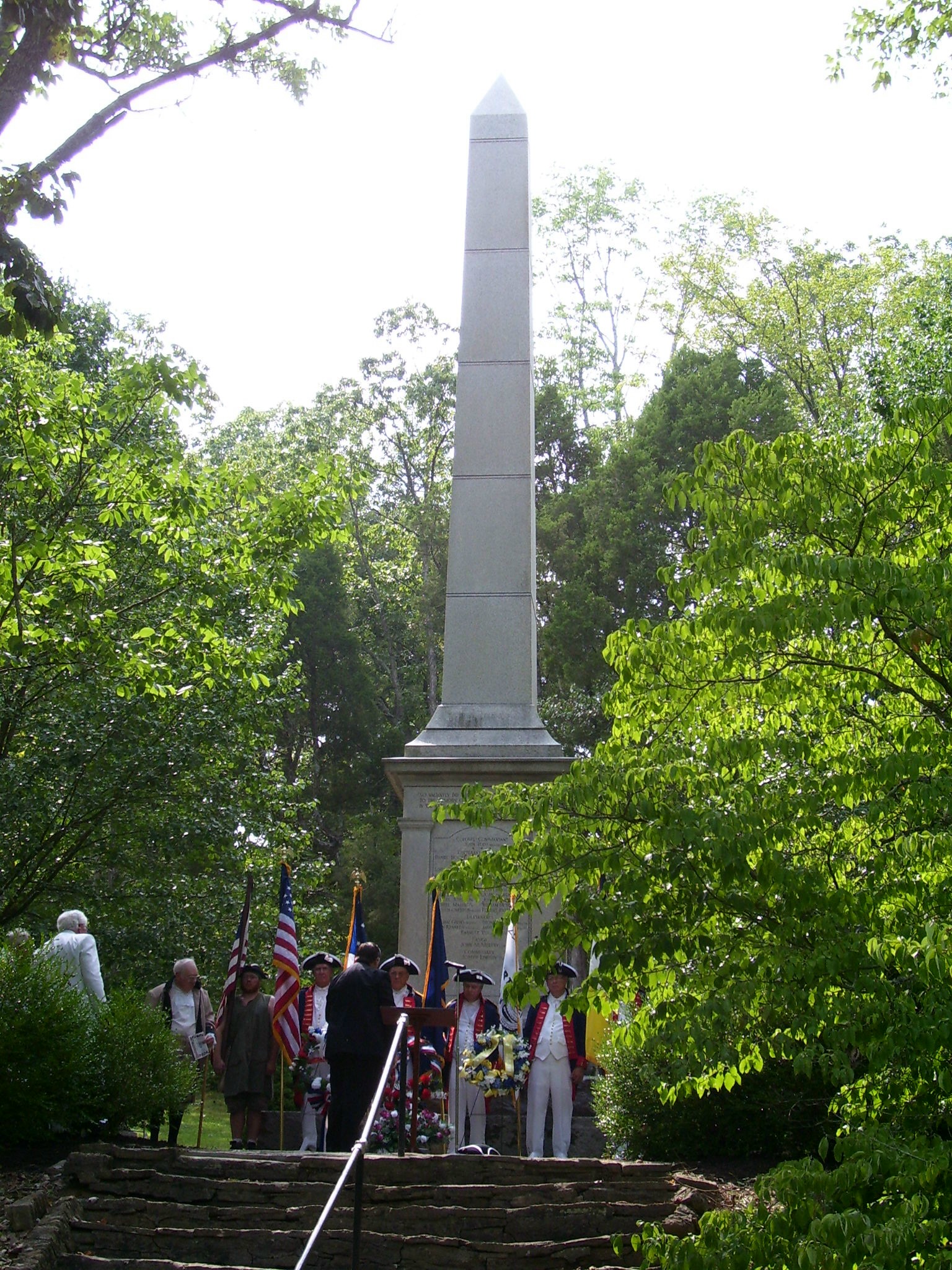
The battlefield sits in what is now Robertson County, Kentucky, marked by Blue Licks Battlefield State Resort Park along U.S. Route 68 north of Carlisle. A 45-foot granite obelisk erected in 1928 stands on the hill where the ambush unfolded. The park includes a pioneer museum, the Worthington Lodge, and the Hidden Waters Restaurant. Every third weekend of August, a reenactment and memorial service draws visitors to this quiet bend in the Licking River. The landscape has softened over two centuries -- the salt licks that gave the place its name, the ford where McGary made his fateful crossing, the slope where Boone fought and survived while so many around him did not. It is a place that remembers how the American Revolution ended not with a grand surrender but with small, brutal engagements fought by men who did not yet know the war was over.
From the Air
Located at 38.43°N, 83.99°W in Robertson County, Kentucky, along the Licking River. The battlefield site is at Blue Licks Battlefield State Resort Park on U.S. Route 68. From altitude, look for the river's distinctive looping bend -- the hill where the ambush occurred sits within the curve. The terrain is rolling Kentucky hills with scattered timber. Nearest airports: Blue Grass Airport (KLEX) approximately 50nm southwest in Lexington; Cincinnati/Northern Kentucky International (KCVG) approximately 55nm north. The river and surrounding ridgeline are visible from 3,000-5,000 ft AGL. Best viewing in clear conditions with fall foliage adding contrast to the river valley.