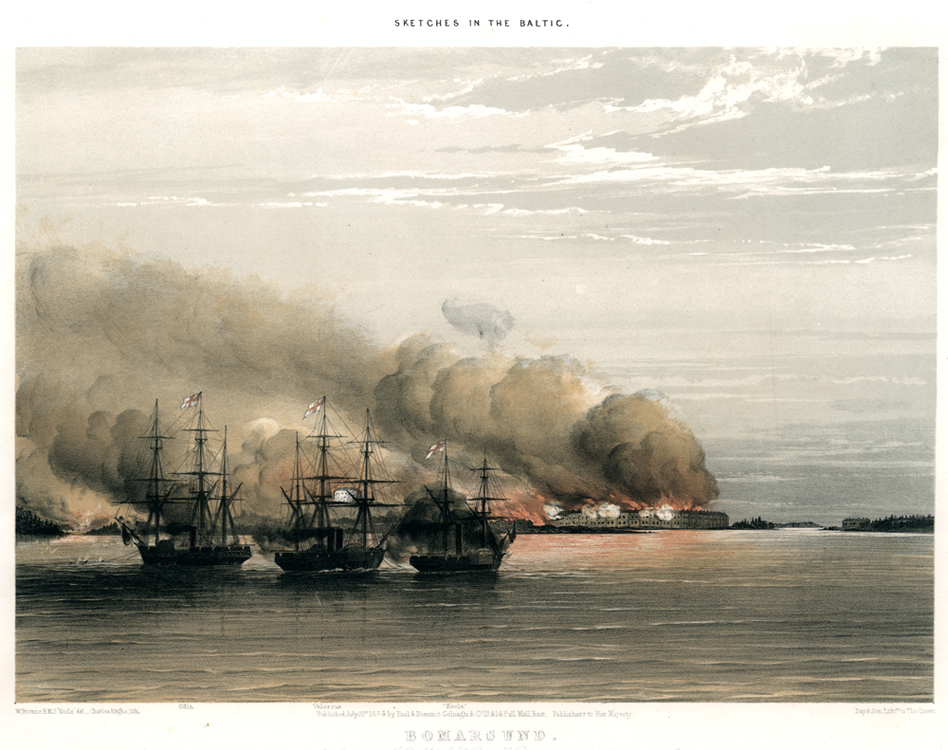
Battle of Bomarsund
The gunpowder magazine exploded on August 15, 1854, sending the captured tower of Brannklint crumbling into rubble. Russian artillery had scored a direct hit on the position their own defenders had abandoned just days before, preferring destruction to surrender. Here in the Aland Islands, far from the Black Sea where the Crimean War raged, an Anglo-French fleet had proven that the age of sailing ships was over and that Russia's Baltic ambitions could be checked by steam power and determination.
An Unfinished Citadel
Construction began in 1832 when Russian engineers chose this narrow strait in Sund to build a fortress that would command the Baltic approaches. Bomarsund was designed with twelve subsidiary towers supporting a central fortification, an imposing statement of imperial power. But by the time war erupted in 1854, only two towers had been completed. The fortress designers had made a critical miscalculation: they assumed the shallow, treacherous channels surrounding the site would prevent large naval vessels from approaching vulnerable sectors. This assumption held true in the age of sail, when ships depended on wind and current. Steam-powered vessels changed everything.
Twenty-Five Ships Against the Fortress
By late July 1854, a British fleet of twenty-five ships had surrounded Bomarsund, their smokestacks belching coal smoke across the Baltic sky. The commanders understood that naval guns alone could not reduce the fortress; they needed infantry. French ground troops arrived in August, and the siege began in earnest. The Russian garrison, knowing their position was hopeless, had already scorched the surrounding countryside to deny supplies to the invaders. On August 13, French artillery opened fire on the Brannklint tower. By nightfall, as cannons suppressed the defenders, French infantry stormed the position. The defenders withdrew to the main fort, leaving a skeleton crew to demolish what they could not hold. The French captured the tower before it could be destroyed, but their victory was brief. Russian gunners turned their own artillery on the fallen position, and two days later, the powder magazine erupted.
The Grenadiers Who Came Home Singing
Among the three hundred soldiers captured at Bomarsund were Finnish grenadiers who had defended the fortress for the Russian Empire. They were transported to Lewes, England, where they remained prisoners until the war's end. When peace came, they were given passage home to Finland, carrying with them a song born of their wartime experience. The Oolannin sota, or War of Aland, became a lasting folk memory of the conflict. In 1877, a Russian Memorial was erected in Lewes to honor those prisoners who died far from home. The fortress itself was demolished by the victors, its stones scattered, its threat eliminated.
Islands Without Armies
The Treaty of Paris in 1856 did more than end the Crimean War. For the Aland Islands, it mandated complete demilitarization, a status that has endured into the present day. No fortifications would rise again where Bomarsund once stood. The islands that guarded the approaches to Stockholm, St. Petersburg, and the Gulf of Bothnia would remain neutral ground. Victoria Crosses were awarded to several British servicemen for actions in the Baltic theater, including John Bythesea and William Johnstone for their valor at the Aland Islands. The battle proved that even remote strategic positions could be contested by modern naval power, a lesson that would reshape military thinking for decades to come.
From the Air
Located at 60.21N, 20.24E on Sund island in the Aland archipelago. The fortress ruins lie along the narrow strait between islands. Nearest airport is Mariehamn Airport (EFMA) approximately 25 km southwest. Best viewed at 2,000-3,000 feet to see the defensive positioning along the waterway. The surrounding islands and channels that once seemed impassable to sailing ships are clearly visible from altitude.