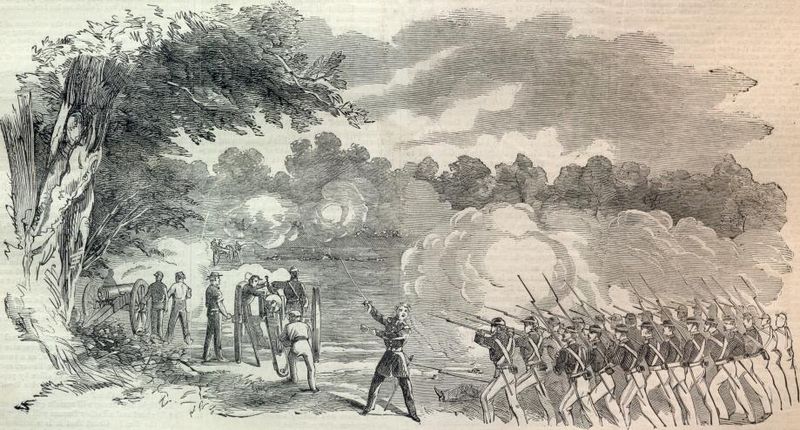
Battle of Boonville
'This means war. In an hour one of my officers will call for you and conduct you out of my lines.' With those words on June 11, 1861, Brigadier General Nathaniel Lyon ended any pretense of negotiation with Missouri's secessionist Governor Claiborne Jackson at the Planter's House hotel in St. Louis. Six days later, Lyon's troops steamed up the Missouri River to Boonville, where the State Guard was assembling under orders to protect the capital at Jefferson City. The fight that followed lasted barely twenty minutes and produced minimal casualties, but its strategic impact was enormous -- far out of proportion to the gunpowder spent. Locals called it 'The Boonville Races,' because the State Guard ran so fast.
The Meeting That Broke Missouri
Missouri in 1861 was a slave state that had not seceded, governed by men who wanted to leave the Union while its largest city, St. Louis, was firmly pro-Union. General William Harney, the Federal commander, had negotiated a fragile truce with Governor Jackson and General Sterling Price, but Missouri Unionists bombarded Washington with demands for Harney's removal. On May 30, Nathaniel Lyon replaced him. Lyon met Jackson and Price at the Planter's House on June 11, where the governor demanded that Federal forces stay confined to St. Louis and that pro-Union militia companies be disbanded. Lyon, according to the governor's own secretary, declared he would rather see every man, woman, and child in the state dead than allow Jackson to dictate terms. Jackson and Price fled the city, ordering railroad bridges burned to delay pursuit. Lyon followed by steamboat.
Twenty Minutes on the Bluffs
Lyon's command encountered State Guard pickets as they approached the bluffs above Boonville on June 17. He deployed skirmishers and pushed forward aggressively. Captain Totten's battery -- Company F, 2nd U.S. Light Artillery -- quickly displaced sharpshooters stationed in the William Adams house. Union infantry closed with the line of guardsmen and fired several volleys, causing an immediate retreat. Attempts to rally collapsed when a Union company flanked the Guard's position, supported by cannon fire from a light howitzer mounted on the river steamer Augustus McDowell. The retreat became a rout. The guardsmen fled through Camp Bacon and the town of Boonville, some scattering to their homes, while the rest followed the governor toward Missouri's southwest corner. Lyon occupied Boonville by 11 a.m.
The Spoils and the Reckoning
Federal casualties amounted to five killed or mortally wounded and seven less seriously injured. The State Guard lost approximately five dead and ten wounded, with 60 to 80 captured. Lyon seized the Guard's supplies: two iron 6-pounder cannons without ammunition, 500 obsolete flintlock muskets, 1,200 pairs of shoes, a few tents, and food. The numbers tell a story of an army barely equipped for the fight it was picking. The captured equipment -- antique muskets, shoeless soldiers, cannons without shot -- revealed just how unprepared Missouri's secessionists were for war.
A Small Fight with Large Consequences
The Battle of Boonville ejected secessionist forces from the center of Missouri and effectively secured the state for the Union. Communications between Confederate sympathizers and the strongly pro-Southern Missouri River valley were cut. Would-be recruits from slave-owning counties north of the river could no longer easily reach Southern armies. Sterling Price realized he could not hold Lexington and retreated, though he would return three months later to briefly retake the city. The Missouri State Guard would go on to win at Wilson's Creek and Lexington, but the early demoralization from Boonville haunted them. Colonel John S. Marmaduke, disgusted by the performance, resigned from the State Guard to seek a regular Confederate commission. He and Price would team up again during Price's Missouri Raid of 1864, only to suffer final defeat at the Battle of Westport on October 23 of that year.
Four Battles, One Town
Boonville would see three more Civil War engagements, all minor. On September 13, 1861, 800 State Guard troops attacked 140 Union Home Guardsmen at breakfast. Rain forced the Confederates to wrap their flags in black sheeting, which the defenders mistook for a no-quarter signal. Believing it was victory or death, the 140 men fought so fiercely they defeated the 800, killing their commander, Colonel William Brown. The Third Battle of Boonville occurred during Shelby's Great Raid on October 11, 1863, when General Joseph Shelby's troops engaged Union forces before retreating when reinforcements arrived. The Fourth, on October 11, 1864, saw elements of Price's Army of Missouri briefly occupy the town during the same ill-fated raid that would end at Westport. Boonville kept finding itself at the crossroads of Missouri's war.
From the Air
Located at 38.9765°N, 92.7430°W along the Missouri River in Cooper County, Missouri, at approximately 700 feet MSL. Boonville sits on the south bank of the Missouri River in the fertile river valley known as 'Little Dixie' for its pro-Confederate sympathies during the Civil War. The town features over 400 structures on the National Register of Historic Places. Nearest airports include Boonville Jesse Viertel Memorial Airport and Columbia Regional Airport (KCOU) approximately 25 nm east. The Missouri River traces a broad curve past the bluffs where the battle took place. Best viewed at 2,000-4,000 feet AGL to see the river, bluffs, and historic town layout.