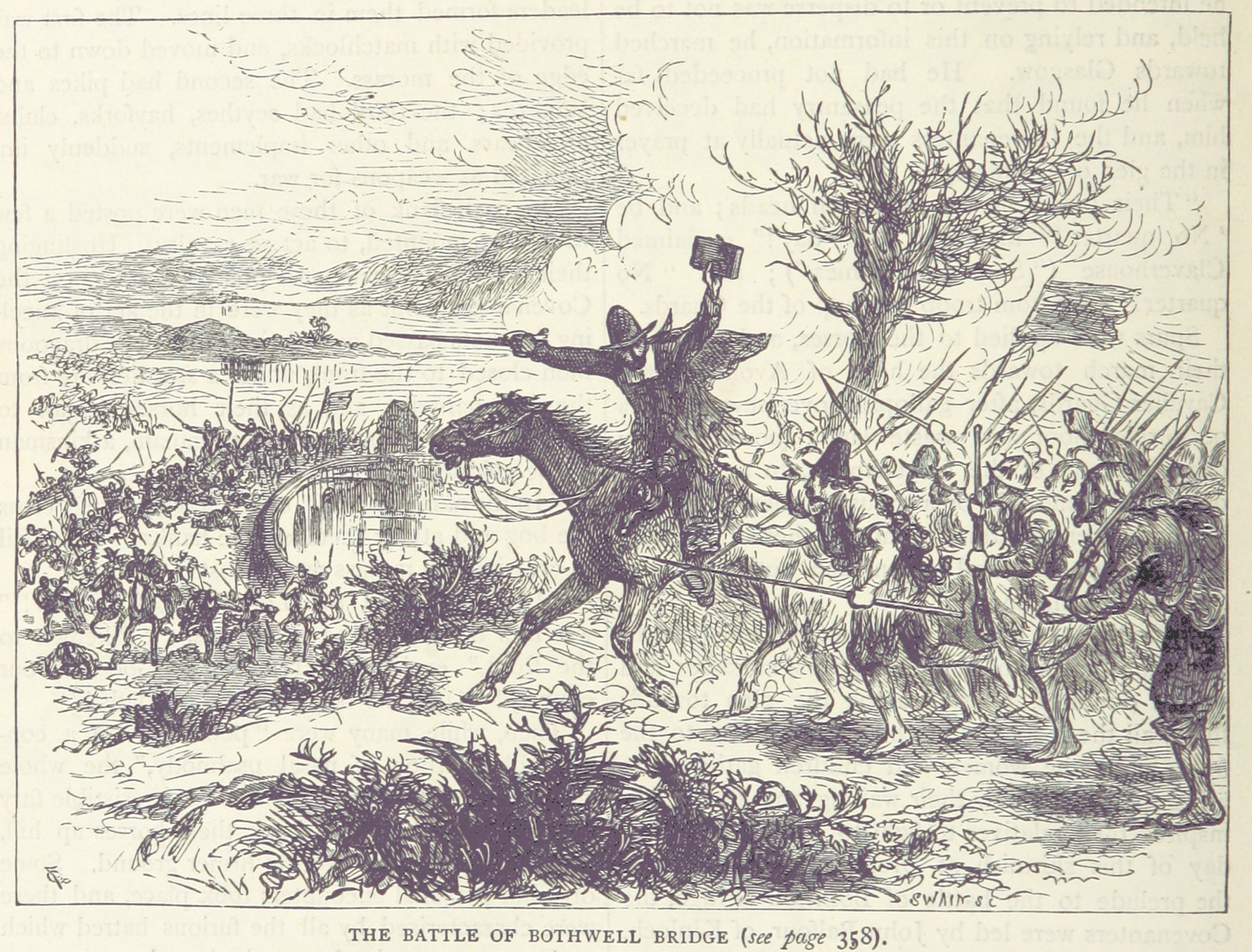
Battle of Bothwell Bridge
Three weeks was all it lasted. The Covenanter rebellion that had begun so promisingly at Drumclog, where armed Presbyterians routed government dragoons on a boggy moor, ended on 22 June 1679 at a narrow bridge over the River Clyde between Hamilton and Bothwell. On one side stood 6,000 Covenanters, poorly disciplined and bitterly divided by the theological disputes that had defined their movement from the start. On the other, 5,000 professional soldiers under the Duke of Monmouth, reinforced by the very commander they had humiliated at Drumclog: John Graham of Claverhouse. The bridge between them was about to become a threshold between rebellion and ruin.
An Army at War With Itself
The Covenanters' greatest enemy at Bothwell Bridge was not the government army but their own disunity. Nominally led by Robert Hamilton of Preston, the rebel force included figures from across the Presbyterian spectrum, and they could agree on little beyond their opposition to Episcopal church governance. Hamilton's rigid stance against the "Indulged" ministers who had accepted government compromise deepened divisions at precisely the moment when unity was essential. Among the ranks were the preacher Donald Cargill, William Cleland the hero of Drumclog, and David Hackston of Rathillet, who had been involved in the assassination of Archbishop Sharp weeks earlier. James Ure of Shirgarton, who led 200 men from Stirlingshire, later wrote a candid account of why the Covenanters lost: they could not stop arguing long enough to fight.
The Bridge
The battle's geography reduced everything to a single question: who would control the narrow bridge across the Clyde. Hackston took charge of its defence and held the crossing with some initial success, his men trading fire with Monmouth's advance troops in close-range skirmishes at the bridge itself. For roughly an hour, the defenders kept the government army on the northern bank. But they lacked artillery and their ammunition ran short. When Hackston's men were finally forced to withdraw, Monmouth's troops poured across, and what had been a battle became a rout. The Covenanters broke and fled, many retreating into the grounds of nearby Hamilton Palace, whose owner, Duchess Anne, was sympathetic to the Presbyterian cause. The final engagements took place there, amid the ornamental parks of one of Scotland's grandest houses.
Greyfriars and the Killing Time
Around 1,200 Covenanters were captured. The prisoners were marched to Edinburgh and confined in an open enclosure beside Greyfriars Kirkyard, a space still known as the Covenanters' Prison. Many spent months exposed to the elements in this makeshift prison yard. Those who survived were eventually transported to the colonies in November, though a later shipwreck allowed 48 of the 257 transported prisoners to escape. All participants on the Covenanter side were declared rebels and traitors. The period of government repression that followed became known as the Killing Time, as field executions and judicial murders targeted anyone suspected of Covenanter sympathies. A core of hardline rebels remained in arms under Richard Cameron, giving their name to the Cameronians. Cameron himself was killed at Airds Moss in 1680, but his followers survived underground until the Glorious Revolution brought William and Mary to the throne in 1689.
Memory Set in Stone
Sir Walter Scott made Bothwell Bridge the centrepiece of his 1816 novel Old Mortality, fictionalising the battle with a novelist's liberty but capturing the flow of the fighting with what historians consider reasonable accuracy. In 1903, on the 224th anniversary, a monument was dedicated beside the bridge, which had itself been largely rebuilt in the nineteenth century. The battlefield is inventoried and protected by Historic Scotland. Standing at the bridge today, looking south across the Clyde toward the ground where the Covenanters made their stand, the scale of the landscape reveals the tactical problem they faced. The bridge funnelled Monmouth's army into a narrow channel that favoured defence, but once that defence broke, there was nowhere to go. The open fields that should have been their retreat became their trap.
From the Air
Located at 55.80N, 4.06W on the River Clyde between Hamilton and Bothwell in South Lanarkshire. Bothwell Bridge is visible crossing the Clyde, with Hamilton Palace grounds (now a public park) to the south. Nearest airports: Glasgow (EGPF) approximately 8 nm northwest; Edinburgh (EGPH) approximately 30 nm east. Best viewed at 1,500-3,000 ft AGL.