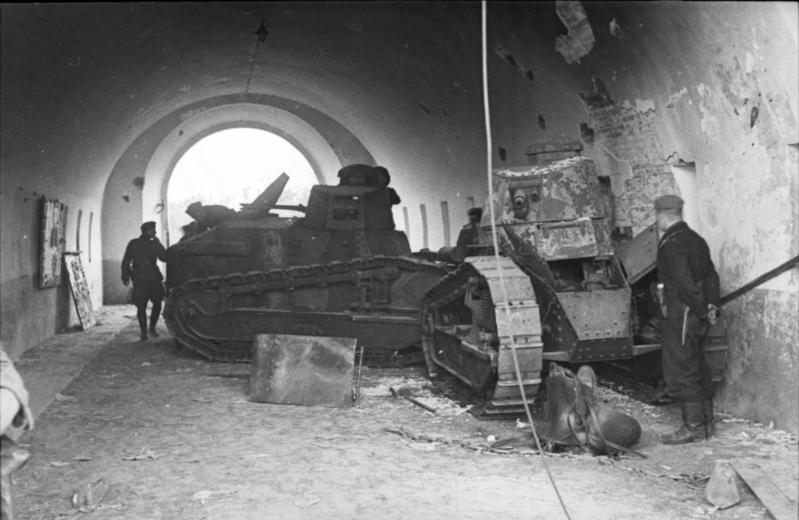
Battle of Brześć Litewski
On September 22, 1939, the Wehrmacht and the Red Army held a joint military parade in the town of Brześć Litewski. Major General Heinz Guderian stood beside Brigadier Semyon Krivoshein on a reviewing stand, and German tanks rolled past while Soviet tanks waited their turn to take possession of a fortress the Germans had spent the previous week capturing from the Polish defenders. The Polish defenders themselves were not present at the parade. They were retreating south through the Polesian marshes, what was left of them, on their way to a war that was already lost.
The Old Fortress
The fortress at Brześć Litewski — Brest, in modern Belarus — sits at the confluence of the Bug and Mukhavets rivers, on the site of a medieval castle. It had been strengthened in Napoleonic times, redesigned and rebuilt in 1847 by the Russian Empire as a major stronghold, and battered during the First World War. By 1939 it was largely obsolete by modern military standards. The Polish army, in its prewar planning, had not intended to defend the place; it sat well behind the front line, useful as a supply depot and a prison, but not as a fighting position. What changed those plans was the speed of the German XIX Panzer Corps. After breaking through the Polish lines at Mława and Wizna in early September, Heinz Guderian's tanks raced south to flank Warsaw from the east and cut Poland in two. Brześć stood directly in their path. If it could be held even briefly, it might let elements of the Independent Operational Group Narew escape encirclement to the south.
What There Was to Defend With
General Konstanty Plisowski took command of an improvised force assembled out of whatever happened to be at hand. Two march battalions of the 82nd and 35th infantry regiments. A battalion of engineers. Newly mobilised reservists who had been arriving at the fortress to await transport to their proper units. Several batteries of artillery. Two companies of FT-17 tanks — the 112th and 113th — used for training. The FT-17 was a French light tank from the First World War, the same vehicle that had introduced the modern tank turret to the world in 1917. By 1939 it was, in Polish hands as in everyone else's, hopelessly obsolete: thinly armoured, slow, with a small main gun. The 113th Company would lose all twelve of its tanks against German armour in the first day's fighting. The defenders also had two armoured trains, PP55 and PP53, commanded by Captains Mieczysław Malinowski and Andrzej Podgórski. Against this Plisowski's force was perhaps three thousand fighting men. Guderian's XIX Panzer Corps numbered tens of thousands.
Three Days
The Germans arrived on September 14. Seventy-seven tanks of the 8th Panzer Regiment tried to take the fortress on the move, were repulsed by the Polish infantry and the FT-17s, and pulled back to wait for artillery. The artillery arrived later that day and began to shell the town and the fortress while the German infantry pushed into the streets. By dawn on September 15 half of Brześć was in German hands. The Polish defenders, lacking effective anti-tank weapons or sufficient artillery to reply, withdrew from the town into the fortress itself. The fortress was then shelled continuously and bombed by the Luftwaffe. On September 16 the main German assault came. Two FT-17 tanks blocked the northern gate of the fortress and held it through repeated attacks; their commanders had stationed them deliberately so that the tanks themselves would die in place rather than the gate be lost. Polish casualties reached almost 40 percent. Resupply was impossible. By the early hours of September 17, General Plisowski ordered the survivors out — across the river to the south, through the marshes, the last unit blowing the bridge behind them as it crossed.
September 17
On the same morning that the Polish garrison was evacuating Brześć, the Red Army crossed Poland's eastern border. The secret protocol of the Molotov-Ribbentrop Pact, signed in August, had assigned Brześć to the Soviet sphere; the Soviets had simply waited for the Germans to do the hard part. The 29th Tank Brigade under Brigadier Semyon Krivoshein reached the area later that day. The Wehrmacht had taken the fortress almost unopposed an hour after the Poles left; now they handed it over. The joint parade on September 22 was, in some ways, the pact made visible — two armies that had spent the past two years insulting each other in public propaganda standing together on a reviewing stand to mark a successful joint operation against a third country. The German troops then crossed the Bug River and continued west, leaving the eastern half of Poland to the Soviets.
What Came After
General Plisowski's withdrawal joined up forty kilometres east with the improvised Kobryń Infantry Division under Colonel Adam Epler, which had just fought its own battle at Kobryń. Together with the Podlaska Cavalry Brigade and the rest of General Franciszek Kleeberg's Independent Operational Group Polesie, they fought on against both the Wehrmacht and the Red Army for another three weeks, all the way to the Battle of Kock, which ended on October 6, 1939. They were the last organised Polish formation in the field. The Brest Fortress, handed to the Soviets, was occupied by them until June 1941, when the Wehrmacht came back in the opening hours of Operation Barbarossa and besieged the fortress all over again — this time defended by Soviet troops, who held out for weeks against impossible odds in a battle that Soviet propaganda would later make iconic. The same stones, the same gates, the same bridges. Different defenders. The fortress sits today on the Belarus-Poland border in the city of Brest, a memorial complex that commemorates 1941 with monumental Soviet realism and 1939 with rather less.
From the Air
The Brest Fortress lies at 52.083°N, 23.653°E on the western edge of modern Brest, Belarus, directly on the Bug River that forms the Belarusian-Polish border. The terrain is flat lowland, marked by the Bug and Mukhavets rivers and the surrounding Polesian wetlands. The fortress's distinctive star-shaped Napoleonic-era earthworks are visible from the air. Brest Airport (UMBB) sits on the city's eastern edge; Warsaw Chopin (EPWA) is roughly 200 km west. Best viewed from medium altitude in clear weather.