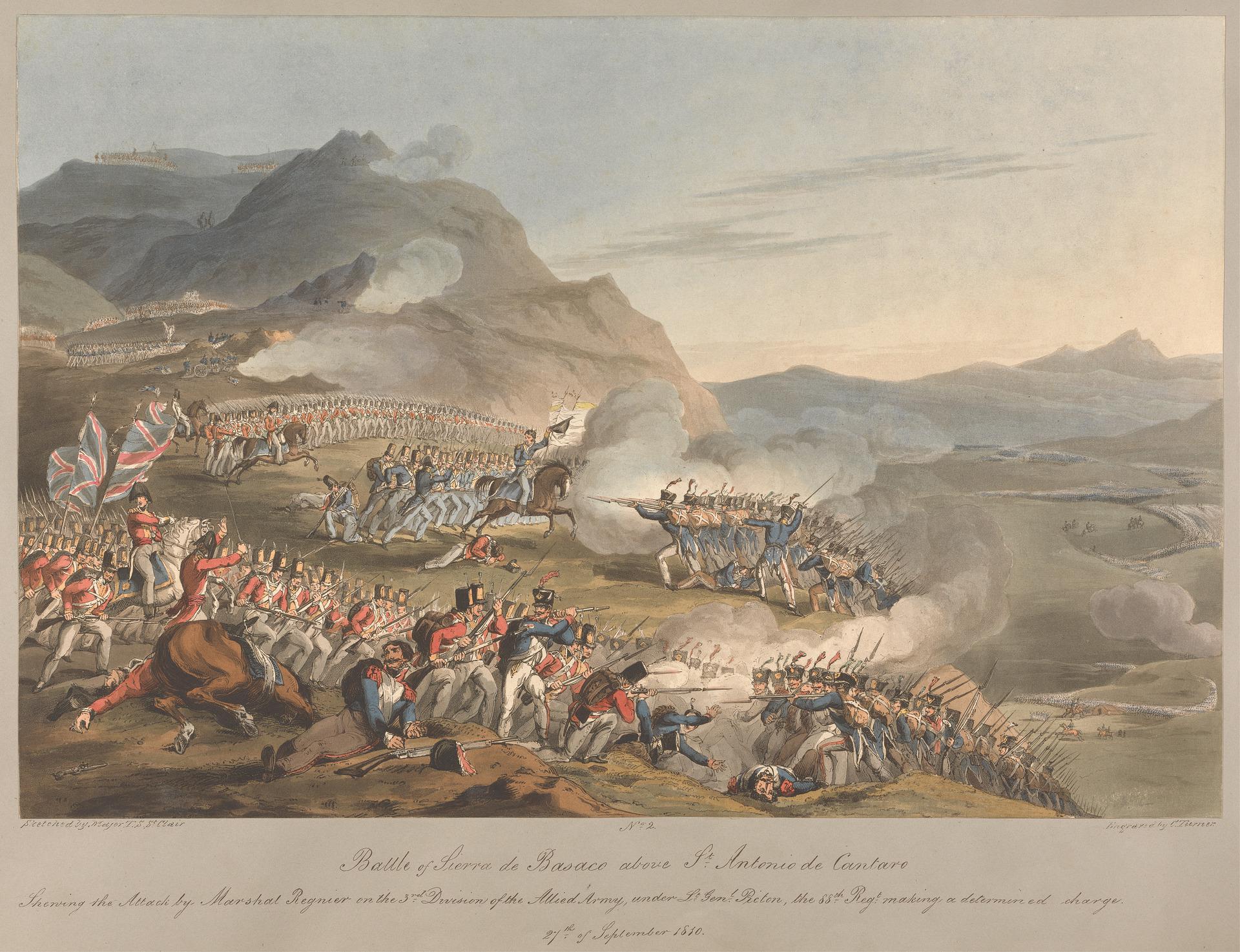
Battle of Bussaco
Wellington hid an entire army on the wrong side of a hill. On 27 September 1810, some 52,000 Anglo-Portuguese troops lay concealed along the reverse slope of the Serra do Bussaco, a ten-mile granite ridge rising 549 meters above the road to Coimbra. No cooking fires gave them away. No glint of bayonets betrayed their positions. Marshal Massena, commanding 65,000 French soldiers tasked by Napoleon with driving the British from Portugal, surveyed the ridge and saw almost nothing. He attacked anyway.
The Ridge That Swallowed Armies
The Serra do Bussaco was Wellington's chosen ground, and he prepared it with a craftsman's care. Engineers from the Royal Corps cut a hidden road along the reverse slope, allowing rapid redeployment that the French could neither see nor anticipate. Six British infantry divisions and half the reconstituted Portuguese Army spread along the crest, invisible to the enemy below. The ridge ran perpendicular to the main road from the Spanish border to Lisbon, and every route the French might take to the capital passed beneath its heights. Wellington was buying time. Behind him, laborers were still building the Lines of Torres Vedras, a vast network of fortifications protecting Lisbon. Every day Massena spent at Bussaco was another day of construction completed.
Through the Morning Mist
Reynier's corps struck first, columns of infantry climbing the steep slope in early morning fog. Heudelet's leading brigade advanced one company wide and eight battalions deep, a formation designed for momentum on flat ground that became a deathtrap on a mountainside. When the lead regiment crested the ridge, they found themselves staring into the muzzles of the 74th Foot, two Portuguese battalions, and twelve cannon. The French tried to deploy from column into line under withering fire. They failed. To the north, Merle's division met the same fate against Picton's defenders, who used Wellington's hidden ridgetop road to mass quickly at the point of contact. The 88th Foot countercharged with such ferocity that Wellington himself rode up afterward to tell Colonel Wallace, "I have never witnessed a more gallant charge."
A Convent Becomes a Battlefield
Marshal Ney, hearing gunfire and assuming Reynier was succeeding, launched his own attack up the spur toward the Convent of Bussaco. What followed was one of the Peninsular War's most devastating ambushes. Near the crest, 1,800 soldiers of the 43rd and 52nd Light Infantry lay flat on the ground, waiting. As Loison's leading brigade approached the convent grounds, the British stood, delivered a volley at point-blank range, and charged with bayonets. The French brigade disintegrated, its commander wounded and captured. A second brigade met the same fate under combined artillery and musket fire, and a third was stopped cold by Denis Pack's Portuguese troops. By the time the skirmishing died down, the French had lost some 4,500 men. The Anglo-Portuguese casualties totaled roughly 1,250, split almost exactly evenly between British and Portuguese soldiers.
Victory Without an Ending
Bussaco was a triumph, but Wellington knew it was not a conclusion. Massena, chastened but resourceful, sent cavalry patrols around both ends of the ridge and found a route that outflanked the position to the north. On the night of 28 September, the French slipped away toward the road from Porto to Coimbra, campfires left burning to mask their departure. Wellington withdrew in good order toward the Lines of Torres Vedras, reaching them by 10 October. The real significance of Bussaco lay not in the ground held or lost but in what it proved. The reconstituted Portuguese Army, retrained under British direction, had fought its first major engagement and performed with distinction. For soldiers who had watched their country invaded and occupied, the ridge became a point of national pride. Massena pressed on to Lisbon, found the Lines of Torres Vedras impregnable, and starved through a miserable winter. He lost 25,000 more men to hunger, disease, and guerrilla attacks before retreating into Spain in early 1811, leaving Portugal free from French occupation at last.
From the Air
Located at 40.34N, 8.34W in central Portugal's Serra do Bussaco, about 25 km northeast of Coimbra. The forested ridge is visible from altitude, running roughly north-south. Nearest airports include Coimbra (no ICAO), with LPCO (Coimbra) for general reference. The terrain rises to 549 m and the area is often misty, especially in autumn. The Bussaco National Forest and Palace Hotel are visual landmarks on the ridgeline.