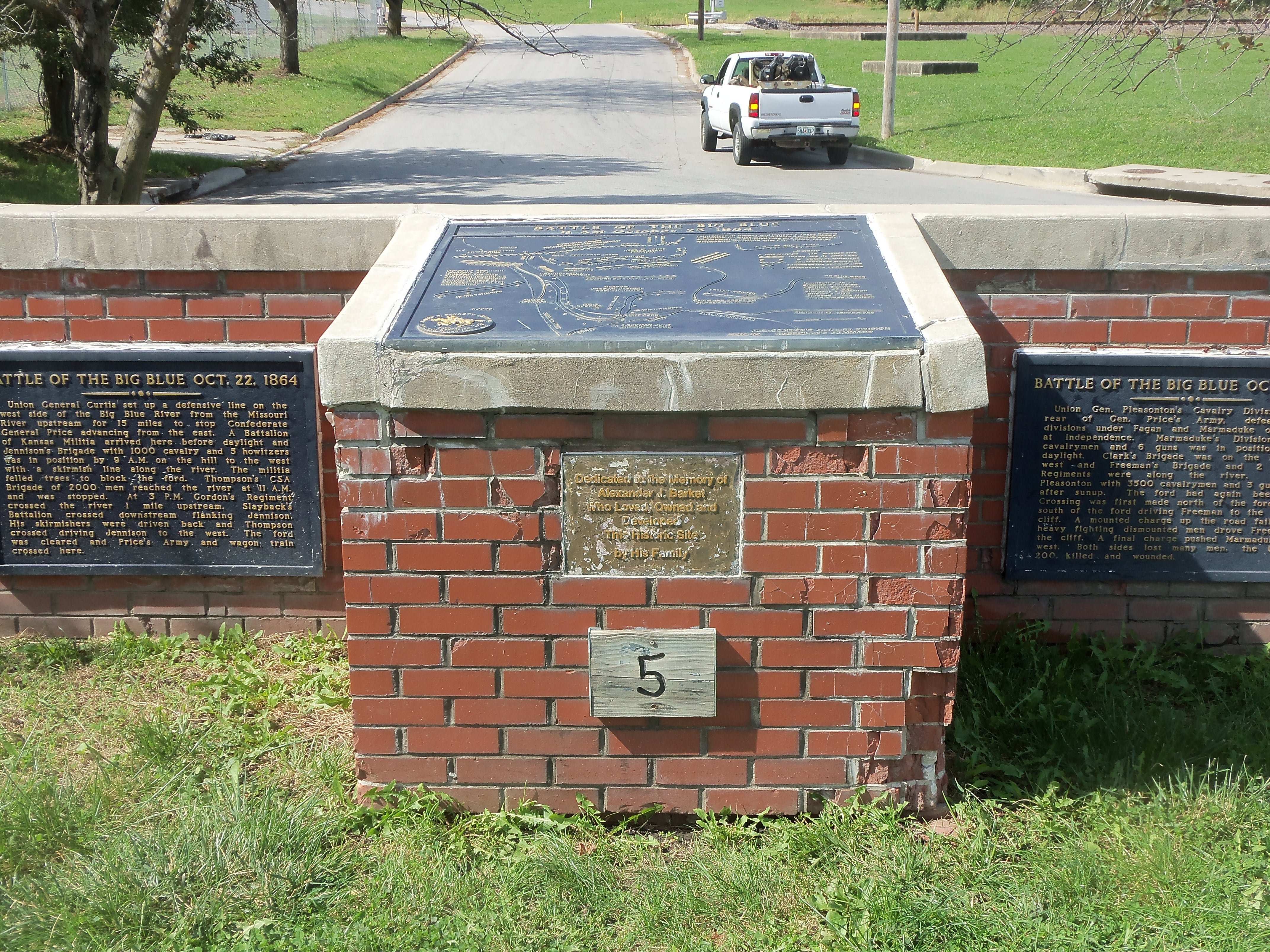
Battle of Byram's Ford
The Confederates found the ford they needed because a local farmer had been using it for years. On the afternoon of October 22, 1864, with the main crossing at Byram's Ford on the Big Blue River stubbornly defended by Union Colonel Charles "Doc" Jennison's brigade, Confederate scouts pushed north and discovered Hinkle's Ford -- an unguarded crossing known only to nearby farmers. Simultaneously, Colonel B. Frank Gordon found another unguarded ford to the south. The two flanking crossings broke the Union defensive line wide open, and within hours, the fighting had shifted to a desperate stand at the Mockbee Farm, where 250 Kansas militiamen with a single howitzer held off repeated Confederate assaults before being overwhelmed. It was the kind of battle the Civil War produced in its western reaches -- fought at river crossings and on family farmland, with militia and irregulars alongside professional soldiers, and local knowledge of terrain proving as decisive as any general's plan.
Trapped Between Two Armies
By late October 1864, Confederate Major General Sterling Price's invasion of Missouri had devolved from bold offensive to desperate retreat. He had entered the state on September 19 with 12,000 to 13,000 cavalrymen and 14 light cannons, dreaming of recapturing Missouri for the Confederacy. A bloody repulse at Pilot Knob killed those ambitions. Price bypassed both St. Louis and Jefferson City, then suffered defeat at the Battle of Westport on October 23. Now, on the banks of the Big Blue River east of present-day Kansas City, Price found himself in the worst possible tactical situation: caught between Major General James G. Blunt's Army of the Border to the west and Major General Alfred Pleasonton's cavalry division pressing from the east. Price needed to get his army and its slow-moving wagon train across the Big Blue before Pleasonton crushed his rear guard.
The Fight for the Fords
The first day's fighting, October 22, centered on Byram's Ford in the southern portion of the Union line. Jennison's 1,200 men held the high ground west of the crossing, with mountain howitzers covering the ford itself. Felled trees and obstructions blocked the passage. Confederate Brigadier General M. Jeff Thompson's brigade hammered at the position for three hours without breaking through. The deadlock ended when Gordon's regiment found the unguarded southern ford and Slayback's battalion discovered Hinkle's Ford to the north. Outflanked on both sides, Jennison's brigade was forced into a chaotic retreat that eventually carried them across the state line into Kansas. Blunt had ordered Colonel Thomas Moonlight's brigade to support Jennison, but Moonlight never received the order. By the time he learned of the breakthrough, the Confederates had already crossed.
The Mockbee Farm and Potato Hill
The most dramatic fighting occurred at Thomas Mockbee's farm, where roughly 250 men of the 2nd Kansas State Militia Infantry Regiment deployed with a single 24-pounder howitzer. Their artillery fire drove Confederate attackers into a ravine, and they repulsed two separate assaults before being overwhelmed by a third attack that threw even unarmed Confederate recruits into the charge. The next morning, October 23, Pleasonton launched his own assault on Byram's Ford, driving Marmaduke's defenders back to a height called Potato Hill. The path uphill was covered with tree stumps, and Confederate sharpshooters fired from treetops. Colonel Edward Winslow was shot in the leg during the charge, and Lieutenant Colonel Frederick W. Benteen -- later famous at Little Bighorn -- took command. Union troops, many armed with repeating rifles, eventually carried the crest. By noon, Pleasonton had broken through to join forces with Blunt's army.
The Last Campaign
The Confederate collapse was total. As Pleasonton's men poured through the breach at Byram's Ford, Shelby's division crumbled at the concurrent Battle of Westport. The retreat became, in the words of observers, a southbound stampede. Price's wagon train escaped Union pursuit, but the army itself was shattered. Three days later, on October 25, the Confederates suffered three more defeats in a single day, including the catastrophic rout at Mine Creek where Marmaduke was captured. By December, Price's survivors reached Texas with barely 3,500 of his original 12,000 men. The campaign was the last major operation west of the Mississippi. Today, part of the battlefield is preserved in the Big Blue Battlefield Park, with traces of the original earthworks still visible. The Byram's Ford Historic District is listed on the National Register of Historic Places, though much of the western battlefield has been swallowed by the expansion of Kansas City.
From the Air
Located at 39.023N, 94.531W in the southern Kansas City, Missouri metropolitan area, along the Big Blue River. Elevation approximately 800 feet MSL. The Big Blue River is visible as a tree-lined waterway running generally north-south through the urban landscape. The Big Blue Battlefield Park preserves a portion of the site. Charles B. Wheeler Downtown Airport (KMKC) lies to the northwest; Kansas City International Airport (KMCI) is further north. The battlefield area is now largely urban, but the river corridor and some open spaces remain identifiable. Brush Creek, site of the concurrent Battle of Westport, is visible to the northwest. Best viewed at 3,000-5,000 feet AGL, where the river crossings and topographic features that shaped the battle are still discernible.