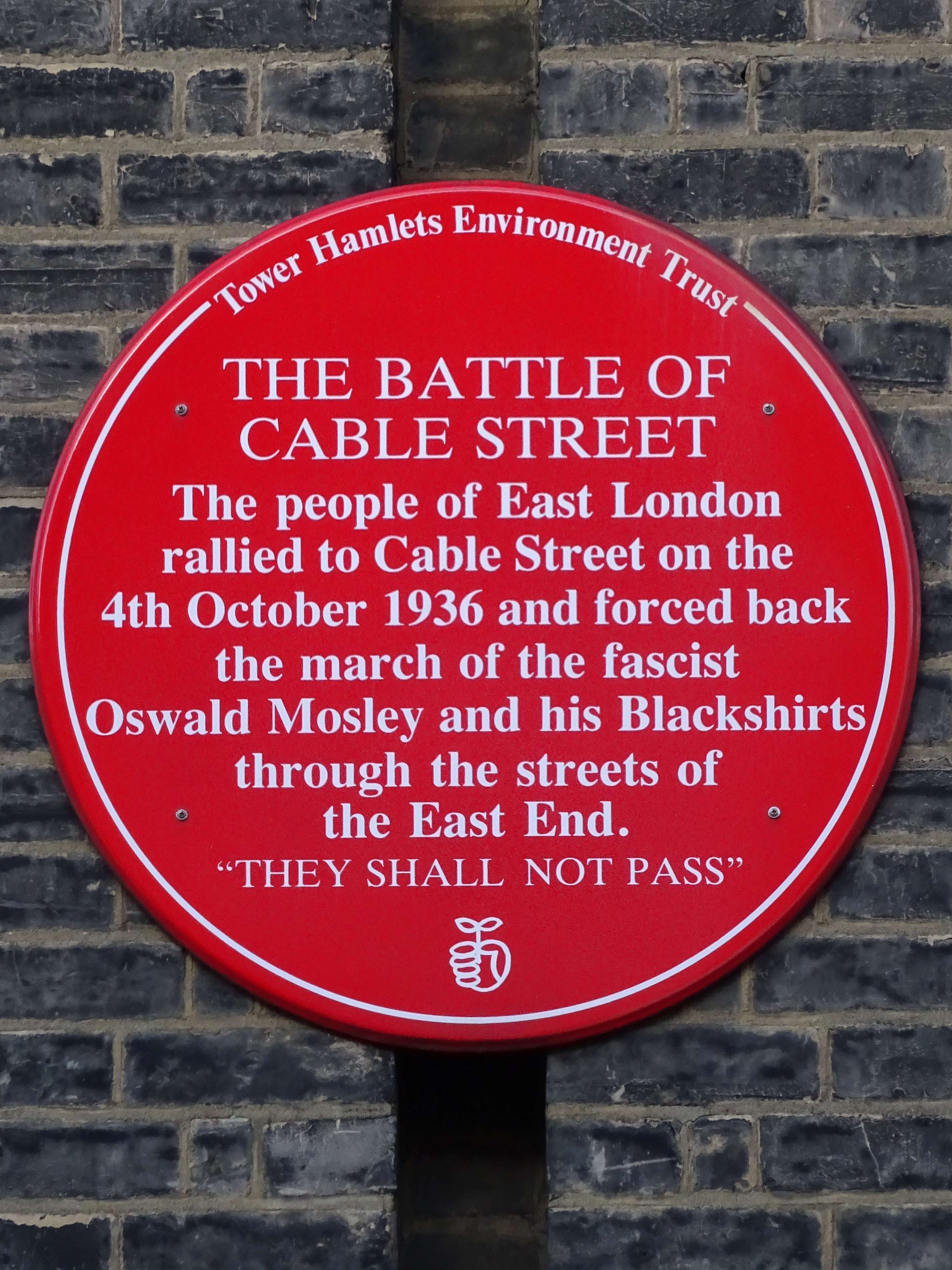
The Battle of Cable Street: The Day the East End Said No
The slogan was borrowed from the Spanish Civil War: 'They shall not pass.' On Sunday 4 October 1936, those words became literal in the narrow streets of London's East End. Oswald Mosley, leader of the British Union of Fascists, had announced that thousands of his Blackshirts would march through the heart of a neighborhood with a large Jewish population. It was an intentional provocation -- the BUF was founded in Chelsea and headquartered in Westminster, but Mosley chose the East End for his anniversary march. The Jewish People's Council gathered 100,000 signatures in two days calling for the march to be banned, including the mayors of five East London boroughs. The government refused. So the people of the East End decided to stop it themselves.
'Alteration! Rally to Aldgate'
The counter-mobilization happened fast. The Communist Party, initially planning a separate rally at Trafalgar Square, reversed course under pressure from its East End branches. On Thursday, thousands of leaflets advertising the Trafalgar Square event were overprinted with a single urgent word: 'Alteration! Rally to Aldgate. 2PM.' The Friday edition of the Daily Worker urged all readers to the counter-protest. The Independent Labour Party joined. So did dockers, trade unionists, local Irish residents, and thousands of ordinary people who simply did not want fascists marching past their homes. By early afternoon on Sunday, somewhere between 100,000 and 300,000 people had gathered at the approaches to the East End, filling the streets from Aldgate Pump along Whitechapel High Street for about a mile.
Barricades and Marbles
London's geography shaped the confrontation. Only three main routes led from the City into the East End, a legacy of the long-demolished London Wall. The greatest concentration of people massed at Gardiner's Corner, the junction of Whitechapel High Street with Leman Street and Commercial Road. Tram cars were stopped in the intersection, blocking it further. On narrow Cable Street, residents built barricades from materials taken from a builder's yard. When police on horseback charged to clear the way, children scattered marbles under the horses' hooves. Several police officers were taken prisoner in the fighting, held in empty shops, and had their helmets and truncheons taken as souvenirs. The police, numbering around 6,000, were there to protect the fascist march, not to stop it -- a fact that shaped community memory for generations.
Mosley Turns West
By 3:40 in the afternoon, it was over. The Metropolitan Police Commissioner, Sir Philip Game, summoned Mosley and told him the march could not proceed into the East End without serious disorder. Mosley was offered an alternative: march west to Hyde Park. His followers booed and sang the Nazi Horst-Wessel-Lied, but the Blackshirt column turned around. They marched through the deserted streets of the City of London business district and dispersed. The BUF tried to spin the retreat as evidence of government weakness, claiming a dangerous mob had denied them free speech. But the damage to their credibility was real. The people of the East End had organized across lines of ethnicity, religion, and political affiliation, and they had won.
What Cable Street Means
The battle's legacy is complicated. Some historians note that BUF membership actually spiked briefly in the weeks afterward, and anti-Jewish violence in the East End continued. The Public Order Act 1936, passed in response, banned political uniforms and gave police new powers over marches -- tools that could be used against any political movement, not just fascists. But Cable Street endures as a symbol of community solidarity against organized hatred. A large mural on the side of St George's Town Hall depicts the barricades, the crowds, and the banner reading 'They Shall Not Pass.' The story matters not because it ended fascism in Britain -- it did not -- but because it showed what organized, cross-community resistance looks like. Jewish garment workers stood beside Irish dockers. Communists coordinated with the Independent Labour Party. And thousands of ordinary Londoners, with no particular political affiliation, simply showed up because they believed their neighbors deserved to live without fear.
From the Air
Cable Street runs east-west through the Wapping area of Tower Hamlets (51.51N, 0.05W), approximately 1km east of the Tower of London. The famous mural is on St George's Town Hall. Gardiner's Corner, the main flashpoint, is at the junction of Whitechapel High Street and Commercial Road. Nearest airports are London City (EGLC) 5km east and London Heathrow (EGLL) 27km west. From the air, the East End streets where the battle occurred are visible as the dense urban grid between the Tower of London and Limehouse.