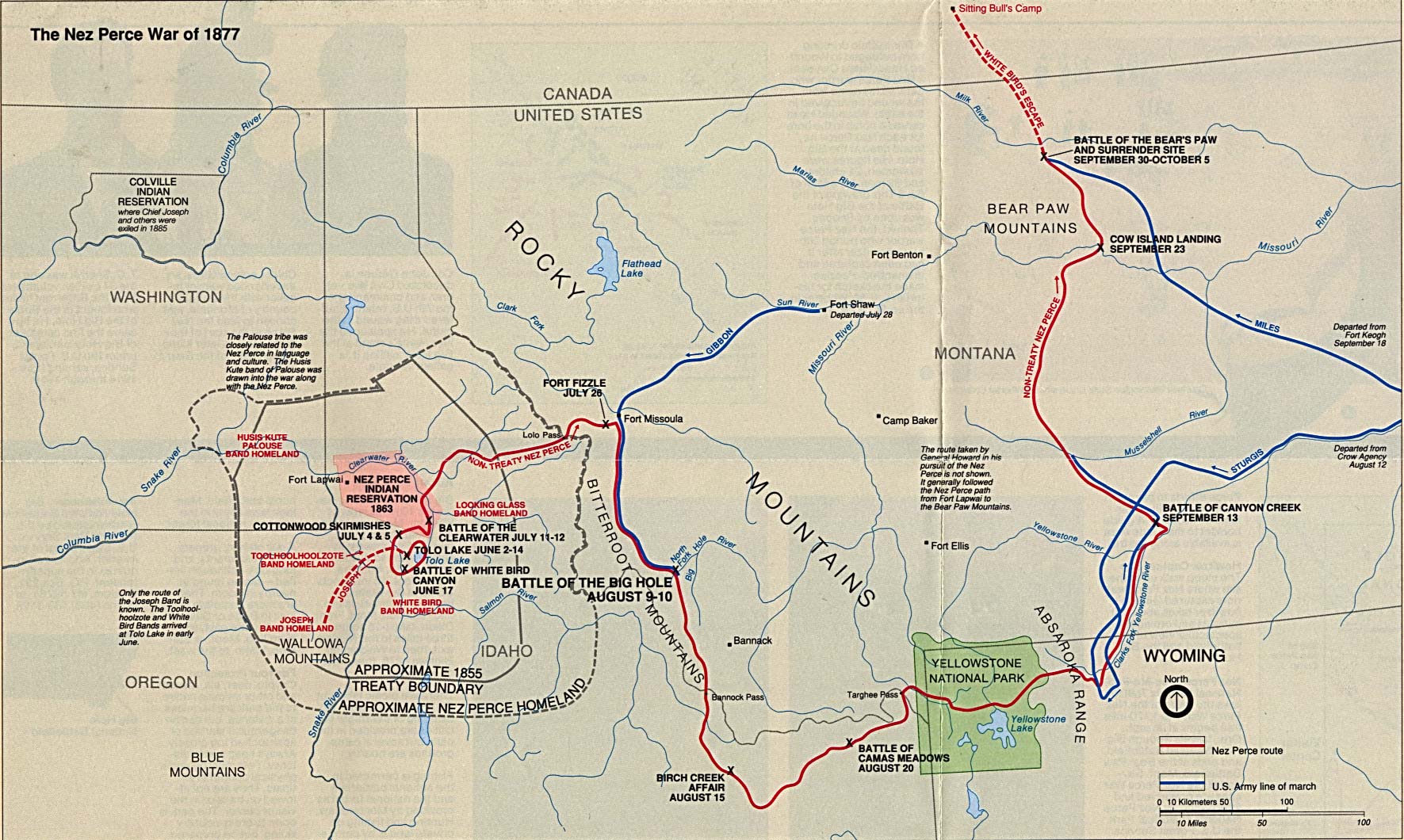
Battle of Camas Creek
At four in the morning on August 20, 1877, Nez Perce warriors crept through the darkness toward a heavily guarded Army camp at Camas Meadows, Idaho. Their mission was audacious: steal the cavalry's horses and leave General Oliver O. Howard's pursuit force stranded on foot. What they got instead were mules - a mistake that still accomplished their goal and added a touch of dark humor to one of the most remarkable fighting retreats in American military history.
The Long Road to Camas Meadows
The Nez Perce who arrived at Camas Meadows were exhausted survivors of a brutal campaign. Just ten days earlier, they had fought the bloody Battle of the Big Hole, where soldiers attacked their sleeping camp at dawn, killing many women and children. About 700 Nez Perce - fewer than 200 of them warriors - were fleeing eastward through the mountains, burdened with wounded, elderly, and grieving families. Their guide was Poker Joe, a half-Nez Perce, half-French man who led them on circuitous routes to confuse their pursuers. General Howard, embarrassed by his failure to defeat the Nez Perce over two months of pursuit, followed with 310 soldiers and Bannock scouts, desperately trying to intercept them before they reached Montana.
A Tactical Masterstroke
Howard was no fool. When his troops made camp at Camas Meadows on August 19, he took "great pains" to cover the camp with pickets in every direction. Nez Perce scouts observed these precautions and reported back to their chiefs. The decision was made: a nighttime raid to put Howard's cavalry on foot. At least 28 warriors, and possibly many more, assembled for the mission. Under cover of darkness, several dismounted and crept among the picketed animals, cutting them loose. Then chaos erupted - a sentry shouted "Who goes there?" just as a Nez Perce scout accidentally discharged his rifle. In the confusion of darkness and gunfire, the raiders drove off the stock and disappeared into the night. Only later did they realize they had captured mostly mules, not horses - the dim light had made the animals indistinguishable.
The Ambush in Black Lava
General Howard dispatched 150 cavalrymen at dawn to recover the stock. The Nez Perce were ready. Their rear guard set up an ambush among hillocks of black lava and broken terrain dotted with aspen trees and sagebrush. A thin skirmish line in a grassy meadow served as bait, while other warriors crept forward on both flanks. When the cavalry realized the trap, they called retreat - but Captain Randolph Norwood and fifty men refused the order. Isolated and surrounded, Norwood's soldiers dug rifle pits in the lava rock and fought for two to four hours. When Howard finally arrived with reinforcements mid-afternoon, the Nez Perce melted away. Norwood had one man dead, two mortally wounded, and six to nine more wounded. Warrior Yellow Wolf later claimed "no Indian was badly hurt, only one or two just grazed by bullets."
Uncle Sam's Boys Are Too Slow
After the battle, Howard was reinforced by 280 infantry and fifty gorgeously decorated Bannock warriors wearing buckskin, sleigh bells, and bright blankets. But his pursuit was agonizingly slow - his troops had marched 26 days averaging miles daily and were exhausted. Scout Stanton G. Fisher and many Bannocks quit in disgust. Fisher commented bitterly: "Uncle Sam's boys are too slow for this business." The Nez Perce, meanwhile, burdened with their wounded and elderly, somehow moved faster. As one journalist noted, they had the "faculty of stealing fresh horses from the settlers." Howard rested for several days at Henrys Lake while his superior, General Philip Sheridan, assembled over a thousand soldiers to trap the Nez Perce when they emerged from Yellowstone.
Echoes in the Sagebrush
Today, the sites of Howard's encampment and Norwood's desperate stand are designated a National Historic Landmark, part of the Nez Perce National Historical Park and the Nez Perce National Historic Trail. The landscape remains largely unchanged - undeveloped except for a grave marker at Camp Callaway. Captain Norwood's rifle pits, hastily dug in volcanic rock as warriors closed in from three sides, still survive at the siege location. The Battle of Camas Creek was not a decisive engagement, but it exemplified the Nez Perce strategy throughout their 1,170-mile retreat: avoid pitched battles, use superior tactics, and keep moving toward a freedom that would ultimately prove unreachable.
From the Air
Located at 44.35N, 111.89W in the Camas Meadows area of eastern Idaho near Dubois. The battlefield lies in a broad valley of sagebrush and black lava formations at approximately 6,400 feet elevation. Look for the distinctive pattern of meadows bisected by Camas and Spring creeks. Nearest airports include Idaho Falls Regional (KIDA, 60nm southeast) and West Yellowstone (KWYS, 30nm northeast). Best viewed at 3,000-5,000 feet AGL to appreciate the terrain that shaped the ambush. Clear summer mornings offer best visibility.