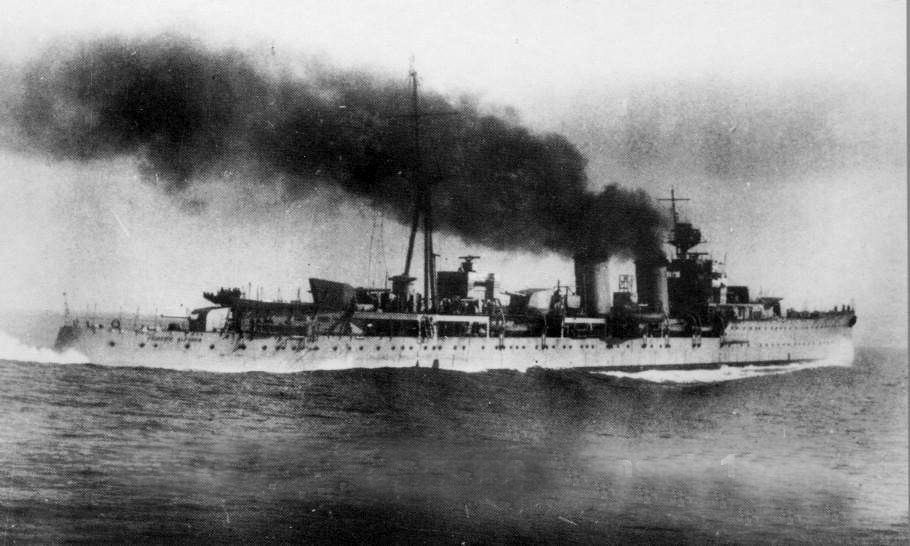
Battle of Cape Cherchell
On the morning of September 7, 1937, the Nationalist heavy cruiser Baleares was patrolling the Mediterranean along the coast of French Algeria when she stumbled into a fight she could not win. Thirty nautical miles north of Cherchell, nine Republican warships -- two light cruisers and seven destroyers -- were escorting a pair of merchant vessels loaded with Soviet supplies back to Spain. What followed was a naval engagement that both sides could reasonably claim as a victory, and that cost the Republican Navy's commander his job.
Caught Between the Convoy and the Coast
Baleares found herself in a dangerous position, trapped between the Republican convoy and the Algerian shore. Captain Manuel Vierna Belando ordered a course change to the northeast, angling toward the rear of the convoy rather than driving into its center. The Republican merchant ships immediately turned south toward Algeria, seeking the safety of French territorial waters. Four of the seven destroyers broke off to continue escorting the merchantmen -- likely, according to later analysis, because their crews lacked the training and confidence needed to launch a torpedo attack against a heavy cruiser. That left the light cruisers Libertad and Mendez Nunez to deal with Baleares alone.
Two Rounds of Gunfire
The first exchange went badly for the Nationalist ship. Baleares opened fire but technical failures degraded her accuracy, and she inflicted only minor damage on the Republican cruisers. Libertad, by contrast, hit her target with precision. Baleares absorbed heavy punishment but did not withdraw. Instead, she renewed pursuit. The warships clashed again in the afternoon off the Algerian coast. Once more, Libertad's gunnery proved superior. With her main artillery and fire-control director operating at reduced capacity from the morning's damage, Baleares limped away to wait for her sister ship Canarias to arrive as reinforcement. Three of her sailors were dead and many more wounded.
A Tactical Loss, a Strategic Win
By conventional measures, Baleares lost the battle. She took heavy damage while inflicting only superficial harm on the enemy warships. But the engagement's real purpose -- from the Nationalist perspective -- was disruption, not destruction. The two Republican merchant ships, frightened toward the Algerian coast, never completed their voyage to Spain. One wrecked and the other was interned by French authorities. Soviet supplies that were meant to sustain the Republican war effort sat impounded in North African ports instead. A single heavy cruiser, vastly outnumbered, had accomplished its mission simply by appearing at the wrong time in the right place.
Consequences and Foreshadowing
The aftermath reshaped careers on both sides. Miguel Buiza Fernandez-Palacios, commander of the Republican Navy, was dismissed for his handling of the battle and replaced by Captain Luis Gonzalez de Ubieta. The criticism centered not on the cruisers' gunnery, which had been excellent, but on the broader failure to protect the convoy's merchant ships -- the entire point of the escort. Captain Vierna, despite commanding the losing ship, was promoted to rear admiral for his aggressive tactics against overwhelming odds. The promotion would prove short-lived. Six months later, in March 1938, both Vierna and Baleares were lost at the Battle of Cape Palos, where Republican forces sank the heavy cruiser in a nighttime torpedo attack. The waters off the Algerian coast had been a rehearsal for something worse.
From the Air
The battle occurred approximately 30 nautical miles north of Cherchell, Algeria, at roughly 36.91N, 2.20E in the open Mediterranean Sea. No land features mark the engagement site. Nearest coastal reference is the port town of Cherchell on the Algerian coast. Nearest major airport is Algiers Houari Boumediene (DAAG), approximately 100 km to the east. The waters between Cherchell and the Balearic Islands were a contested shipping lane throughout the Spanish Civil War.