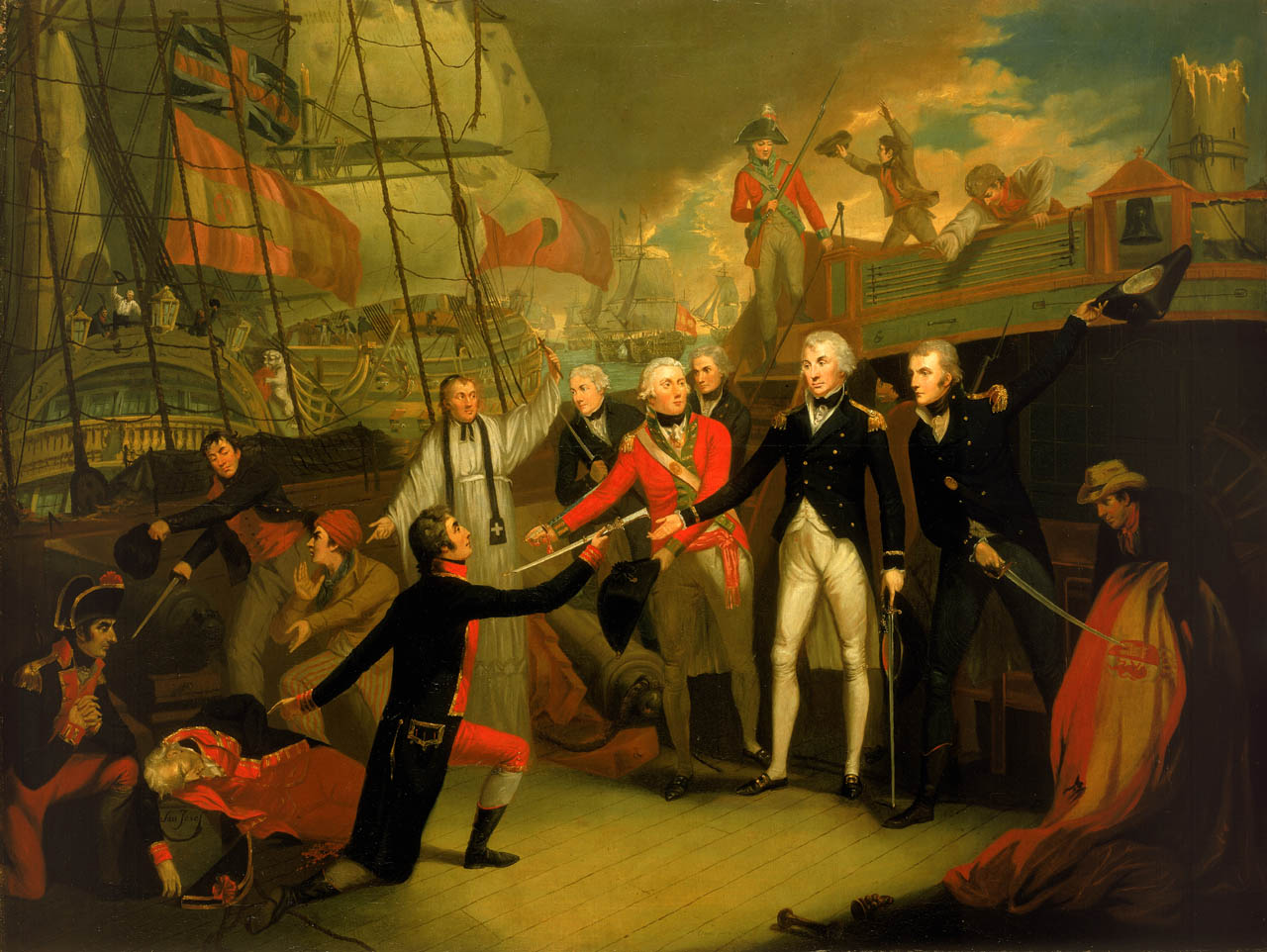
Battle of Cape St. Vincent (1797)
"Westminster Abbey or Glorious Victory!" With that shout, Commodore Horatio Nelson leapt from the deck of his battered seventy-four-gun ship onto the rigging of a Spanish eighty-four, then fought his way across her deck and boarded a second Spanish vessel -- a 112-gun first-rate -- without ever touching the sea between them. It was February 14, 1797, Valentine's Day, and the British were giving the Spanish fleet their valentine in style. The maneuver was so audacious, so unprecedented, that the Royal Navy would forever after call it 'Nelson's patent bridge for boarding enemy vessels.' It was also, technically, a court-martial offense. Nelson had broken formation without orders.
Fog, Signal Guns, and an Admiral's Resolve
The battle grew from fog and miscalculation. A fierce Levanter -- the easterly wind that funnels between Gibraltar and Cadiz -- had pushed Admiral Jose de Cordoba's Spanish fleet of twenty-seven ships of the line far out into the Atlantic. As the wind died, Cordoba worked his way back toward Cadiz, unaware that Admiral Sir John Jervis waited off Cape St. Vincent with just fifteen British ships. On the night of February 13, the sounds that Jervis had been straining to hear finally reached him through the murk: Spanish signal guns, the fleet announcing itself in the darkness. By dawn, the British formed two columns. As the fog lifted to reveal the Spanish ships, a signal lieutenant described them as 'thumpers, looming like Beachy Head in a fog.' On Victory's quarterdeck, Jervis and his officers counted enemy sail after enemy sail. The British were outnumbered nearly two to one. Captain Benjamin Hallowell, a Canadian, thumped the admiral on the back: 'That's right Sir John, and, by God, we'll give them a damn good licking!'
Through the Gap
Jervis saw his opening. The Spanish fleet had separated into two loose groups -- about eighteen ships in the windward column and nine closer to the British. At 11:00 a.m., he formed his fleet into a single line and drove straight between them, firing broadsides in both directions. It was a calculated gamble. The Spanish were unprepared, their ships not yet in battle formation, while the British line was tight and disciplined. HMS Culloden led the charge, tacking to pursue the larger Spanish group while the rest of the fleet followed. The Spanish lee division attempted to break through the British line as each ship tacked in succession, but Jervis's captains covered one another brilliantly. When Victory herself reached the turning point, she took two raking broadsides but swept through before the Spanish could close the gap. By early afternoon, the British line had bent into a U shape, chasing the Spanish rear -- but not fast enough to prevent Cordoba's fleet from regrouping and escaping to Cadiz.
The Bridge Between Two Ships
Nelson saw what his admiral could not. From his position near the rear of the British line, he realized that Jervis's pursuit would not catch the Spanish before they escaped. Without orders -- against orders, in fact -- he pulled HMS Captain out of line and threw his seventy-four-gun ship directly into the path of six Spanish warships, including the Santisima Trinidad, the largest vessel afloat, mounting 130 guns. For nearly an hour, Captain absorbed punishment from multiple directions. Her wheel was shot away, her foretop mast crashed overboard. Unable to maneuver, Nelson did the only thing left: he boarded. His men grappled the eighty-four-gun San Nicolas, fought across her deck, and used her as a stepping stone to board the 112-gun San Jose. On the quarterdeck of that first-rate, the Spanish captain bowed and presented his sword. Nelson handed captured swords to his bargeman, William Fearney, who tucked them under his arm with what observers described as the greatest sang-froid.
Valentines and Aftermath
By five o'clock, Nelson -- still black with gunpowder smoke, his uniform in shreds -- went aboard Victory. Jervis embraced him on the quarterdeck. The battle had cost the Royal Navy 73 dead and 227 wounded. Spanish losses were far heavier: 430 killed and 856 wounded, with four ships captured. The British had proven that fifteen disciplined ships could defeat twenty-seven poorly coordinated ones. Aboard the captured San Jose, some guns were found with their tampions still plugging the muzzles -- the Spanish crews had been too confused to fire them.
Jervis was made Earl St. Vincent and granted a pension of three thousand pounds per year. Nelson was knighted. The victory secured British access to the Mediterranean and bottled up the Spanish fleet in Cadiz for the next three years. More importantly, it launched Nelson toward the fame that would culminate at the Nile and Trafalgar. A satirical recipe published afterward in The Evening Mail captured the mood: 'Take a Spanish first-rate and an 80-gun ship, and after well battering and basting them for an hour, keep throwing in your force balls.' The dish, it concluded, was fit to be set before His Majesty.
From the Air
Located at 37.02N, 8.99W, off Cape St. Vincent at the extreme southwestern corner of Portugal. The cape's dramatic cliffs and lighthouse are unmistakable from the air. The battle took place in the open Atlantic west-southwest of the headland. Recommended viewing altitude: 3,000-5,000 feet to appreciate the coastline where the fleets clashed. Nearest airport: Faro (LPFR), approximately 55 nm east. Lagos aerodrome (LPLG) is about 15 nm northeast. Strong Atlantic winds are common; morning fog is frequent near the cape.