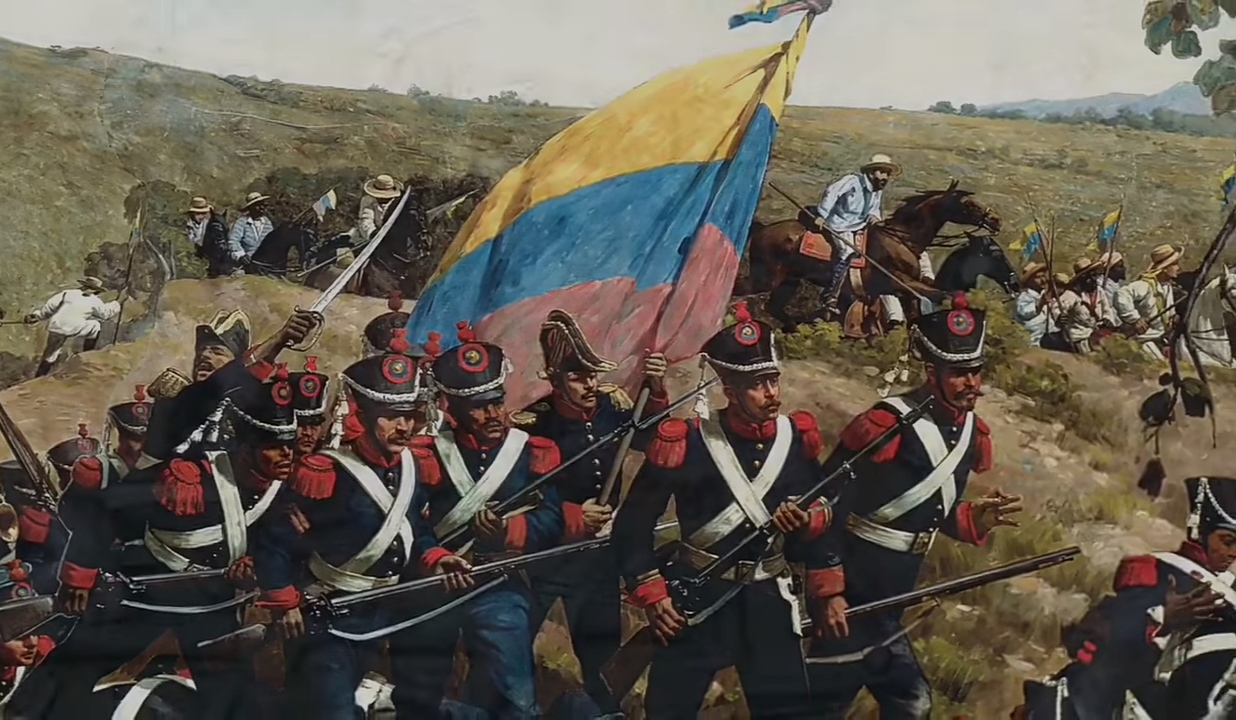
Battle of Carabobo
Pedro Camejo, lance in hand, was trying to rally his men when two musket balls struck him in the chest. General Jose Antonio Paez, watching him stagger, called him a coward. Camejo's reply, delivered with his dying breath, has echoed through Venezuelan history: "No, I am not! My general, I have to tell you goodbye, because now I am dead." It was June 24, 1821, and the plains of Carabobo were deciding the fate of a nation. By the time the smoke cleared, Simon Bolivar's independence forces had shattered the main Spanish Royalist army in Venezuela, and a country that had declared and lost its freedom twice before would not lose it again.
Three Republics and Counting
Venezuelan independence did not arrive on the first attempt, or the second. The First Republic, declared in 1811, collapsed within a year. Bolivar's mentor Francisco de Miranda was handed to the Spanish -- by Bolivar himself, who believed Miranda a traitor, in what historians consider one of the most controversial decisions of his life. Bolivar fled, regrouped, and launched the Admirable Campaign of 1813, re-establishing the Second Republic. That fell too, overwhelmed by Royalist counterattacks in 1814. Bolivar retreated again, this time forging an alliance with New Granada to create Gran Colombia in 1819, with himself as president. By 1820, an armistice with the Spanish had broken down, and Bolivar turned his full attention to liberating Venezuela once and for all. He gathered a force of 6,500 to 8,000 soldiers and marched toward the Royalist positions blocking the road between Valencia and Puerto Cabello.
The Flanking Gamble
The Royalists, commanded by Spanish Field Marshal Miguel de la Torre, held strong defensive ground along the road. Bolivar's plan was to split his army: he would press through the center while Paez swung around to strike the right flank through rough terrain and dense vegetation. But before the flanking column could get into position, two Spanish field guns opened fire on the advancing Patriots. De la Torre, recognizing the threat, split his own force to meet the flank attack. Royalist musket fire hammered the Apure Braves Battalion, and the initial Venezuelan infantry assault faltered and fell back. The battle's outcome hung on whether the flanking force could seize the high ground before the Spanish consolidated their advantage.
The British Who Saved a Revolution
Into the breach went the British battalion -- 340 to 350 men, mostly of British and Irish origin, commanded by Colonel Thomas Ilderton Ferrier. Many were veterans of the King's German Legion and the Napoleonic Wars, hardened soldiers who had crossed an ocean to fight for a cause that was not originally their own. Outnumbered and low on supplies, they attacked the hills that the Venezuelan infantry had failed to take. They succeeded. The cost was staggering: 119 dead by battle's end, including 11 officers. Colonel Ferrier was among them. Bolivar would later call the British legionaries the "Saviors of my Fatherland," a tribute that acknowledged a simple fact -- without their willingness to absorb devastating casualties on a hillside in Carabobo, the battle might have gone the other way.
The Rout and What Followed
Once the British and the reinforcing Apure Braves secured the heights, the tide turned decisively. Patriot cavalry under Colonel Munoz broke through the Royalist center and swept toward de la Torre's rear. Spanish infantry formed defensive squares and fought with discipline, but the Royalist llanero cavalry had already fled the field. The collapse was total. Only about 400 soldiers from one Spanish infantry regiment reached the safety of Puerto Cabello. Both Ambrosio Plaza and Manuel Cedeno, commanders of the Patriot 2nd and 3rd Divisions, were killed in the fighting -- a reminder that the victory cost both sides dearly. Subsequent engagements followed, including the naval Battle of Lake Maracaibo in July 1823 and Paez's capture of Puerto Cabello, the last Royalist stronghold, in November 1823. But Carabobo was the decisive blow.
A National Holiday, on the Battlefield Itself
June 24 is now Battle of Carabobo Day, also known as Army Day in Venezuela. It is the country's largest military observance after Independence Day on July 5 and the celebration of Bolivar's birth on July 24. Each year, the Venezuelan Army stages a televised parade displaying its ground forces, and a historical reenactment takes place on the actual battlefield in Carabobo state, organized jointly by the state government, the Ministry of Defense, and the Ministry of Education. Elementary and middle school students participate in the reenactment, walking the same ground where Camejo fell, where Ferrier's British battalion charged uphill, and where the independence of Venezuela was secured through courage, sacrifice, and a flanking maneuver that nearly did not work.
From the Air
Coordinates: 10.005N, 68.166W, on the plains of Carabobo state between Valencia and Puerto Cabello in northern Venezuela. The battlefield is relatively flat terrain south of the road connecting the two cities, with hills on the western side where the critical British assault took place. Valencia (SVVA) is the nearest major airport, approximately 15 km to the southeast. Puerto Cabello lies to the northwest on the Caribbean coast. The Carabobo battlefield monument and memorial park are visible from low altitude. Recommended altitude: 3,000-5,000 feet to see the terrain that shaped the battle -- the road, the flanking hills, and the flat ground where the cavalry broke through.