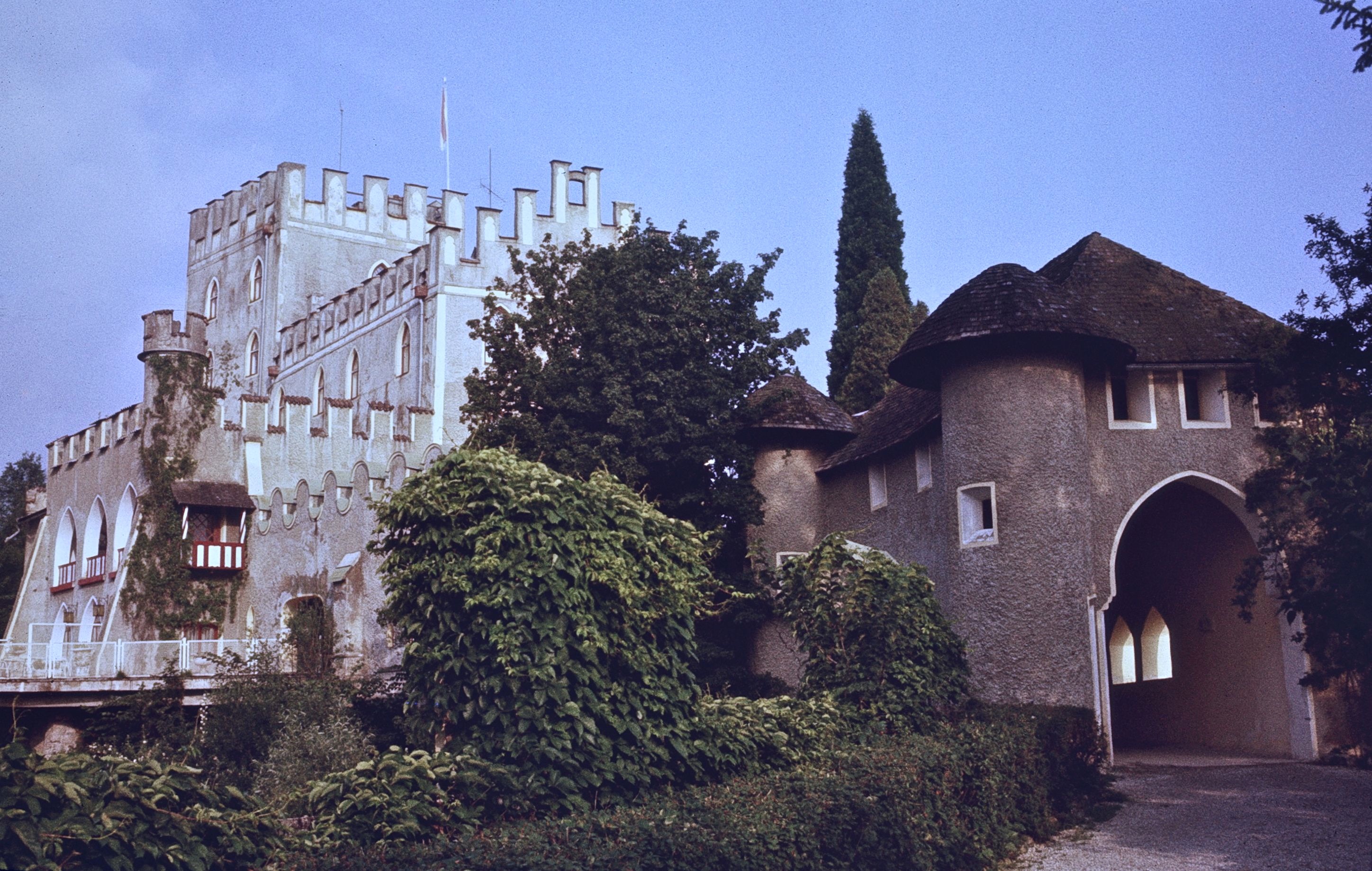
Battle of Castle Itter
Five days after Adolf Hitler's suicide, two days before Germany's unconditional surrender, American and German soldiers fought on the same side. On May 5, 1945, at a small castle on a hill near the village of Itter in Austria's North Tyrol, a force of fourteen American GIs, a handful of Wehrmacht defectors, a convalescing SS officer, and a group of high-profile French prisoners -- including two former prime ministers, two former commanders-in-chief, and Charles de Gaulle's elder sister -- held off an assault by 100 to 150 Waffen-SS troops. Popular accounts have called it the strangest battle of World War II. The facts make the label hard to argue with.
A Castle Becomes a Prison
Castle Itter is a small fortress perched above the village of the same name. After the 1938 Anschluss, the German government leased it from its owner, Franz Gruner. In February 1943, SS Lieutenant General Oswald Pohl, acting on Heinrich Himmler's orders, seized the castle outright. By April 1943 it had been transformed into a prison under the administration of the Dachau concentration camp, purpose-built for French prisoners the Reich considered valuable hostages. The captives included tennis champion Jean Borotra, former prime ministers Edouard Daladier and Paul Reynaud, former commanders-in-chief Maxime Weygand and Maurice Gamelin, resistance leader Francois de La Rocque, trade union leader Leon Jouhaux, and Marie-Agnes de Gaulle, Charles de Gaulle's elder sister. Eastern European prisoners detached from Dachau performed the maintenance work.
A Cook on a Bicycle
As the Third Reich collapsed in early May 1945, the castle's SS guards abandoned their posts. The prisoners armed themselves with leftover weapons but feared roving SS patrols still loyal to the dying regime. On May 3, a Yugoslav prisoner named Zvonimir Cuckovic slipped out under a false errand to seek Allied help. When he failed to return, the castle's Czech cook, Andreas Krobot, volunteered to bicycle to the nearby town of Worgl. There he reached the Austrian resistance and was taken to Major Josef Gangl, a Wehrmacht officer who had defied orders to retreat and instead joined the local resistance to protect civilians from SS reprisals. Gangl needed American help. He found it in Lieutenant John C. Lee Jr., commanding a reconnaissance unit of Sherman tanks from the 12th Armored Division, idling in Kufstein while waiting to be relieved. Lee volunteered without hesitation.
Besotten Jenny at the Gate
Lee's rescue force dwindled on the way to the castle. A flimsy bridge forced him to send back reinforcements from the 142nd Infantry Regiment. He arrived at Castle Itter with just fourteen American soldiers, Gangl, a driver, and ten former German artillerymen in a truck. Meanwhile, the French prisoners had recruited an unlikely defender: Kurt-Siegfried Schrader, an SS officer recovering from wounds nearby whom they had befriended. Schrader moved his own family into the castle and took charge of the defense alongside the Americans and Germans. Lee positioned his lone Sherman tank -- christened Besotten Jenny -- at the main entrance and placed his mixed force of Americans, Wehrmacht soldiers, and armed French prisoners in defensive positions around the walls.
The Last Morning of the War
The SS attacked on the morning of May 5. Machine gun fire and anti-aircraft shells shook the medieval walls hard enough to dislodge bricks; one struck and injured Schrader's wife. An 88mm gun destroyed Besotten Jenny, though its sole occupant -- a radioman trying to fix the tank's faulty radio -- escaped unhurt. Lee ordered the French prisoners to shelter inside, but they refused and fought alongside the defenders. Gangl phoned the Austrian resistance in Worgl for reinforcements; only two more soldiers and a teenage resistance member named Hans Waltl could be spared. By early afternoon, with ammunition nearly spent, word finally reached the 142nd Infantry Regiment. A relief column arrived around 4:00 PM, and the SS were swiftly defeated. About 100 SS prisoners were taken. The sole defender killed was Major Gangl, struck by a sniper's bullet while shielding former Prime Minister Paul Reynaud from fire.
What Remained
The French prisoners were evacuated that evening, reaching Paris on May 10. Lieutenant Lee was promoted to captain and awarded the Distinguished Service Cross. He died in 1973. Gangl, the German officer who chose his conscience over his orders, is honored with a street named after him in Worgl. Schrader received a two-year sentence for his Nazi party affiliation, shortened in recognition of his defense of the castle; he died in 1995. The battle remains one of only two known instances during the war when Americans and Germans fought on the same side -- the other being Operation Cowboy -- and the only documented case of an active Waffen-SS member fighting alongside the Allies. Tennis star Jean Borotra, recognized by French Canadian reporter Rene Levesque (later Premier of Quebec), had asked for an American uniform before joining the relief force racing to the castle.
From the Air
Located at 47.471N, 12.140E, Castle Itter sits on a hilltop above the village of Itter in Austria's Inn Valley, approximately 15 nm southeast of Innsbruck. The castle is visible from 2,000-3,000 feet AGL as a small fortified structure on a prominent hill. The Inn Valley runs east-west below, with mountains rising steeply on both sides. Nearest airports: Innsbruck Airport (LOWI) approximately 40 nm to the west, and Salzburg Airport (LOWS) approximately 60 nm to the northeast. The town of Kufstein is visible to the north along the Inn River.