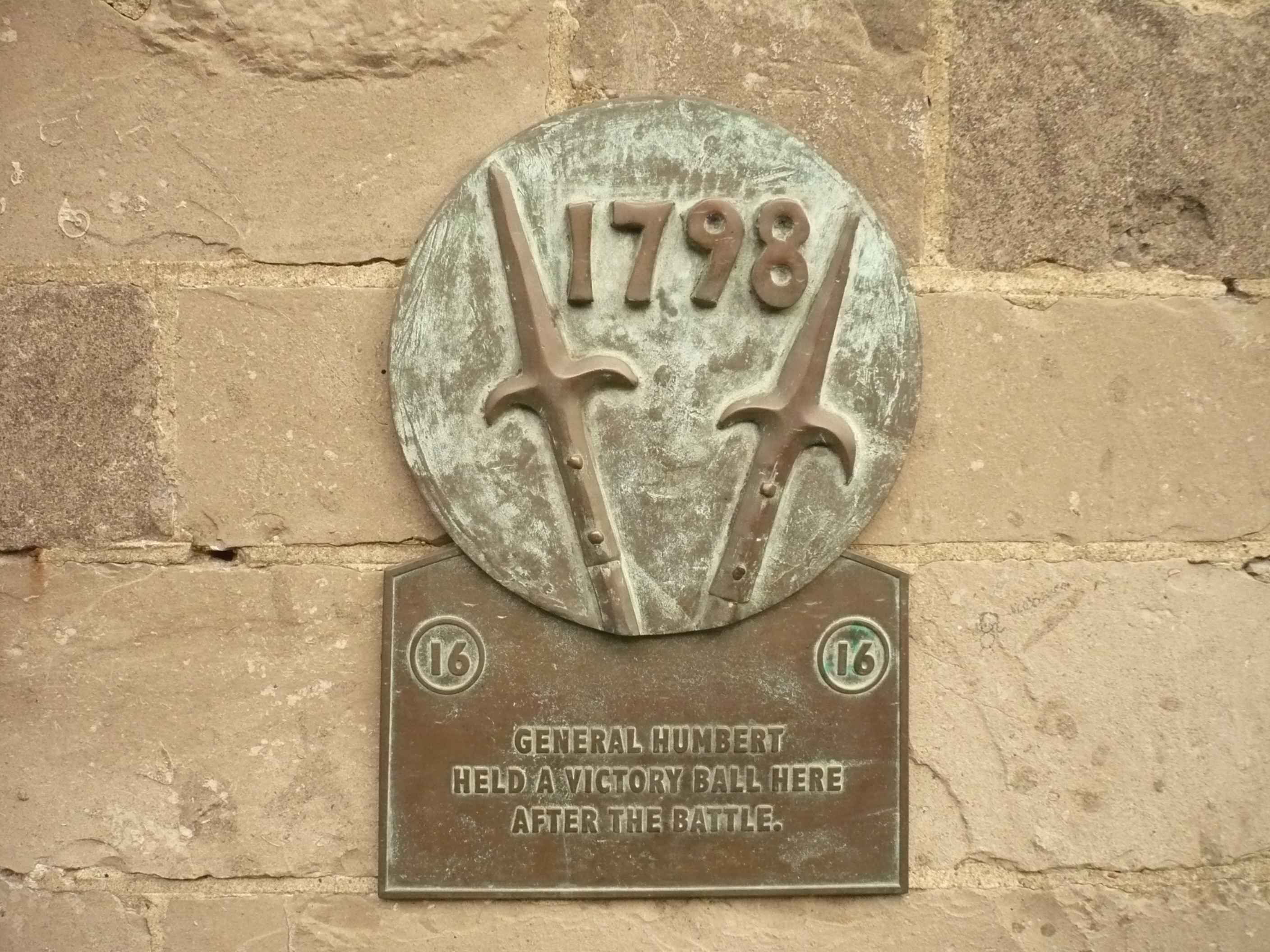
Battle of Castlebar
The British army did not stop running at Castlebar. They did not stop at Tuam, twenty-five miles away. Some units kept going until they reached Athlone, sixty miles to the east, and it took the personal arrival of Lord Cornwallis to prevent them from crossing the River Shannon entirely. On 27 August 1798, a combined force of roughly 800 French soldiers and 2,000 Irish rebels had routed a British Crown force of up to 4,000 men who held the high ground, the artillery, and every tactical advantage. The engagement became known -- with the particular Irish genius for mockery -- as the 'Races of Castlebar.'
The French Are Coming (Again)
Five days before the battle, on 22 August 1798, General Jean Joseph Amable Humbert landed nearly 1,100 French soldiers at Killala Bay in County Mayo. France had been sending -- or promising to send -- military support to Irish rebels for years, and this time the troops actually arrived, though far fewer than hoped. The remote landing site ensured no immediate British opposition; the Crown's tens of thousands of soldiers were concentrated around Leinster, mopping up the remnants of the broader 1798 Rebellion. Humbert quickly captured Killala after brushing aside local yeomanry, then took Ballina two days later. As word spread through County Mayo that the French had come, United Irishmen volunteers began arriving at Humbert's camp from across the county.
The Road Nobody Expected
General Gerard Lake, fresh from his victory at the Battle of Vinegar Hill, concentrated his forces at Castlebar. By dawn on 27 August, he had 3,000 to 4,000 soldiers, dozens of artillery pieces, and abundant supplies. His defensive position seemed unassailable -- he had deployed his forces to cover the obvious approach road from Ballina. Humbert, however, had local knowledge. Irish guides showed the French an alternative route through the wild country west of Lough Conn, a path the British thought impassable for an army with artillery. The exhausting overnight march through boggy mountain terrain worked. When Lake's scouts finally spotted Humbert's force, it was approaching from an entirely unexpected direction, and the British had to scramble to redeploy their entire defensive line.
Bayonets and Panic
Humbert's troops appeared outside Castlebar around six in the morning, already exhausted from their mountain march. The hastily repositioned British artillery opened fire and the initial cannonade was devastating -- most of the Franco-Irish casualties, about 150 men, came in these opening minutes. But French officers spotted a defile of scrub and undergrowth that provided some cover from the guns, and through it they launched a bayonet charge of such ferocity that it unnerved the infantry stationed behind the artillery line. The defenders began to waver before the French even reached them. Then they broke. The panic spread like contagion. Irish militiamen of the Longford and Kilkenny militias abandoned their positions -- some defecting outright, crossing the field to join the rebels and fight their former comrades. Lake's troops fled Castlebar in disorder, abandoning guns, equipment, and the general's personal luggage.
Twelve Days of Republic
The victory electrified Ireland. Thousands of volunteers rushed to join the United Irishmen, and on 31 August the rebels proclaimed a Republic of Connaught. It lasted twelve days. The British recovered quickly, massing over 15,000 troops. On 8 September, Cornwallis defeated Humbert at the Battle of Ballinamuck, and Humbert surrendered. The aftermath was brutally asymmetric: captured French soldiers were sent to England and eventually repatriated, but French officers of Irish origin were hanged in Dublin alongside Irish rebels. Five hundred rebels were killed at Ballinamuck, and 200 more were captured. Killala was retaken on 12 September. A French naval reinforcement was intercepted and defeated at the Battle of Tory Island. The rebellion was over. But the memory of Castlebar -- the day a ragtag force of exhausted Frenchmen and half-armed Irish farmers made a professional army run for sixty miles -- endured. It endures still.
From the Air
Located at 53.86°N, 9.30°W near the town of Castlebar, County Mayo. Castlebar is a medium-sized town visible from altitude in a valley setting. Lough Conn is visible to the north -- the French flanking route ran along its western shore. Nearest airport: Knock Airport (EIKN), approximately 30 km northeast. Croagh Patrick is visible to the southwest. The battlefield area is on the approaches to the town from the northwest.