Battle of Cedar Mountain
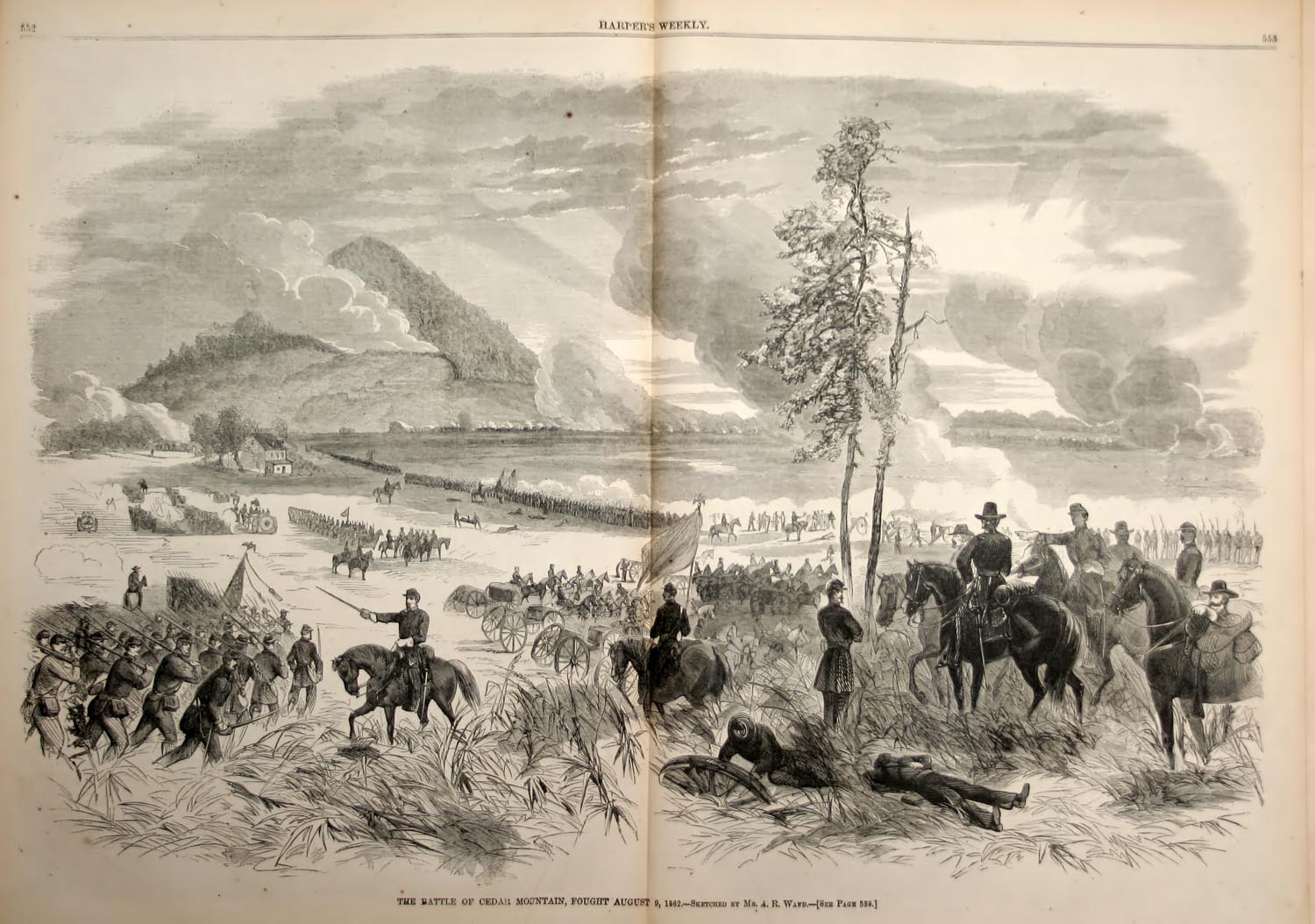
Stonewall Jackson tried to draw his sword, and it would not come. Rusted shut in its scabbard from months of disuse, the blade refused to budge. So Jackson unbuckled the whole thing -- sword, scabbard, and all -- and waved it over his head while grabbing a battle flag from a retreating soldier. It was August 9, 1862, the heat was suffocating, and the Confederate general who had terrorized the Shenandoah Valley was about to lose a battle to an opponent he had already beaten twice. That he did not lose it came down to this desperate, almost absurd moment on a wheat field in Culpeper County, Virginia.
A Grudge March North
The summer of 1862 found Robert E. Lee repositioning his forces across Virginia. In late July, Lee dispatched Jackson with 24,000 men to Gordonsville to counter the newly formed Union Army of Virginia under Maj. Gen. John Pope. Pope had deployed his forces in an arc across northern Virginia, with Maj. Gen. Nathaniel P. Banks holding the center near Little Washington. Banks still smarted from his defeats by Jackson in the Shenandoah Valley that spring. When Pope ordered him to hold a defensive line on a ridge above Cedar Run, south of Culpeper Court House, Banks ignored the spirit of the order. Rather than dig in and wait for reinforcements, he planned to attack Jackson before the Confederates could fully deploy -- despite being outnumbered two to one. It was the kind of decision that wins wars or ends careers.
Heat, Confusion, and a Mortal Wound
Virginia was locked in an August heat wave. Jackson's columns crossed the Rapidan River on the morning of August 9 and began forming up near Cedar Mountain. The temperature climbed past unbearable, and the initial phase of battle was a nearly two-hour artillery duel in which neither side gained the upper hand. Artillerymen collapsed from heat stroke at their guns. The Confederate deployment was chaotic. Jackson's habitual secrecy about his plans had left his division commanders confused about routes and positions, and gaps remained in the Southern line. Then, just before 5:00 PM, a shell fragment tore into Brig. Gen. Charles S. Winder as he directed troops from an ambulance wagon -- he had been too ill to ride a horse. His left arm and side were destroyed, and he died hours later. Command of his division fell to a general who had no idea what Jackson intended.
Five Minutes of Fury
Banks struck with everything he had. Crawford's brigade charged across an open wheat field and crashed into the exposed flank of the Confederate left, rolling through the 1st Virginia Infantry Battalion and the 42nd Virginia, streaming into the rear of the Southern artillery. The Confederate line buckled and threatened to shatter. On the right, Augur's division pushed through a thick cornfield under murderous fire from rebel batteries on the slope of Cedar Mountain. Augur himself took a wound in the foot. But it was Crawford's assault that nearly won the day. His men poured through a gap between two Confederate brigades, and for a few wild minutes it seemed the entire Southern position might collapse. Then came Jackson's desperate rally. The reinforcements of A.P. Hill's division arrived and blunted Crawford's momentum. The Stonewall Brigade wheeled right, cutting into the wheat field behind Crawford's men. The 10th Maine, 461 men strong, was ordered to hold alone against three Confederate brigades. In what survivors said lasted barely five minutes, the regiment lost 179 men.
The Field After Dark
By 7:45 PM the Union line was in full retreat. Banks threw two cavalry squadrons at the Confederate infantry in a last-ditch effort to cover the withdrawal. Only 71 of 174 riders escaped. Jackson pursued for a mile and a half before darkness and uncertainty about the rest of Pope's army made him call off the chase. The butcher's bill was severe: 2,353 Union casualties including 314 killed, against 1,338 Confederate losses. Crawford's brigade had lost more than half its strength. Four days later, Clara Barton arrived to conduct her first field work of the war, spending two days and nights tending the wounded on the ground where they had fallen. Jackson held his position for two days, then withdrew behind the Rapidan. The battle's strategic legacy was decisive: Union General-in-Chief Henry Halleck halted Pope's advance on Gordonsville, surrendering the initiative to Lee and setting the stage for the Northern Virginia campaign that would culminate at Second Bull Run.
What the Wheat Field Remembers
Today the American Battlefield Trust and its partners have preserved significant acreage of the Cedar Mountain battlefield, centered near the intersection of Virginia State Routes 15 and 657 -- the latter now called General Winder Road. The preserved land includes the area where Crittenden Gate once stood, the wheat field where Crawford's charge broke the Confederate line, the spot where Winder fell mortally wounded, and the ground where Jackson waved his rusted sword and turned the tide of battle. The quiet fields of Culpeper County give little hint of the afternoon when two armies fought to exhaustion in killing heat, and a Union general's bold gamble came within a few hundred yards of changing the course of the war.
From the Air
Cedar Mountain battlefield is located at approximately 38.40N, 78.07W in Culpeper County, Virginia. The mountain itself rises prominently above the surrounding farmland and is visible from cruising altitude. Nearest airports include Culpeper Regional (KCJR) approximately 8 miles north and Orange County (KOMH) to the south. The battlefield sits along the Route 15 corridor between Culpeper and Orange. In clear weather, the preserved wheat field and the distinctive profile of Cedar Mountain are identifiable from moderate altitude.