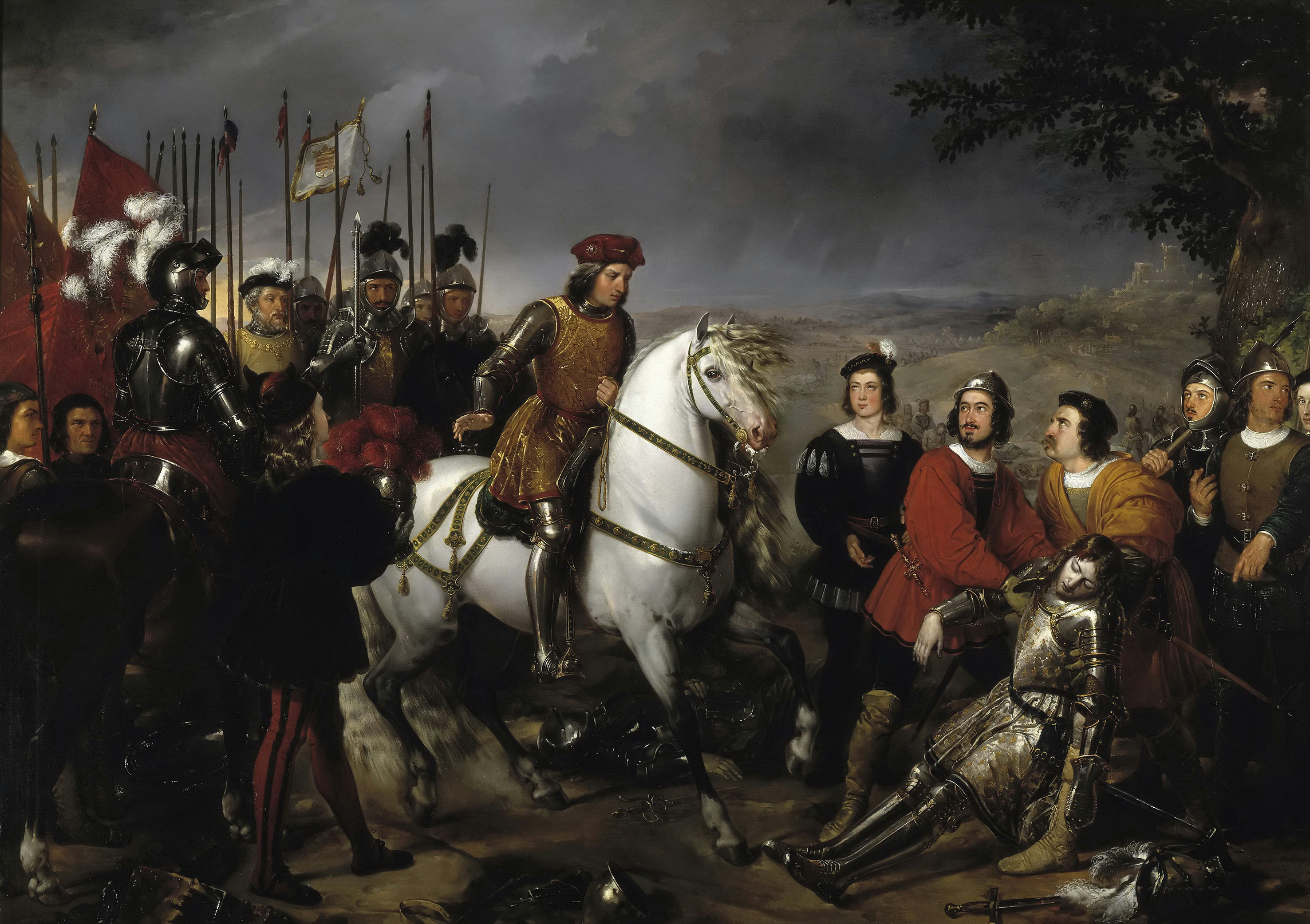
Battle of Cerignola
When Gonzalo Fernandez de Cordoba's gunpowder reserves exploded on the hilltop above Cerignola on 28 April 1503, a lesser commander might have panicked. Instead, El Gran Capitan turned to his troops and said, "Good sign, friends -- those are the lights of victory." Within hours, the man's audacity proved prophetic. His outnumbered Spanish force, dug in behind ditches and vineyard walls, would repel wave after wave of French heavy cavalry and Swiss pikemen, killing the French commander and rewriting the rules of European warfare in the process.
A Quarrel Over Naples
The roots of the battle lay in a secret treaty gone sour. In 1500, France and Spain had quietly agreed to carve up the Kingdom of Naples between them, with Louis XII of France claiming the throne. But shared spoils breed shared resentments, and by late 1502 the two powers were quarreling over the borderlands between their respective zones of control. The Third Italian War reignited. Cordoba, commanding roughly 9,000 Spanish troops in southern Italy, initially avoided the larger French force, content to skirmish and wait. He was drawing the French into complacency, letting their confidence build until the right moment to strike. Cerignola, a hilltop town in Apulia about 80 kilometers west of Bari, would provide the ground he needed.
The Ditch That Changed Everything
Cordoba's genius lay not in some flashy maneuver but in a hole in the ground. He fortified the heights above Cerignola with ditches and stakes, positioning his 1,000 arquebusiers behind the earthworks with 2,000 German Landsknecht pikemen in support. His artillery surveyed the field from the vineyards above. The Spanish infantry itself was organized into a new formation called coronelias -- a mix of pikes, arquebuses, and swords that would evolve into the legendary tercios. These units represented a revolution in military thinking for a nation that, like France, had relied on mounted knights throughout the long centuries of the Reconquista. Now the foot soldier with a handgun was about to become the most important fighter on the battlefield.
The Charges That Failed
The French army under Louis d'Armagnac, Duke of Nemours, was formidable on paper: 9,000 men anchored by armored gendarme cavalry and Swiss mercenary pikemen, backed by roughly 40 cannons. But those cannons never fired a meaningful shot. The battle opened with two thundering cavalry charges against the Spanish center, both shattered by concentrated arquebus fire. A third assault veered toward the right flank, and here the ditch proved deadly -- French horsemen tumbled into the trench while Spanish gunners poured volleys into the chaos. Nemours himself fell to the arquebus fire, making him possibly the first European general killed by small-arms fire in battle. When the Swiss pikemen charged alongside surviving cavalry, they too broke against the Landsknecht line, raked from both flanks by arquebusiers. Their commander Chandieu died in the assault.
Prayers for the Fallen
With the French attack broken, Cordoba launched his counterattack. Spanish and German infantry surged forward while mounted arquebusiers encircled the remaining French gendarmes. The Swiss pikemen managed to retreat in some order, but the rout was total -- the French lost their supply wagons, their artillery, and their commanding general. Spanish casualties amounted to roughly 500 men. What happened next set Cerignola apart from the typical bloodletting of the Italian Wars. Surveying fields strewn with French dead -- fellow Christians, he noted -- Cordoba ordered three long tones played and commanded his men to pray for all the fallen, friend and enemy alike. This toque de oracion became a practice later adopted across Western armies. He then had the body of Nemours recovered and honored with a full military funeral.
The Gun Ascendant
Field Marshal Bernard Montgomery later called Cerignola the turning point where infantry displaced cavalry on the European battlefield, a status the foot soldier with a firearm would hold for over 400 years. The battle inaugurated the age of pike and shot tactics that dominated European warfare until the mid-seventeenth century, and it launched Spain's 140-year reign as the continent's preeminent military power -- a dominance that would last until the defeat at Rocroi in 1643. Japan would arrive at the same conclusion independently, at the Battle of Nagashino in 1575, when massed arquebus fire similarly destroyed cavalry charges. Today, Cerignola is a quiet agricultural town on the Apulian plain, its hillside vineyards giving little hint that this was where the medieval knight, armored and mounted, rode into obsolescence.
From the Air
Located at 41.27N, 15.90E in the Apulian plains of southeastern Italy. The town of Cerignola sits on a gentle rise amid flat agricultural land, visible from altitude as a compact settlement surrounded by vineyards and olive groves. Nearest major airport is Bari Karol Wojtyla (LIBD), approximately 80 km to the east. Foggia Gino Lisa Airport (LIBF) lies about 30 km to the west. The terrain is gently rolling Tavoliere plain, offering good visibility in clear weather.