Battle of Changping
His father had warned against it. On his deathbed, the general Zhao She told his wife: never let their son Zhao Kuo command an army. The young man could debate military philosophy brilliantly -- so brilliantly that his own father sometimes lost arguments. But Kuo treated war as an intellectual exercise, approaching risk with the confidence of someone who had never watched soldiers die. In the summer of 260 BC, Zhao Kuo arrived at Changping to take command of the Zhao army, replaced the cautious defensive strategy of his predecessor Lian Po with an aggressive offensive, and led several hundred thousand men into the most devastating military trap in ancient history.
The Trap at Shangdang
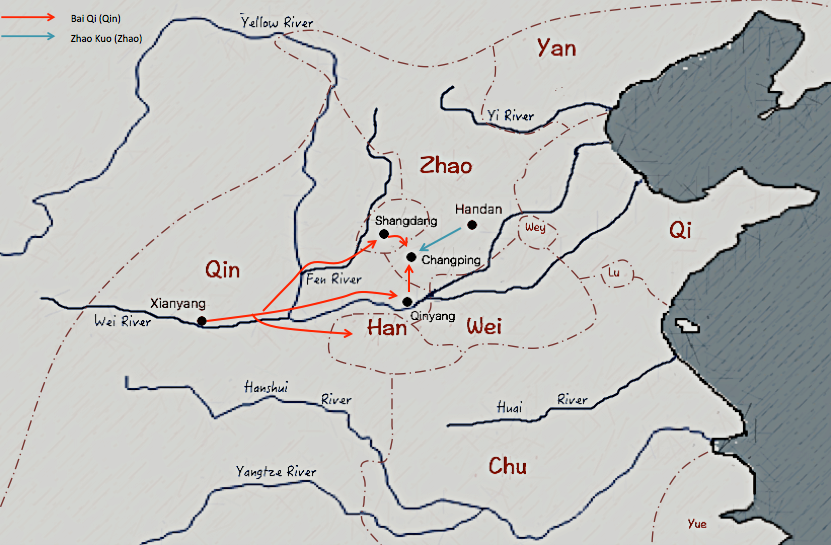
The chain of events began five years earlier when Qin attacked the State of Han and captured Qinyang, cutting off Han's Shangdang Commandery from its southern heartland. Rather than surrender the territory to Qin, Shangdang's governor Feng Ting offered the region to the neighboring state of Zhao. It was a poisoned gift. Shangdang sat just west of Zhao's capital Handan, and its strategic value made it impossible to refuse -- but accepting it meant war with Qin. King Xiaocheng of Zhao dispatched the veteran general Lian Po to secure the region. Lian Po assessed the situation, concluded that Qin's forces were too strong to defeat in open battle, and established three defensive lines along the Dan River south of Changping Pass, settling in for a war of attrition designed to exhaust the Qin army's supply lines.
The General Who Talked Too Well
For two years, the stalemate held. Both sides reinforced their positions until the total number of combatants approached a million. The cost of sustaining these armies strained both states to breaking. Qin, desperate to force a resolution, sent spies into Zhao to spread rumors that Lian Po was too old and cowardly to fight. King Xiaocheng, already frustrated by the war's duration, replaced Lian Po with the theorist Zhao Kuo. Minister Lin Xiangru and Zhao Kuo's own mother tried to reverse the decision. His mother extracted a promise that the Zhao clan would not be punished when -- not if -- her son failed. Meanwhile, Qin secretly replaced their own commander with Bai Qi, arguably the most lethal general of the ancient world, under a classification so strict that leaking the appointment was punishable by death.
A Million Men in a River Valley
Zhao Kuo discarded Lian Po's defensive strategy and crossed the Dan River to attack the Qin left flank. Bai Qi had anticipated exactly this. His left deliberately retreated toward prepared hill fortifications, drawing Zhao Kuo forward. Behind the advancing Zhao army, a Qin detachment of 25,000 men swept through the Taiyue Mountains to cut supply lines from the north. Simultaneously, 5,000 light cavalry crossed the Dan River to sever communications between Zhao Kuo's forward force and his rear depot, splitting the Zhao army in two. Within days, Bai Qi's main force sealed the river valley exits, completing a triangular encirclement. Zhao Kuo's army was trapped without food. For forty-six days they endured siege, slaughtering their horses for meat. Reports describe soldiers killing and eating each other. When Zhao Kuo led his best troops in a final breakout attempt, Qin archers and crossbowmen cut him down.
The Bones Beneath Gaoping
After the Zhao surrender, Bai Qi faced a grim calculus. He could not release hundreds of thousands of prisoners who would be reconscripted against him, and he could not feed them. His solution was mass execution. Sima Qian's Records of the Grand Historian, written roughly 150 years later, states that over 450,000 Zhao soldiers were killed during and after the battle -- most of them buried alive. Only 240 of the youngest captives were released to spread terror. Emperor Xuanzong of Tang built a temple over a collection of the remains centuries later, and scattered bones and mass graves continue to be discovered at the site near modern Gaoping. The catastrophe gave Chinese its enduring idiom for armchair strategists: "talking wars on paper," a phrase that invokes Zhao Kuo's name without needing to say it. Forty years later, Qin conquered every remaining state and unified China for the first time -- a unification made possible, in large part, by the annihilation of the only army that could have stopped it.
From the Air
Located at 35.80N, 112.92E near modern Gaoping, Shanxi province, in the Taihang Mountain foothills. The battlefield stretched across the Dan River valley south of Changping Pass. The terrain is hilly and rugged, transitioning from the Shanxi plateau toward the passes of the Taihang range. Nearest major airport is Changzhi Wangcun Airport (ZBCZ/CIH), approximately 40 km to the northeast. Exercise caution for mountainous terrain.