Battle of Chemulpo Bay
On the morning of February 9, 1904, the crews of British, French, Italian, and American warships anchored at Chemulpo lined their decks and watched in silence as the Russian cruiser Varyag steamed toward the harbor mouth. Aboard the Italian cruiser Elba, the band struck up the Russian national anthem. Everyone in that harbor knew what was waiting outside: six Japanese cruisers, a screen of torpedo boats, and a formal ultimatum that had expired at noon. Captain Vsevolod Rudnev had refused the neutral captains' advice to surrender. He would fight his way out or not come back at all.
An Ultimatum Delivered with Politesse
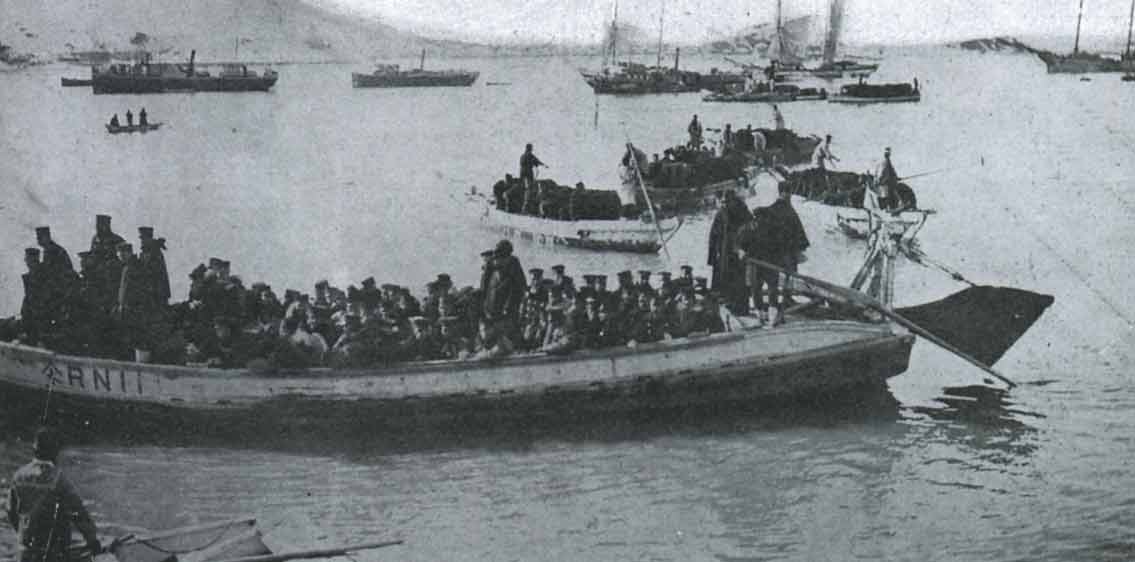
Chemulpo Bay -- present-day Incheon -- was an unlikely stage for the first major naval engagement of the Russo-Japanese War. The port served as Seoul's gateway to the sea, its wide tidal bore, extensive mudflats, and narrow winding channels making it treacherous for any fleet action. Two Russian warships had been stationed there for months: the protected cruiser Varyag and the aging gunboat Korietz, tasked with guarding Russian interests in Korea. The Japanese had kept their own cruiser, Chiyoda, nearby to watch them. When war became inevitable, Rear Admiral Uryu Sotokichi arrived with an overwhelming force -- six cruisers, torpedo boats, three transports, and 2,500 ground troops -- to secure the port and neutralize the Russian presence. His letter to the neutral warships was a masterpiece of diplomatic courtesy: he would attack at four o'clock, and he respectfully requested they keep clear.
Sixty-Five Minutes of Fire
At 11:20 on February 9, Varyag and Korietz cleared the harbor, the gunboat trailing one cable length -- about 200 meters -- behind. The Japanese squadron waited in a bearing line stretching from Richy Island to the Northern Passage. At 11:45, Varyag opened fire with her port guns. Two minutes later, the armored cruiser Asama replied with her eight-inch main battery, and the entire Japanese line erupted. The destruction came fast. One of the first shells obliterated Varyag's forward bridge, killing junior navigating officer Midshipman Count Alexey Nirod and the entire rangefinding station crew. Fires broke out across the ship. By 12:05, a shell fragment struck Captain Rudnev in the head, killing the bugler and drummer standing beside him. The rudder jammed at fifteen to twenty degrees to port, forcing the crew to steer by engines alone through strong currents. A large-caliber shell punched through the hull below the waterline, flooding stokehold number three.
Scuttled Rather Than Surrendered
By 12:40, with Japanese shells falling dangerously close to the neutral warships at anchor, Varyag limped back into the harbor. Every one of her twelve six-inch guns was out of action. She had taken five serious hits at or below the waterline, her upper works were riddled, and her crew had fought at least five major fires. Of her 580 crewmen, 33 were dead and 97 wounded. Rather than let the ship fall into Japanese hands, Rudnev made his decision. At four o'clock that afternoon, the crew of Korietz blew up her powder rooms -- fragments landing alarmingly close to the neutral vessels. The neutral captains urged Rudnev not to repeat the spectacle. Instead, at 6:10 PM, Varyag's seacocks were opened. She rolled onto her port side and slipped beneath the shallow waters of Chemulpo harbor. The crew then set fire to the transport Sungari for good measure.
Heroes in Defeat
The surviving Russian sailors were taken aboard neutral warships and returned to Russia, where they were received not as defeated men but as national heroes. The story of Varyag's hopeless charge against overwhelming odds became one of the defining narratives of Russian naval pride, inspiring songs and monuments that endure to this day. The Japanese, meanwhile, had won a nearly bloodless victory -- though Russian logbooks recorded hitting the cruiser Asama's bow bridge and setting her afire, Japanese records claim she sustained no damage at all. In a final irony, the Japanese raised Varyag from the harbor floor, repaired her, and commissioned her into the Imperial Japanese Navy as a training ship. The cruiser that had chosen destruction over surrender sailed again under the flag of the navy that had destroyed her.
Witnesses in a Neutral Harbor
What makes the Battle of Chemulpo Bay unusual is its audience. The captains of four neutral warships -- HMS Talbot, the French Pascal, the Italian Elba, and the American gunboat Vicksburg -- watched the entire drama unfold from ringside seats. They had convened a conference with Captain Rudnev, they had signed a joint letter protesting the Japanese violation of Chemulpo's neutral status, and they had offered the Russians the option of surrender. When Rudnev refused, they could only watch. The American captain, W. A. Marshall of Vicksburg, notably declined to sign the joint protest -- a small diplomatic footnote that speaks to the larger geopolitical currents already pulling the great powers toward their positions in the coming century's conflicts.
From the Air
Located at 37.35N, 126.52E in present-day Incheon harbor, South Korea. The battle site lies in the approaches to Incheon's modern port area. Best viewed from 3,000-5,000 feet. Incheon International Airport (RKSI) is approximately 25 km to the west. Seoul's Gimpo International Airport (RKSS) lies 20 km to the northeast. The harbor's extensive mudflats and tidal channels are visible at low tide.