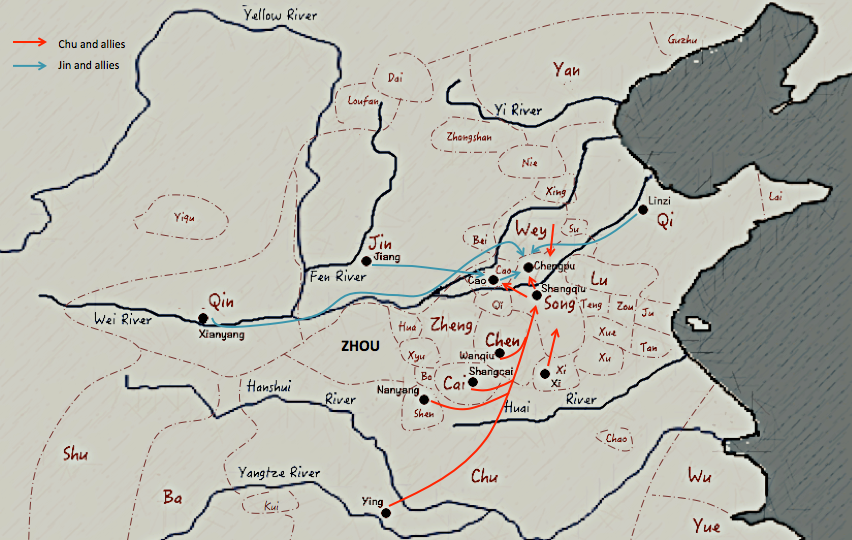
Battle of Chengpu
Before the battle began, Duke Wen of Jin ordered his army to retreat forty-five kilometers. It was not cowardice. Years earlier, when the duke was still a wandering exile named Chong'er, the king of Chu had shown him hospitality. In return, Chong'er had promised that if they ever met on a battlefield, he would withdraw "three days' march" as a gesture of respect. In 632 BC, on the plain of Chengpu, he honored that promise -- and then destroyed the Chu army anyway. The battle became the first major collision between the powers of the Yellow River valley and those of the Yangtze, a fault line that would define Chinese geopolitics for centuries.
A Prince Returns from Exile
Chong'er spent nineteen years wandering from state to state after being driven from Jin. He passed through Qi, Chu, Qin, and half a dozen smaller kingdoms, surviving on the patronage of foreign courts. When he finally returned to Jin in 636 BC with the backing of Duke Mu of Qin, he took power as Duke Wen and immediately set about restoring his state's position among the feudal lords. Meanwhile, the state of Chu had been steadily absorbing smaller states to the south, building an empire that reached northward into territories Jin considered its own sphere of influence. Conflict between the two great powers grew inevitable as the buffer states between them were forced to choose sides.
The Art of the Feigned Retreat
The Chu army arrived at Chengpu in three divisions. Only the center, under Prime Minister Ziyu, consisted entirely of Chu troops. The left wing drew soldiers from Chu's satellite states Shen and Xi, while the right was composed of contingents from Chen and Cai -- perhaps the weakest third of the entire force. Duke Wen's generals exploited this asymmetry with precision. On the battle's opening, Xu Chen attacked the fragile Chu right wing after dressing his chariot horses in tiger skins to panic the enemy mounts. The charge shattered the wing completely. On the opposite flank, Hu Mao's Jin right wing skirmished, then faked a retreat, dragging the great banners of the commander-in-chief with them. The Chu left took the bait and pursued, only to be caught in a devastating flank attack. Behind the Chu lines, Qi and Qin contingents captured the enemy camp.
Tiger Skins and Dust Clouds
Two tactical details from Chengpu entered Chinese military legend. The first was the tiger skins -- a psychological weapon that turned the Chu cavalry's own horses against them. The second was the dust cloud raised by Luan Zhi's chariots, which dragged tree branches across the plain to screen the regrouping of Jin forces from Chu observation. These were not the improvised tricks of desperate men but calculated innovations by commanders who understood that perception shapes battlefield reality as much as swords do. The Zuo Zhuan, which provides the most detailed surviving account of the battle, preserves these moments with an admiration that transcends the twenty-six centuries since they occurred.
Hegemony Won, and Its Limits
After the victory, Duke Wen was recognized by the King of Zhou as first among the feudal lords -- the coveted title of hegemon. A multi-state conference at Jiantu in 631 BC formalized a coalition supporting the Zhou royal house, with Jin at its head. Yet the battle did not permanently contain Chu's ambitions. The southern power regrouped and continued its northward expansion in subsequent generations. What Chengpu demonstrated was not the triumph of one civilization over another, but the pattern that would repeat across China's Spring and Autumn period: alliances shifting, smaller states crushed between larger ones, and military brilliance buying time rather than permanence. The exact location of the battlefield remains debated -- candidates include areas near Chenliu in Henan and southwestern Juancheng County in Shandong -- but the battle's significance in Chinese military and political history is beyond dispute.
From the Air
Located at approximately 34.67N, 114.53E in the plains of eastern Henan province, near the border with Shandong. The exact battlefield location is debated between sites near Chenliu (Henan) and Juancheng County (Shandong). The terrain is flat agricultural land along the Yellow River plain. Nearest major airport is Zhengzhou Xinzheng International (ZHCC/CGO), about 100 km to the west.