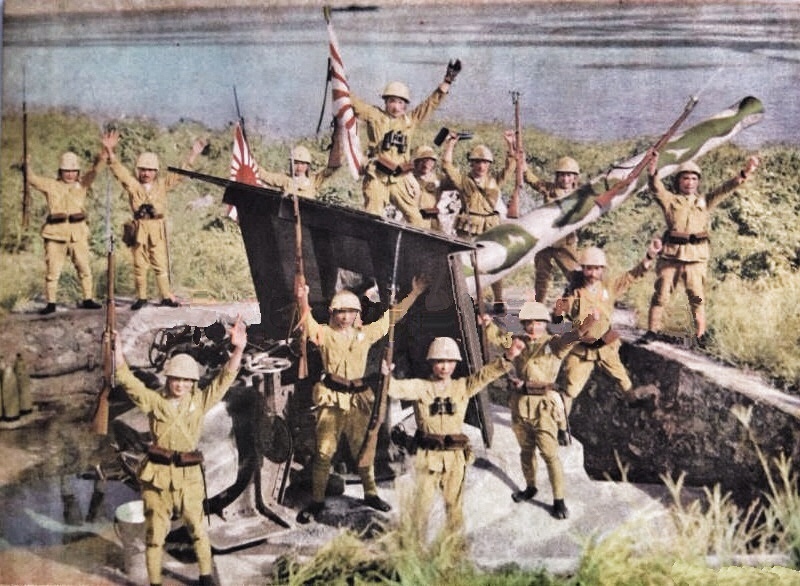
Battle of Christmas Island
Five British soldiers were murdered in their sleep, their bodies thrown into the Indian Ocean. The killers were not Japanese invaders but their own garrison comrades -- Punjabi troops who had turned against their officers on a speck of land most of the world had never heard of. The Battle of Christmas Island, fought in March and April 1942, was less a conventional engagement than a collision of mutiny, imperial propaganda, and sheer geographic isolation, played out on a tiny phosphate-rich island 500 kilometers south of Java.
A Garrison at the Edge of Empire
By early 1942, Christmas Island was a British possession administered through the Straits Settlements, valued almost entirely for its phosphate deposits. The garrison defending it was absurdly small: 32 troops of the Hong Kong and Singapore Royal Artillery, commanded by Captain L. W. T. Williams. His force included one Indian officer, Subadar Muzaffar Khan, 27 Punjabi gunners and NCOs, and four British enlisted men. Their armament consisted of a single coastal gun, built in 1900 and installed on the island in 1940. It was a defensive position designed to deter, not to win -- and in the chaos sweeping Southeast Asia after the fall of Singapore, it sat exposed and nearly forgotten.
Betrayal Before the Battle
Japanese propaganda had been filtering through colonial Asia with a seductive message: the liberation of India from British rule. On Christmas Island, some of the Punjabi troops believed it -- or at least found in it a reason to act. On 11 March 1942, a group of mutineers, likely supported by local Sikh police officers, shot Captain Williams and his four British enlisted men: Sergeants Giles and Cross, Gunners Thurgood and Tate. They disposed of the bodies in the sea. When the actual Japanese invasion force arrived on 31 March, the mutineers raised a white flag before the 850-man landing force had even come ashore. The island fell without a single shot fired in its defense on land.
Nine Torpedoes and Nine Hours of Depth Charges
The real fight happened offshore. At dawn on 31 March, Japanese bombers destroyed the radio station. But lurking beneath the waters was the USS Seawolf, a US Navy submarine whose crew had no intention of letting the invasion go unchallenged. At 09:49 that morning, Seawolf fired four torpedoes at the Japanese cruiser Naka. All missed. The next morning at 06:50, she fired three more at the cruiser Natori -- missed again. That evening, down to her last two torpedoes, Seawolf finally struck Naka on her starboard side near the No. 1 boiler. The damage was devastating: Naka had to be towed to Singapore by Natori and eventually limped back to Japan for a full year of repairs. The Japanese retaliated with over nine hours of depth charging, but Seawolf slipped away into the deep.
Occupation and Exile
With the island secured, the Japanese moved quickly to extract its phosphate wealth. Natori returned to withdraw most of the occupation force, leaving behind a skeleton garrison of just 20 men. Over the following months, more than 60 percent of the island's civilian population -- including European prisoners -- were relocated to Java. Phosphate production was halted entirely. The occupation lasted until mid-October 1945, when British forces reoccupied Christmas Island after Japan's surrender. For three and a half years, the island had been a footnote in the vast Japanese conquest of Southeast Asia, stripped of both its resources and its people.
Justice Across Empires
The postwar reckoning proved as complicated as the mutiny itself. Seven of the Punjabi mutineers were tracked down and court-martialed in Singapore in 1947. Five received death sentences; one was sentenced to two years' imprisonment. King George VI confirmed the executions in August 1947. But history moved faster than military justice. British India ceased to exist that same month, splitting into independent India and Pakistan, and suddenly the executions of South Asian soldiers by a departing colonial power carried diplomatic weight that no one had anticipated. An eighth mutineer was identified but never caught. On 8 December 1947, all death sentences were commuted to life imprisonment after India and Pakistan intervened. Years of argument followed over where the prisoners should serve their time. In June 1955, the six surviving prisoners were transferred to Pakistan, and Britain washed its hands of the case -- a quiet end to a story that had begun with gunshots in the dark on a remote island thirteen years earlier.
From the Air
Located at 10.49S, 105.63E in the Indian Ocean, approximately 500 km south of Java and 1,550 km northwest of Australia. Christmas Island is visible as a small forested landmass rising from deep ocean. The island's only settlement, Flying Fish Cove, is on the northeast coast. Nearest airport is Christmas Island Airport (YPXM). Recommended viewing altitude 5,000-8,000 ft for the full island perspective. The island's steep coastal cliffs and central rainforest plateau are clearly visible from the air.