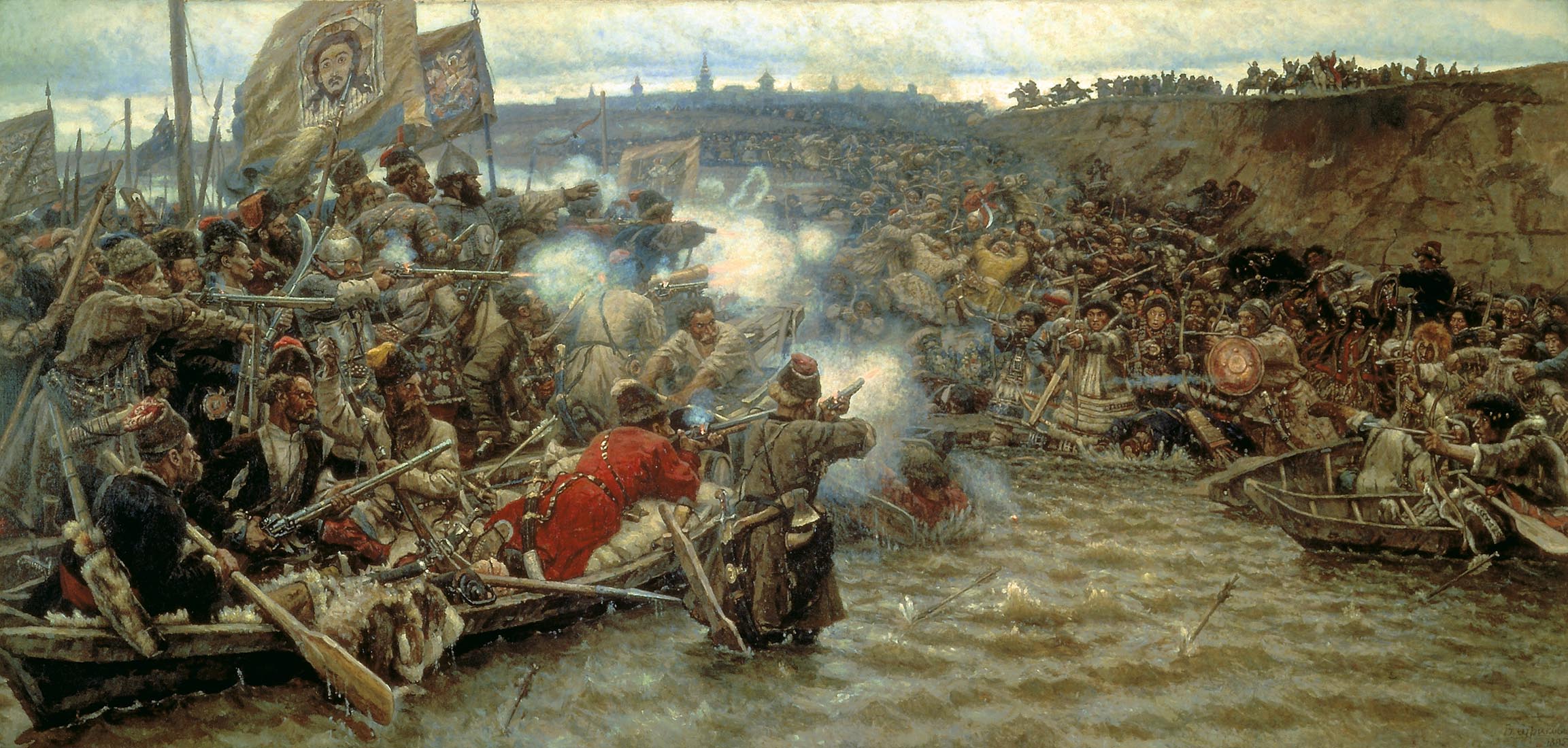
Battle of Chuvash Cape
It was not an army that conquered Siberia. It was a band of Cossacks -- 540 men armed and equipped by the merchant Stroganov family, later joined by 200 more -- led by a man named Yermak Timofeyevich. On November 5, 1582, near the Siberian Tatar capital of Qashliq on the Irtysh River, this small expeditionary force met the combined might of Khan Kuchum's realm. By the time the fighting ended, the Khanate of Sibir had effectively ceased to exist, and Russia's path eastward across the largest landmass on earth lay open.
A Merchant's Grudge, a Cossack's Ambition
The conflict began not with a tsar's decree but with a merchant family's grievance. After Kuchum seized power in the Khanate of Sibir, he launched raids against the lands of Perm, threatening the commercial interests of the Stroganovs, wealthy merchants who had been exploiting mineral deposits in the Ural region. Rather than petition Moscow for a military response, the Stroganovs turned to the Cossacks -- the semi-autonomous warrior communities of the frontier. They equipped Yermak's force with firearms, ammunition, and supplies, essentially hiring a private army. The expedition paddled eastward across the Urals by river, moving deeper into Tatar territory. Historians have compared this model to the Spanish conquistadors -- individuals and private interests driving conquest rather than state apparatus, a pattern that would reshape continents.
Guns Against Arrows on the Irtysh
Qashliq's fortifications were deteriorating, and Kuchum's commanders knew a siege would be fatal. They chose to fight at the riverbank instead, positioning ambush forces behind fallen trees along the shore and bringing cannons into place. When the Cossacks approached by boat and opened fire, the Tatars answered with arrows. The initial exchange favored neither side -- the Siberians' tree cover blunted the Cossack volleys, and Russian fire inflicted few casualties at first. Then the Siberian commander Mametqul ordered a counterattack. As his forces surged forward, the Cossacks formed a defensive square with riflemen in the center. The Khanty and Mansi tribesmen among the Siberian ranks had never faced organized firearms in battle. They were hunters, not soldiers in this kind of war. The concentrated gunfire panicked them, and they broke. The remaining Tatars pressed the attack, but the Cossack volleys kept cutting them down. Mametqul himself was shot and barely evacuated by boat.
An Empty Capital
With Mametqul wounded and evacuated, the rest of the Siberian army scattered. Kuchum fled Qashliq for the Baraba steppe, but most of his subjects refused to follow. The Cossacks, rather than pursuing the retreating khan, pulled back to nearby Atik-town for the night. When they entered Qashliq the following day, they found a deserted city. The population had melted away in the aftermath of the defeat. The capital was briefly reoccupied by Siberian Tatars between 1584 and 1586, but the Khanate of Sibir had fragmented beyond recovery. In 1587, the Russians founded the city of Tobolsk just 17 kilometers away, establishing the administrative seat of what would become Russia's Siberian territories. Interestingly, the Tatar cannons positioned before the battle never fired -- a detail that remains unexplained.
The Hinge of a Continent
The Battle of Chuvash Cape did not merely defeat an army; it dissolved a state. The Khanate of Sibir's territory was absorbed into the Tsardom of Russia, and within decades, Russian fur traders, administrators, and settlers were pushing ever farther east. The popular narrative -- that firearms overwhelmed a bowstring-wielding people, as in the Americas -- captures part of the truth, but the reality was more complicated. The Tatars had cannons. The initial firefight was inconclusive. What decided the battle was the panic of the Khanty and Mansi auxiliaries, who had no experience with this kind of combat, and the wounding of Mametqul at a critical moment. Yermak himself would die just three years later, drowning in the Irtysh River during a night ambush. But the process he set in motion proved irreversible. From this riverbank in western Siberia, Russia would expand across eleven time zones to the Pacific.
From the Air
Located at 58.18N, 68.25E, on the Irtysh River near modern Tobolsk in Tyumen Oblast, western Siberia. The battlefield is on the river's bank near the former site of Qashliq. The terrain is flat Siberian river plain with birch and conifer forest. Nearest airport is Tobolsk (no ICAO), with Tyumen's Roschino Airport (USTR) the nearest major facility. The Irtysh River is the dominant visual landmark -- a broad, winding waterway cutting through forested lowlands. Best viewed at 3,000-5,000 ft AGL.