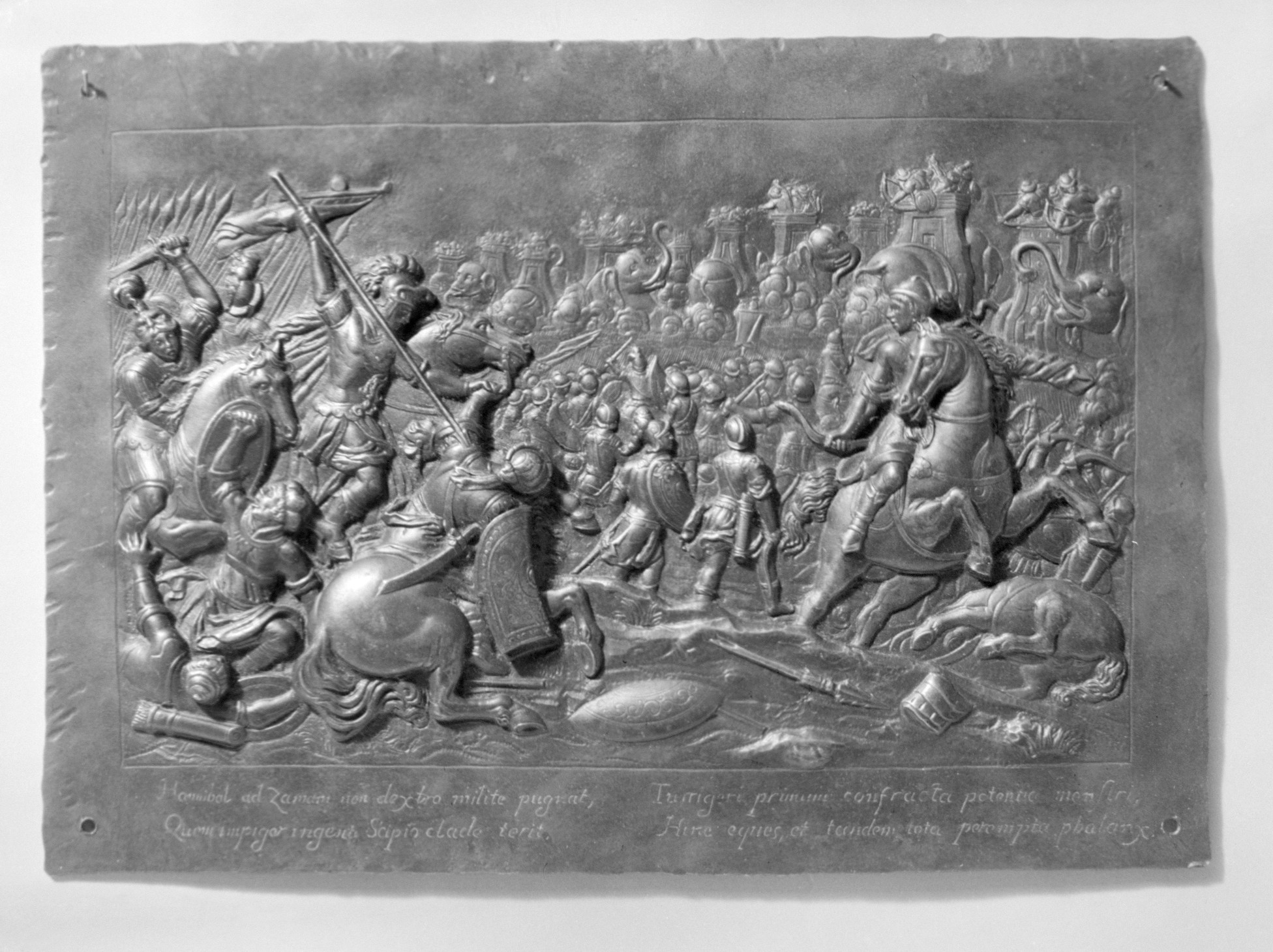
Battle of Cirta
Syphax's horse was shot out from under him. The king of the Masaesyli Numidians hit the ground, was seized by enemy soldiers, and in that single moment the balance of power in North Africa shifted permanently. The Battle of Cirta in 203 BC was fought in the shadow of the city that would become Constantine, and its consequences rippled outward until they helped bring down Carthage itself. It was not a battle between Rome and Carthage directly. It was a war between Numidian kings, with Roman legionaries tipping the scales.
Two Kings, One Bride
The rivalry between Syphax and Masinissa was personal before it was political. Syphax ruled the larger Masaesyli kingdom from his capital at Cirta. Masinissa was prince of the Massylii, a neighboring Numidian confederation based around Zama and Thugga. Both had been drawn into the Roman-Carthaginian struggle: Masinissa fought for Carthage in Spain before defecting to Rome, while Syphax ultimately sided with Carthage after the Carthaginian general Hasdrubal Gisco sealed the alliance by offering his daughter Sophonisba in marriage. The arrangement stung doubly because Sophonisba had originally been promised to Masinissa. Syphax then overran Masinissa's territory, scattered his army, and claimed his kingdom. By the time Roman forces landed in North Africa in 204 BC, Masinissa had been reduced to a fugitive with fewer than 2,000 followers.
Fire and Rout
The Roman general Scipio Africanus landed at Cape Farina with an army that modern historians estimate at 25,000 to 30,000 troops. Masinissa joined him. Together, they inflicted two devastating defeats on the combined Carthaginian and Numidian forces: a night attack at the Battle of Utica, where Roman soldiers set fire to the reed barracks of Syphax's camp and cut down the confused defenders in the dark, and a follow-up engagement at the Battle of the Great Plains, where demoralized Carthaginian troops broke and fled while only Iberian mercenaries stood and fought. Syphax retreated to Cirta. Masinissa pursued, accompanied by the Roman legate Gaius Laelius and a detachment of legionaries.
Cavalry, Then Infantry
At Cirta, Syphax had raised a new army and begun training. Masinissa and Laelius decided to attack before those troops could be drilled into effectiveness. The battle opened as a sprawling cavalry engagement, with each side sending detachments to hurl javelins before wheeling away. Syphax, with more horsemen, initially had the advantage. Laelius then inserted groups of Roman velites, young javelin-armed skirmishers carrying short swords and 90-centimeter shields, between Masinissa's cavalry detachments. These infantry formed an approximate battle line that held off the enemy cavalry long enough for Roman heavy infantry to advance: legionaries in body armor with large shields and gladii, the short thrusting swords that had made Roman infantry the most feared in the Mediterranean. Seeing the legionaries closing in, Syphax's troops broke. The king tried to rally them, but his horse fell and he was captured.
A King in Chains
Masinissa rode for Cirta with the cavalry while Laelius followed with the infantry. When they arrived, Syphax was paraded beneath the city walls in chains. Cirta surrendered without further resistance. Masinissa absorbed Syphax's vast kingdom into his own, becoming the ruler of a unified Numidia that stretched across much of North Africa. Syphax was shipped to Italy as a prisoner, where he died. The following year, Scipio defeated Hannibal at the Battle of Zama, a victory in which Masinissa's 4,000 cavalry and 6,000 infantry played a decisive role. The peace that followed stripped Carthage of its overseas territories, restricted its fleet to ten warships, and recognized Masinissa as the unchallenged king of Numidia. The battle outside Cirta had not merely decided a local rivalry. It had helped redraw the map of the ancient Mediterranean.
From the Air
Located at 36.37N, 6.61E. The battle took place east of ancient Cirta, modern-day Constantine, Algeria. The city's dramatic position atop a rocky plateau above the Rhumel River gorge is visible from considerable altitude. The surrounding plains where the cavalry engagement likely occurred stretch to the east. Best viewed at 3,000-6,000 feet AGL. Nearest airport: Mohamed Boudiaf International Airport (DABC) approximately 10 km south. City elevation approximately 640 meters.