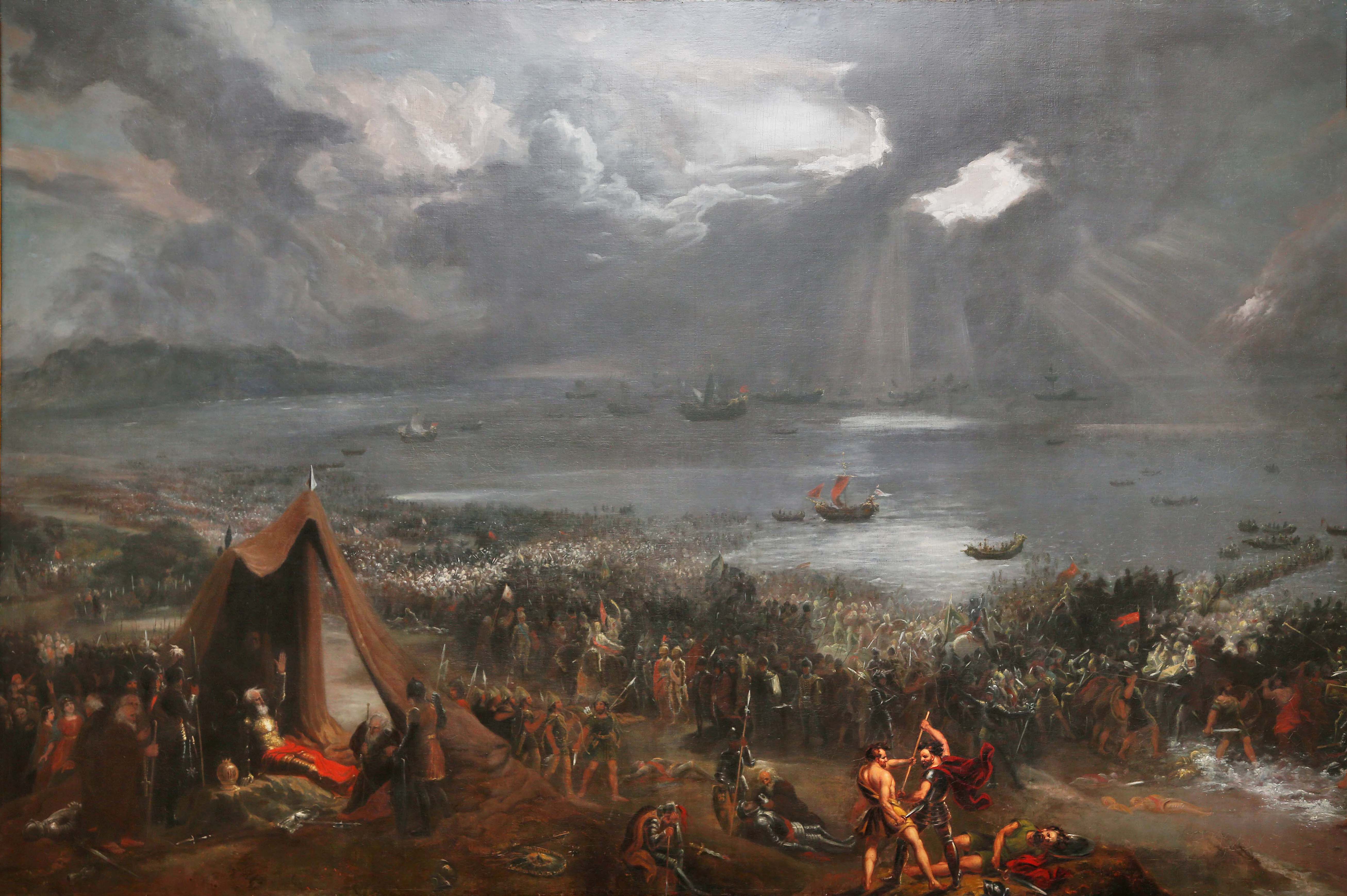
Battle of Clontarf
Two men walked to the centre of the field and killed each other. The Cogad Gaedel re Gallaib, the medieval Irish account of the battle, describes it with a detail that borders on the cinematic: "the sword of each through the heart of the other, and the hair of each in the clenched hand of the other." That opening duel between Plait, described as the bravest knight of the foreigners, and Domnall mac Eimin, a Scottish ally of Brian Boru, set the tone for what followed. The Battle of Clontarf, fought on 23 April 1014 near Dublin, would last from sunrise to sunset, kill between 7,000 and 10,000 men, and end with a victory so costly that the victors barely survived it.
The Innkeeper's Grandson Who Became High King
Brian Boru's rise was improbable. The Dal gCais were a small kingdom in what is now County Clare, nowhere near the traditional power centres of Irish politics. Brian's father, Cennetig mac Lorcain, became King of Thomond by the time of his death in 951. His brother Mathgamain became King of Munster and was killed in 976. Brian seized the Munster kingship, then invaded Leinster, attacked Meath, and by 1002 had marched an army to Athlone and taken the hostages of Connacht and Meath. He was now the undisputed High King of Ireland, the first ruler from outside the Ui Neill dynasty to claim that title. He spent the next decade consolidating power through a series of military circuits of the island, forcing submissions from Ulster kings who had never bent to a southern ruler.
The Alliance Against the High King
The rebellion that led to Clontarf was an alliance of convenience. Sigtrygg Silkbeard, the Norse King of Dublin, joined forces with his uncle Mael Morda mac Murchada, King of Leinster. When Brian brought his army to Leinster in 1013 and camped outside Dublin for months, Sigtrygg went overseas to recruit. He sailed to Orkney and the Isle of Man, enlisting Sigurd Hlodvirsson, the Earl of Orkney, and Brodir, a warrior of the Isle of Man. According to the Icelandic Njals saga, Sigtrygg promised both men the kingship of Ireland -- the same throne, to different men -- if they defeated Brian. It was a promise that could not be kept, but it brought a foreign fleet to Dublin Bay.
Sunrise to Sunset
Brian, now in his seventies, did not fight in person. He stayed behind to pray while his son Murchad led the Dal gCais against the Viking vanguard. According to the Cogad, Murchad killed one hundred of the enemy -- fifty with the sword in his right hand, fifty with his left. The Vikings wore mail armor; the Irish did not. Yet Brian's forces gained the advantage through numbers and the use of small spears hurled into the armored ranks. The battle raged all day across the coastal plain near Clontarf. When the Dublin-Leinster forces finally broke, they fled toward their ships or a nearby wood. But the tide had come in, cutting off escape routes and carrying away the Viking ships. Hundreds drowned. Brian's fifteen-year-old grandson Toirdelbach pursued the enemy into the sea and was swept against a weir. Murchad killed Sigurd of Orkney but was himself killed shortly after.
The Price of Victory
Brian Boru died in his tent. The Cogad says Brodir found the king at prayer and struck him down. The victory at Clontarf was total -- the power of the Viking kingdom of Dublin was broken, and Mael Morda of Leinster lay dead on the field alongside Sigurd and Brodir -- but it destroyed the dynasty that won it. Brian's heir Murchad was dead. His grandson Toirdelbach had drowned. Brian's body was carried to Swords, north of Dublin, where it was met by the coarb of Patrick, the traditional head of the Irish church, and brought to Armagh for twelve days of mourning. Mael Sechnaill, the man Brian had displaced as High King, was quietly restored to power.
A Battle Still Debated
For centuries, Clontarf was understood as the battle that freed Ireland from Viking domination, and Brian Boru became a national hero, especially during the era of British rule when such stories carried particular resonance. Revisionist historians have complicated that picture, arguing that Vikings fought on both sides and that the battle was more accurately an Irish civil war with Norse participants. In 2018, researchers from the Universities of Coventry, Oxford, and Sheffield used network science to mathematically analyze the Cogad Gaedel re Gallaib, mapping over 1,000 relationships between roughly 300 characters. Their conclusion: the traditional view was broadly correct, but the reality was more complex than a clear-cut Irish-versus-Viking conflict. The battlefield itself, now buried under the Dublin suburb of Clontarf, offers no archaeological evidence to settle the argument.
From the Air
Located at 53.37N, 6.20W in the Clontarf area of Dublin's north shore, along Dublin Bay. The battlefield site is now entirely built over with suburban housing. Bull Island and its North Bull Wall are prominent coastal features nearby. Dublin Bay and its characteristic crescent shape provide context from altitude. Nearest airport: Dublin (EIDW) 5km north. Best understood as part of a Dublin Bay overflight at 2,000-3,000 feet.