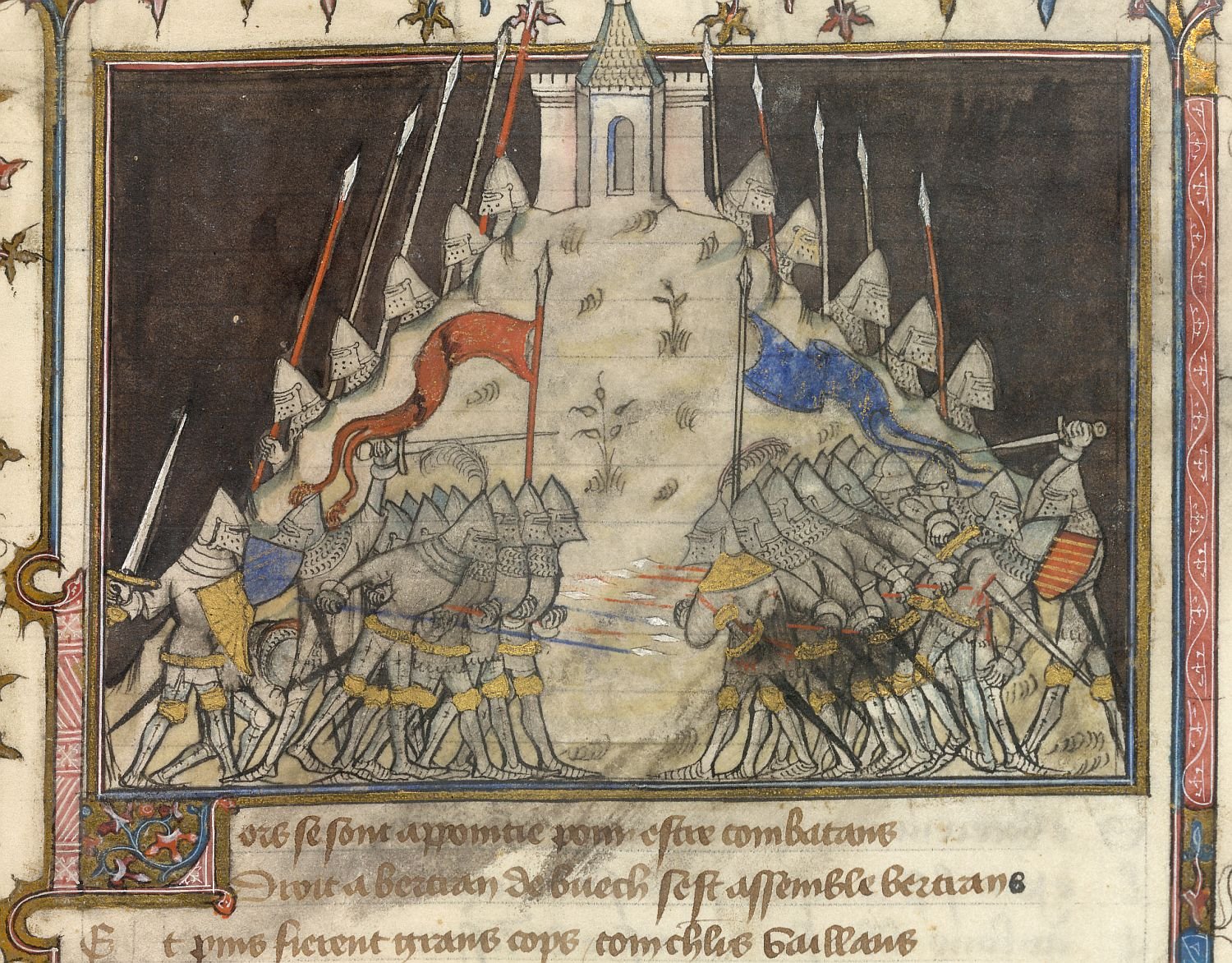
Battle of Cocherel
For decades, English armies had perfected a formula that seemed unbeatable: take the high ground, plant sharpened stakes, arrange longbowmen in wedge formations, and let the enemy impale themselves on a wall of arrows. At Crecy and Poitiers, French knights had charged uphill into this killing field and died by the thousands. On 16 May 1364, near the village of Cocherel in Normandy, a Breton knight named Bertrand du Guesclin demonstrated that the answer to English tactical superiority was not brute force but cunning. His feigned retreat at Cocherel remains one of the most celebrated tactical deceptions of the Hundred Years' War.
A Kingdom in Dispute
The battle grew from a contest over the Duchy of Burgundy, but its roots ran deeper into the political chaos of fourteenth-century France. Charles II of Navarre -- known to history as Charles the Bad, a name he worked hard to earn -- had been scheming against the French crown since 1354. By 1363, with King John II of France held captive in London and the Dauphin Charles politically weakened, the Navarrese saw their opportunity to seize power. A peace treaty between England and France, the Treaty of Bretigny signed in 1360, theoretically kept English forces neutral. In practice, the English military support for Navarre came through mercenary routier companies, freelance soldiers who had been ravaging Brittany and western France. The largest company was led by the English knight Sir John Jouel, an experienced commander of men-at-arms and archers.
The Trap on the Hill
The Navarrese army deployed in three battalions on high ground, arranged in the classic English defensive posture. Archers formed wedge-shaped divisions along the front, their position designed to shred any force that attacked uphill. Sir John Jouel commanded the first battalion of English mercenaries, while the Captal de Buch, Jean III de Grailly, held the second with roughly four hundred combatants. It was a formation that had won battles across France for a generation. Du Guesclin, commanding the French forces loyal to the Dauphin, understood that a frontal assault against this position would be suicidal. He needed the English and Navarrese to come to him.
The Art of Running Away
Du Guesclin's solution was elegant in its simplicity. He ordered his troops forward in what appeared to be a genuine assault, then commanded a sudden retreat. The withdrawal looked convincing enough that Sir John Jouel, eager for the kill, abandoned his defensive hilltop and led his battalion in pursuit. The Captal de Buch followed with his company, drawn downhill by the momentum of the chase and the intoxicating prospect of cutting down fleeing Frenchmen. It was exactly what du Guesclin wanted. Once the Navarrese and English had committed themselves to the pursuit and lost the advantage of their elevated position, du Guesclin sprang the trap. A reserve force that he had held back struck the overextended enemy on the flank. Caught in the open, stripped of their defensive formation, the Navarrese army crumbled. The battle was decided not by superior numbers or heavier armor but by a commander who understood that the most dangerous weapon on a medieval battlefield was patience.
A Star Rises for France
Cocherel was a defining moment for Bertrand du Guesclin, who would go on to become Constable of France and one of the most successful military commanders of the Hundred Years' War. More immediately, the victory secured the Dauphin's claim and arrived at a critical political juncture: Charles V was crowned King of France just three days later, on 19 May 1364, with Cocherel as proof that French arms could prevail against English tactics. The battle demonstrated that the era of English invincibility on French soil was ending. The longbow and the defensive hill position could be beaten -- not by charging into them harder, as the French had tried so many times before, but by making the English leave their prepared ground. Du Guesclin would apply this lesson repeatedly in the years to come, waging a war of sieges, skirmishes, and calculated maneuvers that slowly eroded English territorial holdings across France.
From the Air
Located at 49.06°N, 1.34°E near the village of Cocherel in the Eure department of Normandy, France. The battlefield sits in the rolling countryside of the Eure river valley. Nearest airport is Evreux-Fauville (LFOE) approximately 20 km to the east. Best viewed from 2,000-4,000 feet AGL. The terrain features gentle hills typical of the Norman bocage landscape where the tactical deception unfolded.