Battle of Coral–Balmoral
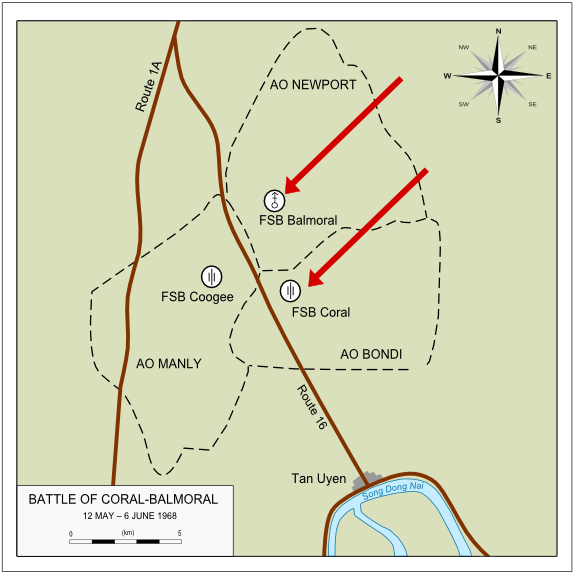
The Australians never expected to land in the middle of a hornet's nest. On 12 May 1968, two battalions of the 1st Australian Task Force helicoptered into dense scrub 40 kilometers northeast of Saigon to establish Fire Support Base Coral, a position meant to block North Vietnamese forces retreating after their failed May Offensive against the capital. Delays, confusion, and poor reconnaissance left them scattered and only half dug in by nightfall. Nine kilometers to the east, unbeknownst to any of them, sat the headquarters of the People's Army of Vietnam 7th Division -- and its commanders had been watching the fly-in all afternoon.
A Base Built on Borrowed Time
Nothing about the insertion went according to plan. The proposed landing zone turned out to be unsuitable for helicopters, forcing a last-minute relocation a thousand meters southwest. An American unit still fighting nearby prevented the Australians from deploying into their assigned positions. The New Zealand artillery battery arrived by Chinook before the base was ready and had to set down in an improvised clearing a kilometer away. By dusk, the 1st and 3rd Battalions of the Royal Australian Regiment and their supporting elements were strung out around FSB Coral in four loosely connected groups rather than a coordinated defense. No barbed wire had been laid. No claymore mines were set. Many fighting pits were shallow, quickly filling with water from a heavy evening rain. The task force commander, Brigadier Ron Hughes, was still at Nui Dat. The soldiers settled in for the night expecting little trouble -- intelligence suggested the enemy would be dispersed in small groups, trying to slip away undetected.
The Night the Jungle Erupted
At 03:30 on 13 May, rockets and mortars began hammering the 102nd Field Battery gun positions and the mortar line of the 1st Battalion. Five minutes of intense bombardment, then a ten-minute pause. Then flares arced overhead, and two companies of the PAVN 141st Regiment charged from the northeast. They had bypassed the Australian rifle companies in the darkness, dug in within 250 meters undetected, and now poured through gaps in the unfinished perimeter. In the mortar position, gunners fought back with pistols and rifles at point-blank range. The PAVN briefly overran a forward gun emplacement before Australian firepower -- artillery firing at danger-close range, small arms, and the sheer determination of soldiers fighting for their lives in half-dug positions -- drove them back. By morning, the ground in front of FSB Coral was littered with dead from both sides. It would not be the last attack. On 16 May the PAVN launched another regimental assault. Again they penetrated the wire. Again, after six hours of fighting, they were repelled.
Centurions in the Rubber Trees
The Australians adapted fast. Centurion tanks and additional artillery were rushed forward, and on 24 May the 3rd Battalion established a second base, FSB Balmoral, 4.5 kilometers to the north, deliberately positioned to provoke a fight. It worked. At 03:45 on 26 May, the PAVN 165th Regiment hit Balmoral with a two-battalion assault preceded by a rocket and mortar barrage. This time the defenders were ready -- dug in, wired, and backed by tanks firing canister rounds at close range. The attack fell hardest on D Company but was beaten back with devastating losses to the attackers. On 28 May, the PAVN tried again with another regimental-strength assault. It lasted barely thirty minutes. Between the attacks, Australian infantry and tanks swept through surrounding bunker systems in the first combined armor-infantry assault Australians had conducted since fighting the Japanese on Bougainville in the Second World War. Centurions crushed bunkers with their tracks and engaged others at point-blank range while infantry followed with rifles and grenades.
The Cost of Twenty-Six Days
When the 1st Australian Task Force withdrew to Nui Dat on 6 June, they left behind a battlefield that had fundamentally changed the nature of Australia's war in Vietnam. In 26 days of fighting, PAVN and Viet Cong losses in the area totaled 267 confirmed killed, with another 60 probable, plus 7 wounded and 11 captured. Australian casualties were 25 killed and 99 wounded, with 5 New Zealanders and 5 Americans also wounded. These were not guerrillas operating in small bands -- for the first time, the Australians had faced regular North Vietnamese formations fighting in regimental strength with heavy firepower. The Royal Australian Regiment, the 3rd Cavalry Regiment, and the 1st Armoured Regiment all received the battle honour "Coral-Balmoral," one of only five awarded to Australian units during the entire Vietnam War. In 2008, the 102nd Field Battery received the honour title "Coral" -- the first such award to an Australian sub-unit -- for those gunners who had fought off the initial assault with small arms when their howitzers could not be depressed low enough to hit the attackers swarming their positions.
A Watershed in the Jungle
The battle exposed hard truths. The Australians had built their Vietnam expertise on counter-insurgency -- careful patrolling, small-unit ambushes, winning local populations -- and suddenly found themselves in conventional set-piece combat against an enemy with greater numbers and heavier weapons than they had ever faced. The PAVN 7th Division was forced to postpone its planned second attack on Saigon, but the cost was steep. Beyond the casualty figures lay the weight of what these soldiers endured: nearly a month of night assaults, constant mortar fire, and the terror of fighting in darkness against an enemy who knew the terrain intimately. Today, Coral-Balmoral stands alongside Long Tan as one of the defining actions of Australia's Vietnam commitment.
From the Air
Located at 11.08°N, 106.79°E in Bình Dương Province, approximately 40 km northeast of Ho Chi Minh City (Saigon). The area lies in flat, scrub-covered terrain between Route 16 and the Saigon River corridor. Nearby airports include Bien Hoa Air Base (VVBH) to the southeast and Tan Son Nhat International Airport (VVTS) in Ho Chi Minh City. Best viewed from 3,000-5,000 feet AGL. The former Iron Triangle region is now largely developed with industrial zones and rubber plantations.