Battle of Corunna
Sir John Moore was already dying when his men carried him from the field. A cannonball had torn into his left shoulder, shattering ribs and exposing his lung, yet the British lieutenant-general refused to look away from the fighting. "I hope the people of England will be satisfied," he murmured as the battle raged around the village of Elvina on 16 January 1809. They would be. His army, battered and starving after a 250-mile winter retreat across northern Spain, had just beaten back a French corps under Marshal Soult at the port of Corunna -- buying the time needed for the fleet to carry the survivors home.
A Retreat That Broke an Army
The campaign that ended at Corunna began with high ambition. Moore had advanced into Spain with 30,000 troops to support Spanish forces resisting Napoleon's invasion, but when the Emperor himself took the field with overwhelming numbers, the British had no choice but to fall back toward the coast. What followed was one of the most harrowing retreats in British military history. Through mountain passes choked with snow, across rivers swollen by winter rains, Moore's army stumbled northwest toward the port of Corunna in Galicia. French cavalry harried the column relentlessly. Discipline crumbled among exhausted, hungry soldiers. Stragglers froze to death in the Cantabrian passes, and officers struggled to prevent their men from looting Spanish villages. Only the rearguard -- particularly the Light Brigade under Robert Craufurd -- maintained its cohesion, fighting a series of sharp actions to keep Soult's pursuing forces at bay.
Waiting for the Ships
When the British reached Corunna in mid-January, the harbor was empty. The transport fleet had not arrived. For two anxious days, Moore's exhausted army waited while French columns closed in from the south and east. The troops destroyed stores, spiked guns they could not take, and shot thousands of horses rather than leave them to the enemy. When the transports finally appeared on 14 January, embarkation began immediately -- but Soult was too close. His corps of roughly 16,000 infantry, bolstered by superior cavalry and artillery, occupied the heights south of the town. Moore positioned his 15,000 men along a defensive ridge near the villages of Elvina and Oza, rough terrain that would neutralize the French advantage in cavalry. The stage was set for a fight neither commander had sought but neither could avoid.
The Fight at Elvina
The French attacked in the early afternoon. Soult's infantry struck the British right flank near the village of Elvina, driving back the initial defenders in fierce house-to-house fighting. Moore personally led a counterattack with the 42nd Regiment of Foot and the 50th Regiment, pushing the French back through the village in a savage exchange of musket fire at close range. It was during this counterattack that the cannonball struck him. Command passed to Sir John Hope, who continued the defense as fighting spread across the line. On the British left, French columns attempted to turn the flank but were repulsed by well-directed volleys. By nightfall, every French assault had been thrown back, and Soult withdrew to regroup. The French suffered approximately 1,500 casualties; the British lost around 800 killed and wounded, including their general.
Buried by Torchlight
Moore died that evening in a house in Corunna, having lived long enough to learn the battle was won. His officers buried him that night on the ramparts of the citadel, wrapped in his military cloak, by the light of torches while the embarkation continued below. The poet Charles Wolfe later immortalized the scene in "The Burial of Sir John Moore after Corunna," one of the most quoted war poems of the 19th century: "Not a drum was heard, not a funeral note / As his corse to the rampart we hurried." By dawn on 17 January, the bulk of the army was aboard the transports. The evacuation was complete. Roughly 26,000 soldiers eventually reached England -- fewer than had set out, and many in wretched condition, but alive and able to fight another day.
A Costly Victory's Long Shadow
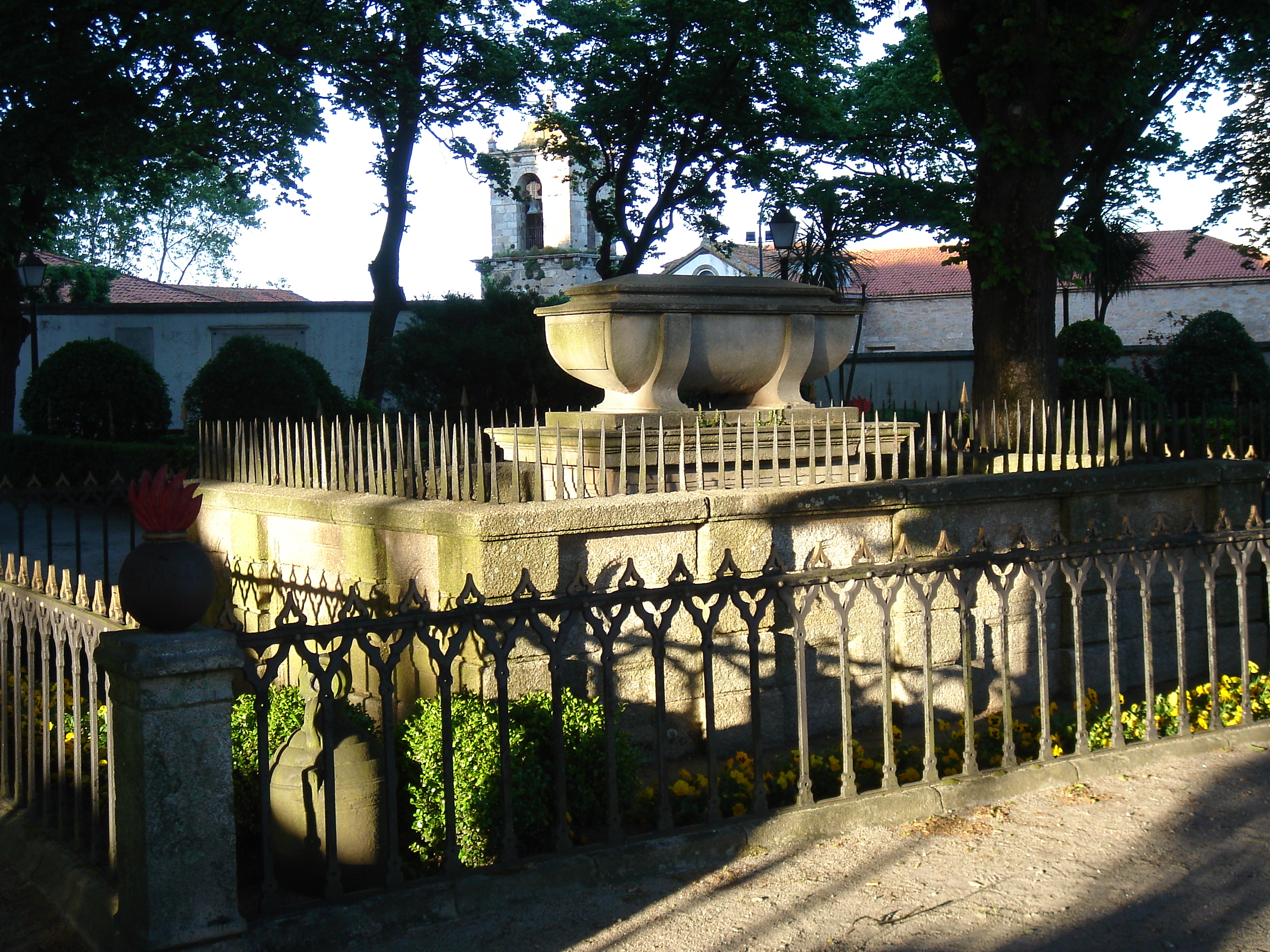
The Battle of Corunna was tactically a British success and strategically a French frustration. Soult had failed to destroy the British expeditionary force or prevent its evacuation. Moore's sacrifice preserved an army that would return to the Peninsula under Sir Arthur Wellesley -- the future Duke of Wellington -- and ultimately drive the French out of Spain. Today, a memorial to Moore stands on the spot where he fell near the village of Elvina, now absorbed into the expanding suburbs of A Coruna. The garden surrounding the tomb on the citadel ramparts remains a quiet place of reflection, shaded by elms that were not yet planted when his officers lowered him into Galician soil more than two centuries ago.
From the Air
Located at 43.37N, 8.40W on the Atlantic coast of Galicia in northwestern Spain. The battle site near the village of Elvina is now part of A Coruna's urban area, south of the port. The port itself and the citadel ramparts where Moore is buried are visible landmarks. Nearest airport: LECO (A Coruna Airport, ~7 km south). The coastline and harbor provide strong visual references when approaching from the sea.